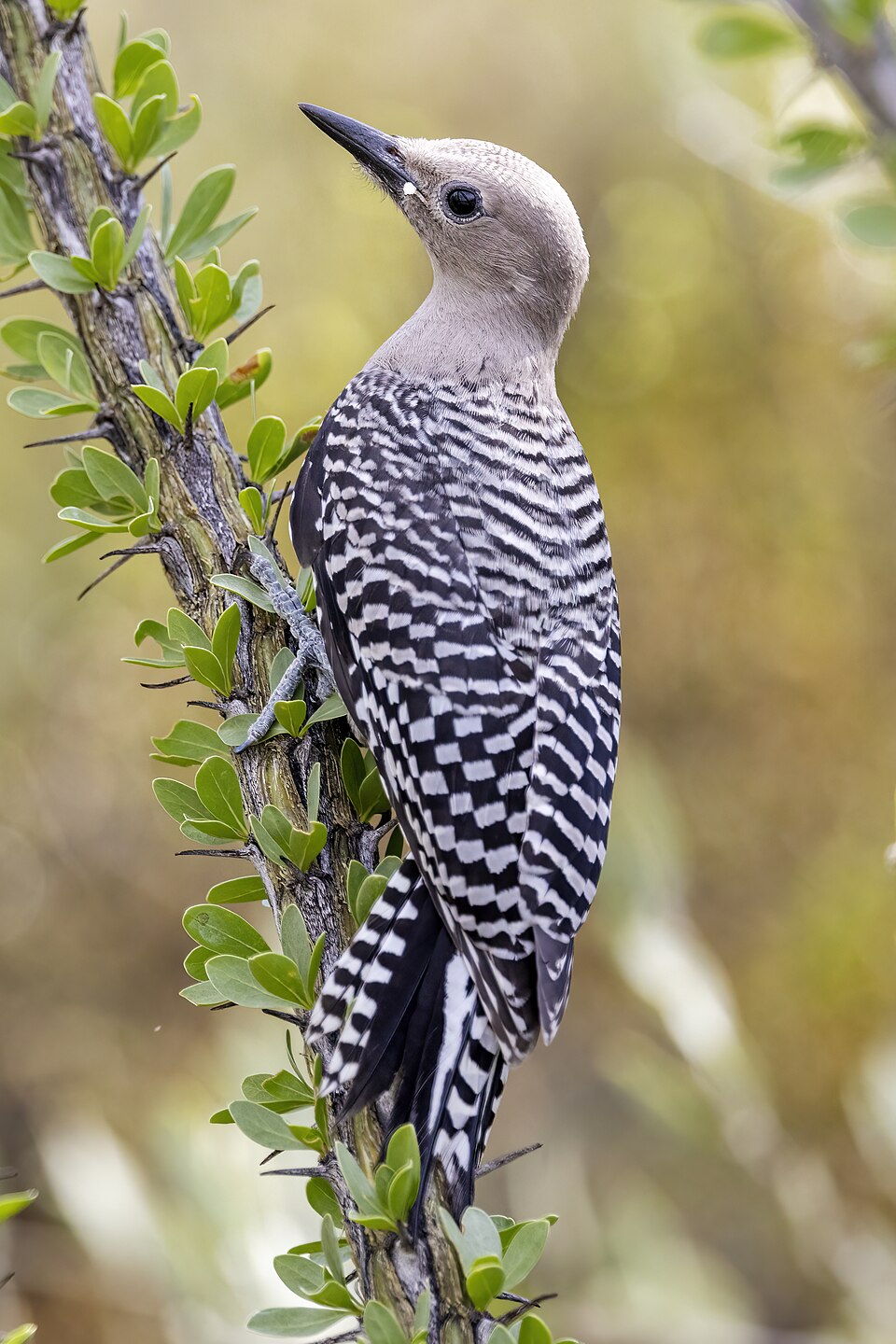
The Gila Woodpecker is one of the defining birds of the Sonoran Desert, as much a part of the saguaro landscape as the cactus itself. Medium-sized and built like a typical woodpecker, it stands out for its tan-brown head and underparts paired with a crisp black-and-white "ladder" pattern across the back and wings. Where there are saguaros, palo verdes, and mesquite bosques, there are almost always Gila Woodpeckers, announcing themselves with loud, rolling calls that carry across the open desert.
Named for the Gila River of Arizona, this bird is a year-round resident of the deserts of the American Southwest and northwestern Mexico. It is bold, noisy, and endlessly busy, hammering at cactus and mesquite, raiding flowers and fruit, and excavating the cavity nests that later shelter a long list of other desert creatures. For anyone birding in southern Arizona, it is one of the first species you learn by sound long before you spot it.
Look for a stocky, medium-sized woodpecker with a straight, chisel-tipped bill and the upright, clinging posture typical of the family. The most reliable mark at any distance is the contrast between a plain, grayish-tan head and underparts and a sharply barred black-and-white back, wings, and tail.
| Back & wings | Bold black-and-white horizontal barring (a 'zebra' or ladder pattern), with a white wing patch flashing in flight |
| Head & underparts | Uniform pale grayish-tan to buffy brown, lacking strong markings |
| Crown patch | Males show a neat round red cap on the center of the crown; females have a plain tan crown |
| Rump | White rump, often barred, visible as the bird flies away (source of the species name uropygialis) |
| Bill | Long, straight, and stout, a classic woodpecker chisel |
| Size & shape | Robin-sized but chunkier, with a short stiff tail used as a prop while clinging |
Male vs. female
The sexes look nearly identical except for the crown. The male has a small, bright red patch in the center of the crown, like a little cap set back on an otherwise tan head. The female lacks the red entirely and shows an unbroken plain tan crown. Both share the same zebra-barred back, pale tan body, and white wing flash, so the red cap is the quick tell when a bird sits still long enough to study.
Juveniles
Juveniles resemble adult females overall, barred backs and plain tan heads, but look slightly duller and softer, with less crisp barring and a somewhat scruffier appearance. Young males may show only a faint, dull reddish wash or a few red feathers coming in on the crown rather than the clean red cap of an adult male. By their first fall they are difficult to separate from adults.
Gila Woodpeckers are vocal and hard to ignore. The most familiar sound is a loud, rolling churr or chuurr, often run together into a laughing series, frequently written as yip-yip-yip or a rising kee-u, kee-u, kee-u. A sharp, repeated churrr rattle serves as a contact and alarm call, and excited birds give a piercing, almost squeaky pit or jee note.
Like other woodpeckers, they also "drum", a rapid burst of taps on a resonant surface used to claim territory and attract mates. In suburbs this drumming sometimes lands on metal chimney caps, gutters, or signs, where the loud, ringing result can startle homeowners at dawn.
This is a bird of the desert Southwest. In the United States its core range is southern and central Arizona, with smaller numbers reaching extreme southeastern California along the lower Colorado River and the southwestern corner of New Mexico. From there its range extends south through much of western Mexico, including Baja California and the Pacific slope states.
Gila Woodpeckers are non-migratory and hold their territories year-round. Pairs and family groups stay put across the seasons, so a desert neighborhood that has them in spring will generally have them in winter too. Their range has expanded into towns and suburbs wherever native trees, cactus, and shade plantings provide enough food and nesting sites.
Gila Woodpeckers are true generalists. They forage by probing and hammering into cactus, mesquite, palo verde, and tree bark for insects, especially ants, beetles, and caterpillars, and they readily take fruit, including the pulp and seeds of saguaro and other cactus fruit, mistletoe berries, and cultivated fruit in yards and orchards. They also drink nectar and visit flowers, and will eat the eggs and nestlings of other birds on occasion.
Around homes they are quick to exploit new food sources, sipping from hummingbird feeders, taking suet and peanuts, and stealing soft fruit. This adaptability is a big reason they thrive alongside people in the desert where many specialists cannot.
The Gila Woodpecker is the classic saguaro-cavity nester. The pair excavates a hole in the fleshy trunk or arm of a giant saguaro, and the cactus responds by forming a hard, callused inner lining, a structure long called a "saguaro boot." These cavities stay remarkably cool in the desert heat. Where saguaros are absent, the birds also dig nests in cottonwoods, mesquites, and other large trees.
A typical clutch is 3 to 4 white eggs, and pairs often raise two broods in a season. Both sexes share excavation, incubation, and feeding of the young. Old Gila Woodpecker cavities are enormously important to the desert community, Elf Owls, screech-owls, flycatchers, kestrels, and other species reuse them, making this woodpecker a keystone provider of desert real estate.
If you live within its desert range, the Gila Woodpecker is very much a backyard bird and one of the easier woodpeckers to draw in. The key is offering the foods it already seeks and keeping native desert plants nearby.
- Offer suet, peanuts, and black-oil sunflower seed at a sturdy feeder, they cling readily and visit often.
- Put out fruit such as orange halves, apple, or soft melon; Gila Woodpeckers have a real sweet tooth.
- Keep a hummingbird feeder filled, they will perch and sip the sugar water, sometimes monopolizing it.
- Preserve saguaros and native trees (mesquite, palo verde, cottonwood) for natural food and nest sites.
- Provide a shallow water source or dripper; reliable water is a strong draw in the dry desert.
- Tolerate the noise, if drumming on metal becomes a nuisance, gently cover or pad the resonant surface rather than chasing the bird off.
- Gilded Flicker: Larger, with a black chest crescent, spotted belly, and yellow wing/tail shafts; shares saguaro habitat but looks very different up close.
- Ladder-backed Woodpecker: Much smaller, with a boldly black-and-white striped face and barred underparts; Gila has a plain tan head and unmarked underparts.
- Golden-fronted Woodpecker: Very similar barred back, but shows yellow-orange nape and forehead and a white rump patch in flight; ranges in Texas, not Arizona deserts.
- Red-bellied Woodpecker: Eastern counterpart with a full red nape-to-crown stripe on males; ranges don't overlap with the desert Gila.
What does a Gila Woodpecker look like?
A medium-sized woodpecker with a plain tan-brown head and underparts and a sharply barred black-and-white back and wings. Males have a small round red cap on the crown; females have a plain tan crown. A white wing patch and white rump flash in flight.
How do you tell a male Gila Woodpecker from a female?
The only consistent difference is the crown. Males have a neat red patch in the center of the crown, while females have an unbroken plain tan crown. Their bodies, backs, and wings look identical.
Where do Gila Woodpeckers live?
They are year-round residents of the Sonoran and surrounding deserts, mainly southern and central Arizona, with smaller numbers in extreme southeastern California, southwestern New Mexico, and a broad range through western Mexico, including Baja California.
Do Gila Woodpeckers really nest in cactus?
Yes. They excavate cavities in giant saguaros, and the cactus heals over the wound to form a hard 'saguaro boot' that stays cool. They also nest in cottonwoods and mesquites. Old cavities are later reused by Elf Owls, screech-owls, and many other species.
How do I attract Gila Woodpeckers to my yard?
If you live in their desert range, offer suet, peanuts, sunflower seed, and fruit, keep a hummingbird feeder filled, provide a shallow water source, and preserve native saguaros and trees. They adapt readily to backyards and become regular feeder visitors.