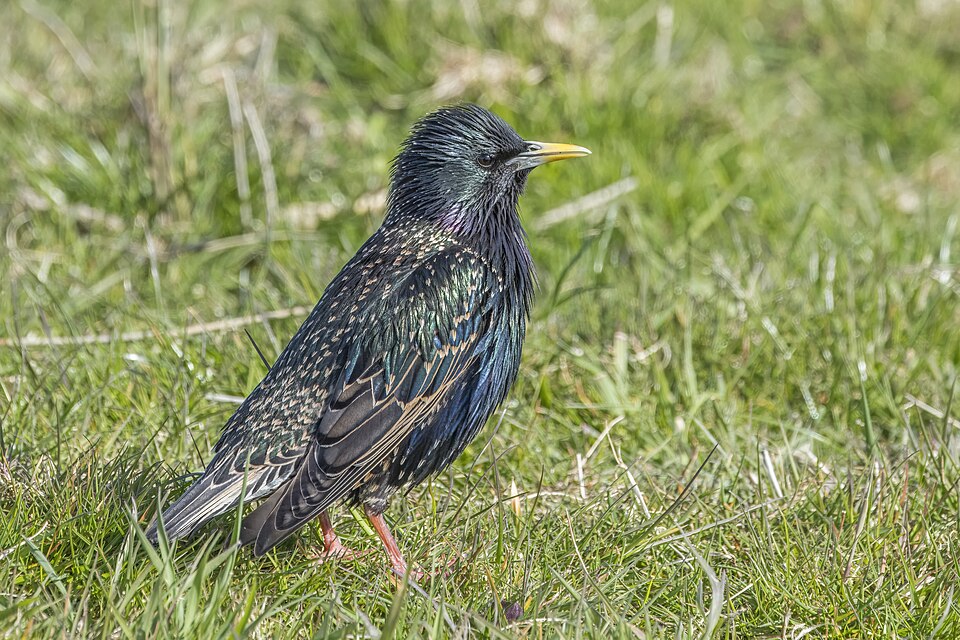
Few birds spark as much opinion as the European Starling. To some it is a pest at the feeder; to others it is a small marvel of iridescence, sound, and aerial coordination. Compact and chunky, with a short squared tail and a long pointed bill, the starling is one of the most successful birds on the planet. In good light its plumage glows green and purple, freckled with pale spots like a night sky. Native to Europe and western Asia, it now thrives across North America, having spread from a small release in New York City in the early 1890s to nearly every corner of the continent.
Starlings are intensely social and almost always found in the company of others, whether probing a suburban lawn in a loose flock or wheeling overhead in the breathtaking shape-shifting clouds known as murmurations. They are bold, adaptable, and endlessly vocal, capable of weaving the calls of other birds and even mechanical sounds into their own rambling songs. Love them or not, the starling is a bird worth knowing well, because once you can recognize its silhouette and chatter, you will notice it everywhere.
Look for a stocky, short-tailed blackbird-shaped bird with a noticeably long, slender, pointed bill and a confident, waddling walk on the ground. The triangular silhouette in flight, with swept-back pointed wings and a stubby tail, is a reliable clue even at distance.
| Plumage | Glossy black overall with strong green and purple iridescence; covered in white or buff spots in fresh fall and winter plumage that wear away by spring |
| Bill | Long, straight, sharply pointed; bright yellow in breeding adults, dark gray-brown in winter and juveniles |
| Shape | Chunky body, short squared tail, pointed triangular wings in flight |
| Legs | Sturdy reddish-pink legs |
| Size | Smaller than an American Robin, larger than a House Sparrow |
| Flight | Fast and direct on rapidly beating wings, often in tight flocks |
Male vs. female
Males and females look very similar and both show the spangled iridescent plumage. The most reliable difference appears in the breeding-season bill: the base of the lower mandible is bluish-gray in males and pinkish in females. Females also tend to retain slightly more pale spotting and have paler eyes with a thin yellowish ring, while males have uniformly dark brown eyes. These marks take practice and good light to see, so most birders simply call them starlings.
Juveniles
Juvenile starlings look startlingly different from adults and confuse many backyard birders. Fresh juveniles are a plain, dusky grayish-brown all over, with a darker bill and a paler throat, lacking any of the gloss or spots. In late summer they molt into adult-like plumage in a patchy, awkward stage, often showing a brown head atop an increasingly spotted black body before the transformation completes. By their first winter they wear the heavily spotted plumage of an adult.
The starling's song is a long, energetic, rambling jumble of whistles, clicks, rattles, warbles, and harsh buzzes, often delivered with the bill pointed skyward and wings quivering. Among the squeaks you will hear a signature rising or descending wolf-whistle and a wheezy, drawn-out tssseeeer. Starlings are gifted mimics and routinely fold the sounds of other birds, car alarms, ringtones, and squeaky gates into their performances, so a "Killdeer" or "Eastern Wood-Pewee" coming from a rooftop is often a starling.
Common calls include a harsh, scolding chrrr, a sharp chit alarm note, and a soft conversational chatter from feeding flocks. In flight, flocks keep up a constant murmur of clicks and whistles.
European Starlings are native across Europe, north Africa, and western Asia. In North America they now occur from southern Canada and Alaska's panhandle south through the Lower 48 into northern Mexico, making them one of the most widespread land birds on the continent. They are equally at home in cities, suburbs, farmland, and open country, favoring areas with lawns, livestock, and buildings or trees for nesting cavities.
Across much of their North American range they are year-round residents, but northern populations are partly migratory, drifting south and forming enormous winter flocks that can number in the thousands or more. Outside the breeding season starlings often roost communally in spectacular gatherings, sometimes mixing with blackbirds and grackles.
Starlings are true omnivores and opportunists. In spring and summer they feed heavily on insects and other invertebrates, especially beetle and crane-fly larvae, which they hunt with a distinctive technique called gaping: they jab the closed bill into soil or turf and then force it open to expose hidden prey. This is why you often see them marching across lawns, heads bobbing, probing as they go.
In fall and winter they shift toward fruits, berries, grains, and seeds, readily descending on orchards, agricultural fields, and feedlots. At backyard feeders they are notorious for mobbing suet and any easy soft food, and they will gulp down mealworms, cracked corn, and bread scraps with gusto.
Starlings are cavity nesters and will use almost any suitable hole, including natural tree cavities, old woodpecker holes, building crevices, vents, streetlights, and nest boxes. The male begins building and often decorates the cavity with fresh green vegetation to attract a female, who completes the messy cup of grass, twigs, and feathers inside.
The female lays a clutch of usually four to six pale blue or bluish-white eggs, and both parents incubate over roughly twelve days before feeding the young together. Their aggressive competition for cavities is a real conservation concern, as starlings frequently evict native cavity nesters such as bluebirds, Tree Swallows, Purple Martins, and woodpeckers.
Starlings need no encouragement and usually arrive on their own; for most backyard birders the goal is the opposite, managing them so other species get a turn. They are an introduced, non-native species in North America, so there is little reason to deliberately attract them, but understanding what draws them helps you discourage them.
- Use upside-down or caged suet feeders, which clinging woodpeckers can use but starlings struggle with.
- Offer safflower seed and nyjer rather than cracked corn, bread, or open suet, since starlings dislike them but finches and cardinals do not.
- Choose nest boxes with a 1.5-inch entrance hole for bluebirds and chickadees; starlings cannot squeeze through and native cavity nesters are protected.
- Avoid open platform trays of soft food like bread, kitchen scraps, and chunky peanut butter, which starlings mob in flocks.
- If a flock takes over, pause feeding for a few days to encourage them to move on before resuming.
- Common Grackle: Larger with a long keel-shaped tail, pale yellow eye, and no pale spotting; struts rather than waddles.
- Brown-headed Cowbird: Male has a clean brown head and unspotted glossy black body with a short conical (not pointed) bill.
- Red-winged Blackbird: Slimmer with a longer tail; males show red-and-yellow shoulder patches, females are streaky brown.
- Brewer's Blackbird: Sleeker with a longer tail and uniformly glossy plumage; male has a pale yellow eye and lacks spotting.
Are European Starlings native to North America?
No. They are native to Europe and western Asia and were introduced to New York City in the early 1890s. From roughly 100 released birds, the population spread across the entire continent and now numbers in the hundreds of millions.
How do I keep starlings off my feeders?
Switch to foods they dislike, such as safflower and nyjer, use caged or upside-down suet feeders, and remove open trays of bread, corn, and soft suet. Briefly pausing feeding when a flock arrives also encourages them to disperse.
Why do starlings have spots in winter but not summer?
The white and buff spots are the pale tips of fresh feathers grown in fall. Through the winter and spring those tips gradually wear away, revealing the glossy iridescent plumage underneath, so breeding birds look much darker and shinier.
What is a starling murmuration?
A murmuration is a large flock of starlings flying in tight, swirling, shape-shifting formations, often at dusk before settling into a roost. The mesmerizing patterns are thought to help confuse predators and coordinate safe landing.
Can European Starlings really mimic sounds?
Yes. Starlings are skilled vocal mimics and weave the calls of other birds, as well as car alarms, phone ringtones, and other mechanical noises, into their rambling songs. Captive starlings can even learn to imitate human words.