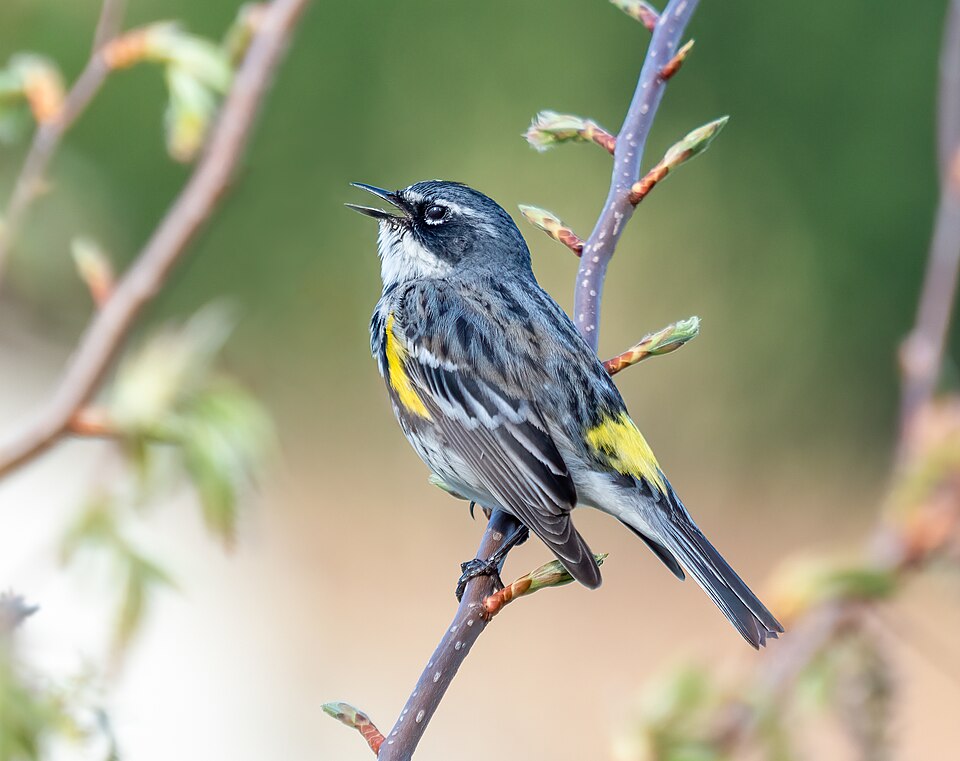
If there is one wood-warbler that nearly every North American birder learns to recognize, it is the Yellow-rumped Warbler. Birders affectionately call it the "butter-butt" for the splash of bright yellow on its rump that flashes whenever it flits away. It is one of the most abundant warblers on the continent, and unlike most of its relatives that vanish to the tropics each fall, the Yellow-rumped lingers far into the cold season, turning up in coastal scrub, suburban yards, and along weedy hedgerows long after other warblers have departed.
Its secret to staying north is a flexible appetite. Where other warblers depend almost entirely on insects, the Yellow-rumped can switch to berries, most famously the waxy fruit of bayberry and wax myrtle, which lets it survive winters that would starve a more specialized bird. The species also has a tangled taxonomic story: the eastern "Myrtle" form and the western "Audubon's" form were once split, then lumped into one species, and are again debated today. For most backyard birders, though, it is simply the small, active, gray-and-yellow bird that never seems to sit still.
The Yellow-rumped Warbler is a small, slim, fairly long-tailed songbird with a thin warbler bill. It is constantly in motion, hopping through outer branches and sallying out after flying insects. In any plumage the field mark to anchor on is the bright yellow rump patch, visible as the bird flicks its tail or flies away.
| Rump | Bright lemon-yellow patch on the lower back, present year-round in every plumage - the single most reliable mark. |
| Side patches | Yellow patches on the sides of the breast/flanks, brightest on breeding males. |
| Breeding male | Slaty blue-gray above with black streaking, black mask or cheek, and a yellow crown patch; bold white wing markings. |
| Throat (form) | "Myrtle" form has a white throat and dark cheek; "Audubon's" form has a yellow throat. A useful way to tell the two subspecies apart. |
| Winter plumage | Drab brownish above, streaky below, but the yellow rump and side patches still show - look for them. |
| Tail | Dark with white spots near the tip, flashing white in the outer feathers in flight. |
Male vs. female
In breeding plumage the sexes differ clearly. The male is a crisp slate-blue-gray above with bold black streaking, a black chest band or smudging, white wing bars or a wing patch, and bright yellow on the crown, sides, and rump. The female is a more muted version of the same pattern: browner and grayer overall, with softer, less contrasting streaking and duller yellow patches, though her rump is still distinctly yellow. By fall and winter both sexes molt into a drabber, browner plumage and become much harder to tell apart, with females and immatures looking especially washed-out.
Juveniles
Juveniles fresh out of the nest are streaky and brown, and very young birds may show only a hint of yellow on the rump. By their first fall, immatures resemble drab winter adults: brownish above with diffuse streaking below and a buffy or grayish wash, but they reliably carry the yellow rump patch (and usually faint yellow side patches), which gives them away even when nothing else looks distinctive. First-winter females are the dullest plumage you are likely to encounter.
The song is a loose, musical trill or warble, often described as a series of soft notes that rise or fall slightly toward the end, rendered as a wavering tew-tew-tew-tew-tew-twee-twee or a junco-like trill that loosens and changes pitch midway. It is sweet but somewhat lazy and unhurried compared with the buzzier songs of many warblers.
Far more familiar to most birders is the call note: a hard, flat, distinctive check or chip given constantly as the birds forage and move through migration flocks. The two forms differ subtly - the "Myrtle" note is often described as a flatter check and the "Audubon's" as a softer, higher chip. Learning this single check note is one of the quickest ways to pick Yellow-rumps out of a mixed flock by ear.
Yellow-rumped Warblers breed across the vast coniferous and mixed forests of Canada, Alaska, the northern United States, and the mountains of the West. The white-throated "Myrtle" form breeds mostly across the boreal east and north, while the yellow-throated "Audubon's" form breeds in the western mountains.
In migration they pour south in enormous numbers, often the most numerous warbler in a given flock. They winter farther north than any other North American warbler: across the southern United States, both coasts (including surprisingly far up the Atlantic and Pacific shorelines), Mexico, and Central America. This is why a "warbler" seen in a U.S. backyard in December is very often a Yellow-rumped.
In the breeding season Yellow-rumped Warblers are insectivores, gleaning caterpillars, beetles, aphids, gnats, and other small arthropods from foliage and bark, and frequently flycatching - darting out from a perch to snatch insects in midair. They also forage low, even hopping on the ground or picking insects from the surface of water and beaches.
What sets this species apart is its winter diet. It readily eats fruit and is one of the very few birds able to digest the waxy berries of bayberry and wax myrtle (the source of the "Myrtle" name), along with juniper berries, poison ivy, Virginia creeper, and dogwood. This ability to switch from bugs to berries is exactly what lets it winter so far north.
Yellow-rumped Warblers nest in conifers, typically placing a cup-shaped nest on a horizontal branch well out from the trunk, often at moderate to considerable height in spruce, fir, pine, or hemlock. The female does most or all of the building, weaving a sturdy cup of twigs, bark strips, rootlets, and plant fibers and lining it with finer material such as hair and feathers - sometimes arranging feathers so they curl over and partly conceal the eggs.
The female lays a clutch of usually 4 to 5 eggs (sometimes 3 to 5), creamy white with brown and gray spotting, and incubates them for roughly 12 to 13 days. Both parents feed the nestlings, which leave the nest after about 10 to 14 days. Pairs commonly raise two broods in a season where the breeding period is long enough.
Yellow-rumped Warblers are one of the few warblers you can realistically attract to a yard, especially during migration and winter when they are looking for food. They will not behave like a typical seed-eating feeder bird, but the right plantings and offerings can pull them in.
- Plant native berry shrubs, especially bayberry or wax myrtle, plus juniper, dogwood, and Virginia creeper - these are exactly the winter fruits Yellow-rumps depend on.
- Offer suet in cold weather; Yellow-rumped Warblers are among the warblers most willing to visit a suet feeder.
- Try shelled or chopped peanuts, peanut butter blends, and even raisins or fruit - they will sometimes sample these in winter.
- Keep a clean, ice-free water source or bird bath; moving or dripping water is a strong draw for warblers.
- Plant or preserve native trees and shrubs that host insects, since foliage gleaning supplies most of their natural food.
- Watch for them in migration along weedy edges and hedgerows, where loose flocks pause to refuel.
- Magnolia Warbler: Also shows a yellow rump, but has bright yellow underparts with heavy black streaking and a distinctive white tail band; Yellow-rumped is grayer and white-bellied.
- Cape May Warbler: Has a yellowish rump and yellow underparts but shows fine breast streaking, a yellow neck patch, and (in males) chestnut cheeks; lacks the clean gray-and-yellow look.
- Palm Warbler: A common winter/migration warbler with a yellow undertail and constant tail-wagging; it has a yellowish or brownish rump, not the bright lemon patch, and pumps its tail persistently.
- Townsends Warbler: A western bird with a bold black-and-yellow face pattern; lacks the bright isolated yellow rump patch of the Yellow-rumped.
Why is it called a butter-butt?
"Butter-butt" is a birders' nickname for the Yellow-rumped Warbler, referring to the bright butter-yellow patch on its rump. The patch shows in every plumage and flashes when the bird flies away, making it the easiest way to identify the species.
What is the difference between Myrtle and Audubon's Warblers?
They are two forms of the same species. The "Myrtle" form (mostly eastern and northern) has a white throat and a dark cheek; the "Audubon's" form (mostly western) has a yellow throat. They were once considered separate species, were lumped into the Yellow-rumped Warbler, and the split is still debated today.
Do Yellow-rumped Warblers come to bird feeders?
Yes, more than most warblers. They are especially drawn to suet in winter and will sometimes take peanut butter blends, chopped nuts, raisins, or fruit. Native berry shrubs and a water source attract them even more reliably than feeders.
Where do Yellow-rumped Warblers go in winter?
They winter farther north than any other North American warbler - across the southern U.S., both coasts well up the Atlantic and Pacific, Mexico, and Central America. A warbler seen in a U.S. yard in winter is very often this species.
How can I tell a Yellow-rumped Warbler from other small yellow-marked birds?
Look for the combination of a bright yellow rump, yellow side patches, white or yellow throat, and white belly, along with the constant flat "check" call note. The yellow rump on an otherwise gray or brown, streaky warbler is the clincher.