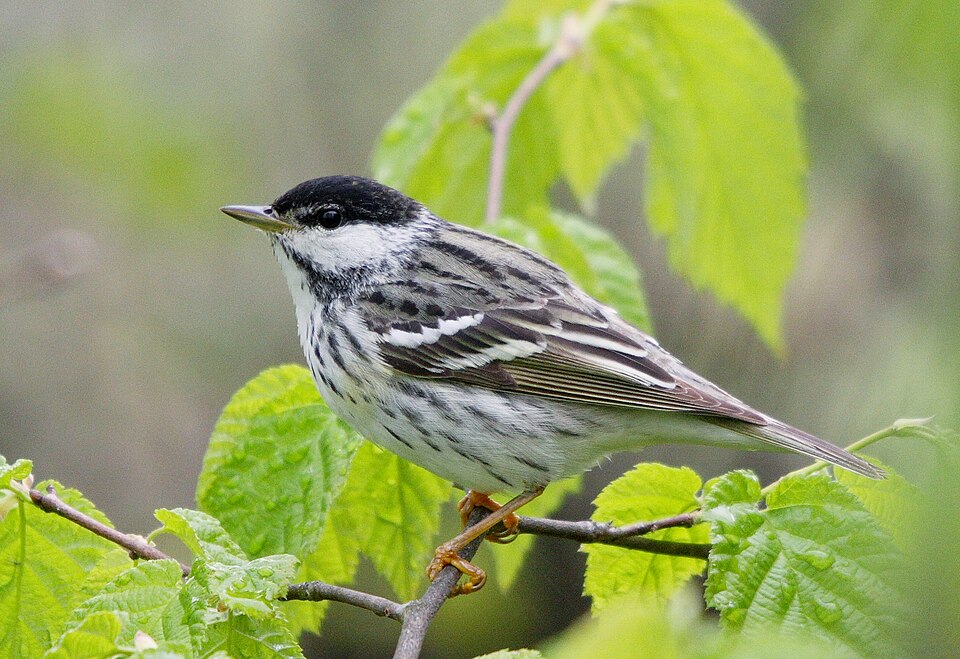
The Blackpoll Warbler is one of those small songbirds that hides an enormous secret. Weighing about as much as four paperclips, it makes one of the longest nonstop overwater flights known among songbirds, launching from the northeastern coast of North America and flying for two to three days straight over the open Atlantic to reach South America. Before that journey it nearly doubles its body weight in fat. For such a tiny, plain-looking bird, it is a genuine endurance athlete.
In spring the breeding male wears a crisp black cap, bright white cheeks, and bold black-and-white streaking that gives the species a tidy, formal look. It breeds across the boreal spruce forests of Canada and Alaska, then trickles south in fall in a much drabber greenish-yellow plumage that frustrates beginning birders every autumn. Most people encounter the Blackpoll only during migration, when it passes through in a brief window, often high in trees and singing a song so thin and high that many ears never register it at all.
This is a fairly small, slim warbler with a sharp, pointed bill and a relatively long body. Its proportions and crisp streaking can suggest a chickadee from a distance in spring, but the key to clinching an ID often lies below the body: look at the legs and feet, which are usually pale orange or yellowish, a detail that separates it from several very similar species.
| Breeding male cap | Solid black cap from forehead to nape, like a neat skullcap |
| Cheeks | Bright clean white cheeks bordered below by a thin black malar (mustache) line |
| Underparts | White with bold black streaks down the flanks; breeding male especially crisp black-and-white |
| Wings | Two white wingbars on dark wings |
| Legs and feet | Pale orange to yellowish legs, often with bright yellow soles - a key field mark in all plumages |
| Fall plumage | Drab olive-green above, faintly streaked, with yellowish wash on throat and breast and white undertail |
Male vs. female
In breeding plumage the sexes are fairly easy to separate. The male has the classic crisp black cap, snow-white cheeks, and clean black-and-white streaked body. The female is grayer and softer overall: she lacks the solid black cap, showing instead a streaked grayish-olive crown, and her cheeks and underparts are dingier with finer, less contrasting streaking. By fall both sexes and young birds molt into a similar drab olive-green plumage, and at that point males and females become very hard to tell apart in the field.
Juveniles
Immature and fall birds are the famous "confusing fall warblers" of field-guide lore. They are washed olive-green above with two whitish wingbars and a pale yellowish tone on the throat, breast, and face, fading to white on the belly and undertail coverts. The streaking on the back and sides is faint and blurry rather than bold. Even in this plain plumage, the pale orange or yellowish legs and bright yellow foot soles remain one of the most reliable clues, especially when separating them from the very similar fall Bay-breasted Warbler.
The Blackpoll's song is one of the highest-pitched of any North American songbird, and it sits right at the upper edge of human hearing. It is a thin, mechanical series of identical high notes, tsi tsi tsi tsi tsi tsi, typically rising in volume in the middle and then fading at both ends, like a tiny insect rather than a bird. Many older birders simply cannot hear it at all, which is a recognized challenge in spring count surveys.
The call note is a sharp, high chip or tsip, easy to overlook among the chips of other migrating warblers. During fall migration the birds are mostly silent, which adds to the difficulty of finding and identifying them.
Blackpoll Warblers breed across the northern boreal forest, from Alaska and the Yukon east across Canada to Newfoundland and into the spruce woods of New England and the Maritimes. They favor stunted, dense conifers, especially spruce, often near the tree line and in cool, damp northern habitats.
Their migration is the species' claim to fame. In fall, many funnel to the northeastern coast of the United States, fatten heavily, and then fly out over the Atlantic Ocean on a multi-day nonstop flight to northern South America, a route that may cover roughly 1,800 miles or more without landing. In spring the return route runs largely overland and up through the eastern and central states, so spring and fall passage can look quite different depending on where you watch. They winter in northern and Amazonian South America.
During the breeding season Blackpoll Warblers are heavily insectivorous, gleaning caterpillars, beetles, aphids, mosquitoes, gnats, spiders, and other small arthropods from spruce and fir foliage. They forage methodically, often fairly high in conifers, hopping along branches and sometimes hovering briefly to pick prey from needles and tips.
Before and during migration their diet shifts to include berries and fruit, which help them lay down the heavy fat reserves needed for the long ocean crossing. In late summer a Blackpoll can pack on so much fat that its weight nearly doubles, fuel that is burned almost entirely during the marathon flight south.
The nest is a bulky open cup built low in a conifer, often against the trunk of a small spruce or fir, typically only a few feet off the ground. The female does most or all of the building, weaving twigs, bark, grass, and lichen and lining the cup with finer materials, feathers, and hair.
She lays a clutch of usually 4 to 5 eggs, pale and speckled with brown, and incubates them herself for around 11 to 12 days. The young leave the nest after roughly another 10 to 12 days, and both parents help feed the nestlings. In the short northern summer most pairs raise a single brood before beginning the long journey south.
The Blackpoll Warbler is not a feeder bird and will not come to seed or suet. It is an insect-eater of the northern forest that most people see only as a passing migrant, but you can improve your odds of hosting one during migration with the right habitat.
- Plant and keep native trees and shrubs that host caterpillars and insects; migrating Blackpolls forage in leafy canopy, not at feeders.
- Offer a clean water source such as a dripping or moving bird bath, which can draw in tired migrants of many warbler species.
- Leave native fruiting shrubs (like bayberry and viburnum) in fall; berries help fuel pre-migration fat reserves.
- Watch during the narrow migration windows - late spring (May) and fall (September into October) are your best chances.
- Skip pesticides so the insect populations migrants depend on stay healthy in your yard.
- Scan the tops of tall trees and learn the high, thin song, since Blackpolls often forage higher and quieter than feeder birds.
- Black-and-white Warbler: Has bold black-and-white head striping and creeps along trunks and branches like a nuthatch; lacks the solid black cap and clean white cheeks, and has dark legs.
- Bay-breasted Warbler: In breeding plumage shows chestnut crown, throat, and flanks; in confusing fall plumage looks very similar to a fall Blackpoll but has dark legs and buffy undertail coverts rather than orange legs and white undertail.
- Blackburnian Warbler: Breeding male has a flaming orange throat and face; only superficially similar, but fall birds can cause confusion. Note the orange tones and different facial pattern.
- Black-capped Chickadee: A non-warbler that shares the black cap and white cheeks at a glance, but is a plumper, larger-headed bird with a black bib, no streaking, and a buzzy chick-a-dee call.
How can I tell a Blackpoll Warbler from a Black-and-white Warbler?
The Blackpoll has a solid black cap and bright clean white cheeks, with streaking mainly on its sides, and it forages out among the foliage. The Black-and-white Warbler has bold black-and-white stripes running over the top of its head and creeps along tree trunks and limbs like a nuthatch. The Blackpoll also has pale orange legs, while the Black-and-white has dark legs.
Why is the Blackpoll Warbler famous?
It makes one of the longest nonstop overwater migrations of any songbird, launching from the northeastern coast and flying two to three days straight over the open Atlantic to South America. To fuel that flight it nearly doubles its body weight in fat beforehand.
Will Blackpoll Warblers come to my bird feeder?
No. They are insect-eaters that forage in trees and switch to berries before migration. They do not eat seed or suet. Your best chance to attract one is native, insect-rich plantings and a water source during spring and fall migration.
Why is the Blackpoll Warbler so hard to hear?
Its song is among the highest-pitched of all North American songbirds, a thin series of identical high tsi tsi tsi notes that sits at the very top of human hearing. Many people, especially as their high-frequency hearing declines with age, simply cannot detect it.
What does a Blackpoll Warbler look like in the fall?
Fall and immature birds are drab olive-green above with faint streaking and a yellowish wash on the throat and breast, fading to white below. They look very different from the crisp black-capped spring male. Look for the pale orange legs and bright yellow foot soles to help separate them from similar fall warblers like the Bay-breasted.