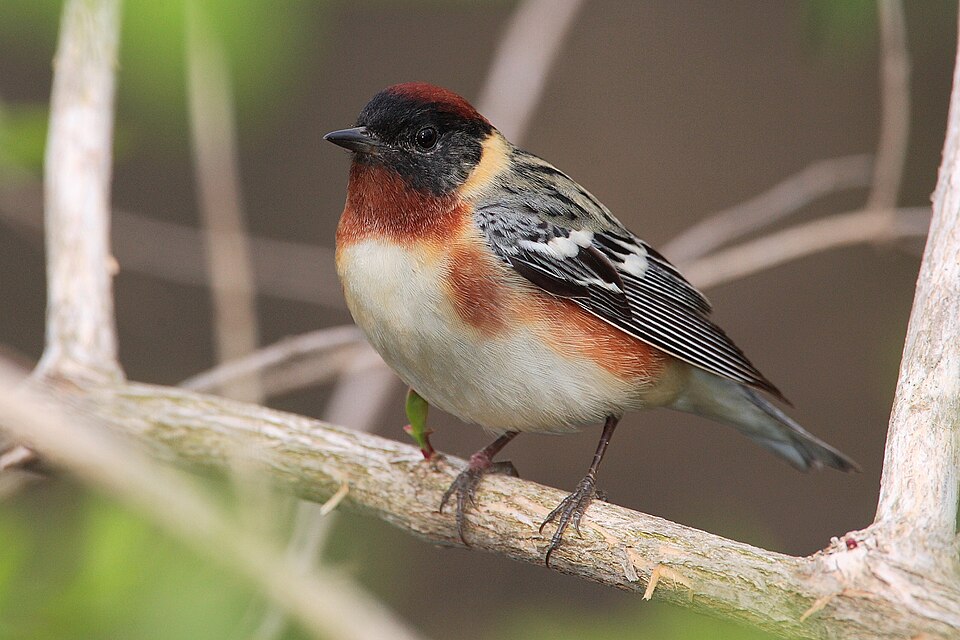
The Bay-breasted Warbler is a stocky, deliberate wood-warbler of the great northern spruce and fir forests, where its fortunes rise and fall with the spruce budworm. In years when this caterpillar outbreaks, Bay-breasted Warblers can become locally abundant, packing several nests into a single stand of conifers; in lean years their numbers drop sharply. That boom-and-bust relationship with an insect makes this bird one of the classic examples in North American ornithology of how a songbird's population tracks its food supply.
For most birders south of the boreal forest, the Bay-breasted is a migration bird, glimpsed high in the canopy during the warbler waves of May and again, far more subtly, in the confusing yellow-green plumages of fall. A breeding-plumage male is unmistakable and gorgeous, washed with rich chestnut on the crown, throat, and flanks against a creamy neck patch. The trick, as with so many warblers, is recognizing the same bird once that color drains away in autumn.
This is a relatively large, full-bodied warbler with a fairly thick neck and a slow, methodical way of moving through foliage compared with the frenetic activity of many of its relatives. Look for two bold white wingbars on dark wings in every plumage, a useful starting point before you work out the rest of the bird.
| Breeding male | Rich chestnut (bay) crown, throat, and flanks; black face mask; large creamy-buff patch on the side of the neck; dark back streaked with black. |
| Wingbars | Two crisp white wingbars on every plumage and age, a reliable anchor mark. |
| Breeding female | A muted echo of the male; pale chestnut wash on the crown and flanks, grayer face, neck patch present but dingier. |
| Fall plumage | Greenish above with faint dark streaks, dull whitish-yellow below; often a hint of buff or warm color along the rear flanks. |
| Legs and feet | Dark legs but distinctly pale, dull-pinkish feet, a subtle clue in tricky fall birds. |
| Overall shape | Stocky and large-headed for a warbler, moving slowly and deliberately along branches. |
Male vs. female
In breeding plumage the sexes are clearly different. The male is the showpiece, with deep chestnut saturating the crown, throat, and flanks set off by a black mask and a bright creamy patch on the side of the neck. The female wears the same pattern in watercolor: her chestnut is paler and more restricted, often just a wash on the crown and a smudge along the flanks, her face is grayer than black, and the neck patch is duller. By fall, both sexes are drab and greenish and can be very hard to sex in the field.
Juveniles
Immature birds in their first fall are the most challenging of all. They are plain greenish above with blurry streaking, dull yellowish-white below, and lack any obvious chestnut, though many show a faint warm buff wash along the rear flanks and undertail that betrays their identity. Combined with the two white wingbars, the dark-legged-but-pale-footed look, and the unstreaked, clean-faced expression, that subtle flank color is often the best fall clue. These birds are routinely confused with fall Blackpoll Warblers.
The song is one of the highest-pitched and thinnest of all the wood-warblers, a series of very high, sibilant notes often written as seetzy-seetzy-seetzy or teesi-teesi-teesi, sometimes likened to a Black-and-white Warbler's song but even thinner and faster. It is so high that some birders simply cannot hear it, and it carries poorly through wind or traffic. The notes are typically delivered on roughly one pitch, without the rising-then-falling structure of many warblers.
The most useful call note is a sharp, fairly loud chip given in migration and on the breeding grounds, lower and richer than the song. In flight, especially during nocturnal migration, the bird gives a high, buzzy flight call.
Bay-breasted Warblers breed across the boreal forest belt of Canada, from the Maritime provinces and the Adirondacks and northern New England west through Ontario and Quebec to the spruce forests of Alberta and the southern Northwest Territories. They favor dense, mature spruce and fir, exactly the habitat where spruce budworm thrives, and their breeding density swings dramatically with budworm abundance.
They are long-distance migrants, wintering primarily in Panama and northwestern South America (Colombia and Venezuela), with smaller numbers through Costa Rica and the rest of southern Central America. In spring they move north relatively late, peaking in May across the eastern and central U.S.; fall passage runs from late August into October. Migrants are most often seen in the eastern half of the continent, with the route concentrated through the Mississippi and Atlantic flyways.
This is fundamentally an insectivore and, above all, a caterpillar specialist. On the breeding grounds spruce budworm larvae can make up the overwhelming majority of its diet during outbreak years, and the bird's slow, deliberate foraging style is well suited to methodically picking caterpillars from clusters of conifer needles. It gleans from foliage and twigs, working middle and upper levels of the canopy, occasionally hovering to take prey from the tips of branches.
Beyond budworm it takes a wide range of other caterpillars, beetles, flies, ants, wasps, and spiders. On migration and especially on the wintering grounds it broadens its diet considerably, adding fruit and small berries to its insect intake, which helps it survive when caterpillars are scarce.
The nest is a loose, bulky cup of twigs, grass, and rootlets lined with fine fibers, hair, and sometimes lichen, placed on a horizontal branch of a spruce or fir, usually well out from the trunk and at moderate height. In budworm outbreak years, when food is superabundant, pairs may nest unusually close together, producing local concentrations of breeding birds.
The female builds the nest and incubates the eggs, while the male feeds her and later helps feed the young. Clutches are typically four to five eggs, whitish and speckled with brown, and the species raises a single brood per year in most of its range. The short boreal summer leaves little room for a second attempt.
The Bay-breasted Warbler is not a backyard or feeder bird. It eats caterpillars and other insects high in conifers, ignores seed and suet, and breeds far to the north in remote spruce forest. You won't lure one to a feeder, but you can improve your odds of seeing one during migration.
- Time your birding for warbler migration, peak in May, with a quieter, drabber passage from late August into October.
- Search the middle and upper canopy of mature trees, especially conifers and tall hardwoods where mixed warbler flocks forage.
- Visit migrant traps, lakeshores, ridgelines, woodlots, and parks where tired migrants concentrate after a night of flight.
- Plant or protect native trees and avoid broad-spectrum insecticides, since this bird depends entirely on a healthy caterpillar supply.
- Learn the very high, thin song and sharp chip note so you can pick one out before you ever see it.
- Bird in the early morning when canopy warblers are most active and feeding low enough to see well.
- Blackpoll Warbler: The classic fall confusion species; very similar greenish immatures, but Blackpoll has yellowish (not buffy) flanks, pale orange-yellow legs and feet, and crisper underpart streaking, while Bay-breasted shows warm buff on the rear flanks and dark legs with pale feet.
- Chestnut-sided Warbler: Breeding males of both have chestnut on the flanks, but Chestnut-sided has a yellow crown, white underparts, and chestnut only along the sides, lacking the chestnut throat and crown of the Bay-breasted.
- Pine Warbler: Dull fall Bay-breasteds can suggest a Pine Warbler, but Pine is plainer-faced with an unstreaked back, longer tail, and yellower breast, and forages more sluggishly low in pines.
- Cape May Warbler: Another budworm specialist sharing the same spruce forests; Cape May has a thin sharp bill, streaky yellow underparts, and (in males) a chestnut cheek patch rather than chestnut flanks and crown.
How do you tell a Bay-breasted Warbler from a Blackpoll Warbler in fall?
Focus on the flanks, legs, and feet. Fall Bay-breasted Warblers usually show a warm buff wash along the rear flanks and have dark legs with pale, dull-pinkish feet. Fall Blackpolls tend toward yellowish flanks, crisper dark streaking below, and pale orange-yellow legs and feet. Bay-breasted also looks slightly stockier and moves more slowly.
Why are Bay-breasted Warbler numbers so variable from year to year?
Their population is tightly linked to the spruce budworm, a caterpillar that periodically outbreaks in boreal conifer forests. In outbreak years food is abundant, birds nest densely, and numbers surge; when budworm populations crash, the warblers decline. This makes them a textbook example of a songbird tracking its food supply.
Where do Bay-breasted Warblers spend the winter?
They are long-distance migrants that winter mainly in Panama and northwestern South America, including Colombia and Venezuela, with smaller numbers through Costa Rica and southern Central America. There they broaden their diet to include fruit alongside insects.
Will Bay-breasted Warblers come to a backyard feeder?
No. They are insect eaters, primarily caterpillar specialists, and forage high in trees rather than at feeders. The best way to see one is to look for migrating warbler flocks in May and again in fall, especially in tall trees and at migrant hotspots like lakeshores and woodlots.
What does a Bay-breasted Warbler sound like?
The song is extremely high, thin, and sibilant, a rapid series like seetzy-seetzy-seetzy delivered on nearly one pitch. It is one of the highest-frequency warbler songs and can be inaudible to some listeners. The call is a sharp, fairly loud chip note that is easier to detect.