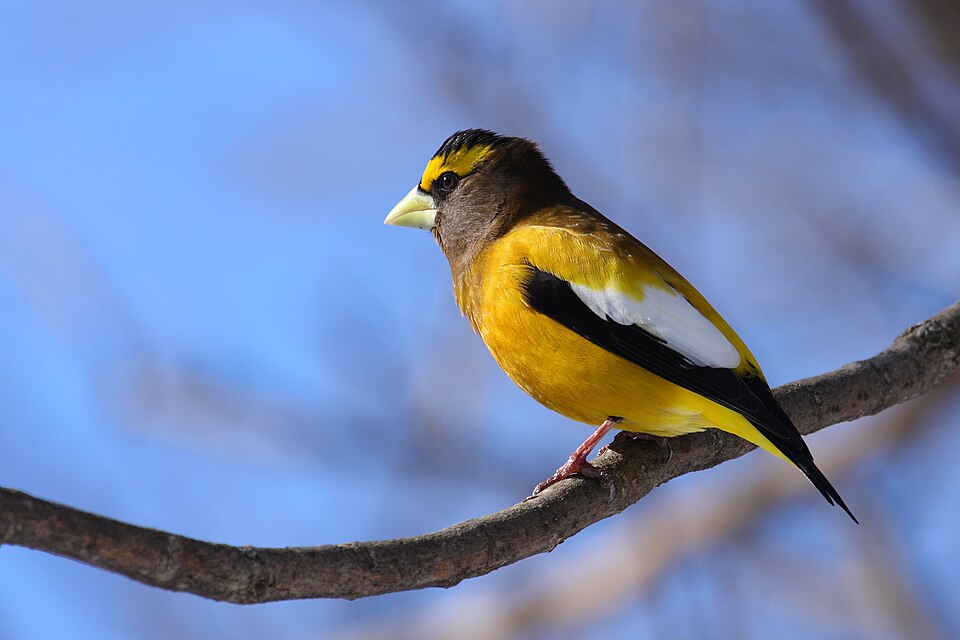
The Evening Grosbeak is one of North America's most striking finches, a heavyset, big-headed bird about the size of a fat starling. Males glow with gold and yellow, set off by a dark hood, bold white wing patches, and a thick, conical bill so pale it almost looks chalky. When a flock descends on a winter feeder, the racket of cracking sunflower seeds and the flash of black-and-white wings make these birds hard to miss. They feed greedily and gregariously, often shoulder to shoulder, and can empty a feeder with startling speed.
This is a bird of the northern and western coniferous forests, breeding across the boreal belt of Canada and down the spine of the western mountains. For many backyard birders in the eastern and central United States, the Evening Grosbeak is a treasured surprise rather than a regular visitor: it shows up in irruption years, when food shortages in the north push flocks far south. Sadly, this is also a species in real trouble. Surveys have documented a steep, long-term decline over recent decades, making each visit feel a little more special and a little more urgent.
Look for a compact, top-heavy finch with a short tail, a large rounded head, and an enormous pale conical bill that dominates the face. Even in silhouette, the bulky body and oversized bill set it apart from other feeder finches. In flight, flashing white wing patches against dark wings are an instant giveaway.
| Bill | Massive, conical, and pale ivory to greenish-white; turns more greenish in spring |
| Male body | Bright yellow-gold body and rump, dusky brown head fading to a bold yellow forehead and eyebrow stripe |
| Wings | Black wings with large, clean white inner-wing (secondary) patches, obvious in flight and at rest |
| Female | Soft silvery-gray and tan with a greenish-yellow wash on the neck and flanks, and white wing markings |
| Size & shape | Stocky and big-headed with a short, notched tail; larger and chunkier than a House Finch or goldfinch |
| Tail | Short and black, often with white at the base, visible in flight |
Male vs. female
Males and females are easy to tell apart. The male is unmistakable: a vivid yellow-gold body, a dark brown head that brightens to a striking yellow forehead and eyebrow, black wings with big white patches, and a black tail. The female is far more subdued, a soft pearly gray washed with greenish-yellow on the nape and sides, with a hint of yellow and the same white wing markings on a darker wing. She also shows a delicate dark mustache mark and a whiter, cleaner underside than the male. Both sexes share the same outsized pale bill.
Juveniles
Juveniles resemble adult females in their muted gray-brown and yellowish tones but look scruffier and less crisply marked, with a duller, browner bill before it develops the adult's pale coloration. Young males begin to show brighter yellow tones as they mature, and by their first winter they take on a more adult-like patterned appearance. In late summer, family groups of begging juveniles trailing the adults are a common sight near breeding areas.
The Evening Grosbeak is not much of a singer. Unlike most songbirds, it lacks a true complex song, relying instead on a small set of distinctive calls. The most familiar is a loud, ringing cleer or peeer, a sharp burry note often given from a treetop or in flight that carries a long way and frequently announces a flock before you see it.
You may also hear a short, chirping tchew and a variety of trills and burry chatters, especially from excited birds at a feeder. The overall impression is of a noisy, sociable flock keeping in constant contact rather than a melodious performer. Many birders learn to recognize the species by that piercing, almost House Sparrow-meets-finch cleer drifting down from overhead.
Evening Grosbeaks breed across the boreal forest of Canada, the northern Great Lakes and New England, and southward through the Rocky Mountains and other western ranges into Mexico. They favor mature coniferous and mixed forests, particularly spruce and fir, and are closely tied to the boom-and-bust cycles of conifer seed crops and outbreaks of spruce budworm.
In winter, their movements are famously unpredictable. In some years flocks stay close to breeding grounds; in others, when northern food crops fail, large numbers irrupt far to the south and east, appearing at feeders well beyond their usual range. These irruption years can bring grosbeaks to backyards across much of the United States, then vanish for several winters afterward. Their long-term range has also contracted, and they are now scarcer in parts of the East than they were in the mid-20th century.
That powerful bill is a seed-crushing tool. Evening Grosbeaks feed heavily on the seeds of conifers, maples, ash, and other trees, along with buds, berries, and small fruits. The huge mandibles can crack open hard seeds and even small pits that defeat most other birds. In the breeding season they also eat large numbers of insects, with spruce budworm being a key food that drives their abundance and movements.
At feeders they are voracious and unmistakable, gathering in flocks to hammer through black-oil sunflower seeds. A group can go through seed at an impressive rate, hulling one seed after another with quick, efficient bites. They often feed calmly and stay put, allowing close, prolonged views, a real treat for anyone lucky enough to host them.
Evening Grosbeaks nest in the conifers and mixed woods of the north and the western mountains, usually placing a loose, flimsy cup of twigs lined with finer materials, rootlets, and lichens high in a tree and well out on a branch. They tend to be quiet and inconspicuous around the nest, which makes nesting behavior surprisingly hard to observe for such a noisy bird.
The female builds the nest and incubates the clutch, while the male helps feed her and, later, the young. After hatching, both parents bring food, including a heavy dose of insects, to the nestlings. Pairs sometimes nest in loose association with others, and family groups stay together into late summer before joining larger post-breeding flocks.
Yes, the Evening Grosbeak can be a backyard bird, though largely on its own terms. You cannot count on them every winter, but in irruption years a well-stocked feeder gives you a real shot at hosting a flock. The key is offering the right food and being ready when the birds move south.
- Offer black-oil sunflower seeds, their clear favorite, in large platform or hopper feeders that can accommodate a hungry flock.
- Use sturdy platform or tray feeders; these big birds feed more comfortably on open surfaces than on small clinging perches.
- Keep feeders stocked through late fall and winter, especially in irruption years when grosbeaks push south of their normal range.
- Provide a reliable water source such as a heated birdbath; grosbeaks readily come to drink and bathe.
- Plant or preserve maples, ash, box elder, and conifers, whose seeds are natural grosbeak food and may draw them in even without feeders.
- Be patient and watch eBird and local birding reports for regional irruptions so you know when to expect them.
- American Goldfinch: Much smaller and slimmer with a tiny pinkish bill; lacks the grosbeak's bulk and giant pale bill, though both show yellow and black wings.
- Pine Grosbeak: Larger and longer-tailed with a stubby dark bill; males are rosy-red rather than gold, and it lacks the bold white wing patches.
- Black-headed Grosbeak: Has rich orange-cinnamon underparts and a dark head; a chunkier overall shape but warm orange tones rather than the Evening Grosbeak's yellow-gold.
- House Finch: Far smaller and slimmer with a small bill and red (not yellow) coloring on males; no white wing patches.
Why do Evening Grosbeaks show up some winters but not others?
They are an irruptive species. In years when conifer seed crops fail in the north, flocks travel far south in search of food and may flood feeders well outside their usual range. In years with good northern food, they stay put, so you might host them one winter and not see another for several years.
What is the best food to attract Evening Grosbeaks?
Black-oil sunflower seeds are by far the best bet, offered on a large platform or hopper feeder that can handle a flock. Their massive bills make quick work of sunflower seeds, and a group will feed steadily for long stretches.
How do I tell an Evening Grosbeak from an American Goldfinch?
Size and bill are the giveaways. The Evening Grosbeak is much chunkier and bigger-headed, roughly starling-sized, with an enormous pale conical bill. The goldfinch is small and slim with a tiny pinkish bill. Both show yellow and black wings, but the grosbeak's bulk and big white wing patches are distinctive.
Are Evening Grosbeaks endangered?
They are not formally endangered, but they have declined sharply over recent decades and are now considered a species of conservation concern, listed as Vulnerable. They remain locally common in good years, but the long-term population trend is downward, likely tied to habitat change and shifts in food supply.
Do Evening Grosbeaks sing?
Not really. They lack a true complex song and instead use a small set of calls, most notably a loud, ringing 'cleer' or 'peeer' that often announces a flock overhead, along with short chirps and burry chatters at feeders.