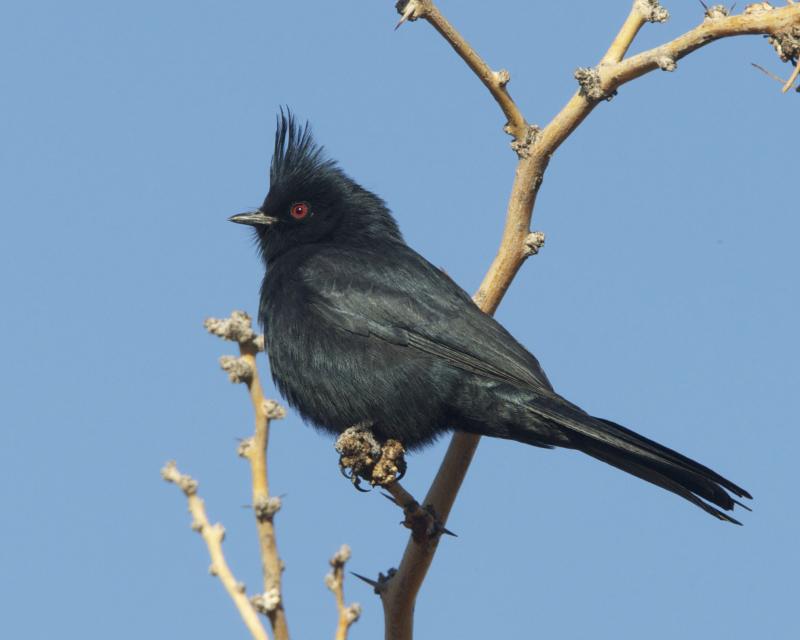
The Phainopepla is one of the most striking and oddly elegant birds of the American Southwest, a slim, crested songbird that looks almost too refined for the harsh deserts it calls home. The name comes from Greek words meaning "shining robe," a fitting description for the glossy, silken plumage of the male. Perched bolt upright at the very top of a desert shrub or mesquite, with its pointed crest and bright red eye, a male Phainopepla cuts an unmistakable silhouette against the dry sky.
This is the only North American member of the silky-flycatcher family, a small group of fruit-loving birds otherwise found in Mexico and Central America. The Phainopepla's life is wrapped tightly around one plant in particular: desert mistletoe. It depends on mistletoe berries through the cooler months and, in return, spreads the plant's seeds across the desert. That close partnership shapes nearly everything about the bird, from where it lives to when and where it breeds.
Phainopeplas are slender, medium-small songbirds with a long tail, an upright posture, and a tall, pointed crest that gives the head a distinctive peaked shape. The shape alone, slim body, long tail, jaunty crest, often perched high and conspicuous, is usually enough to name the bird before you even confirm the color or that glowing red eye.
| Crest | Tall, slender, pointed crest on both sexes, a key shape cue at any distance |
| Eye | Striking deep-red eye that stands out against dark plumage |
| Wing patches | In flight, bold white wing patches flash conspicuously, especially on the male |
| Tail | Long and narrow, often held still in an upright perched posture |
| Male color | Glossy silky black overall with a faint blue-green sheen in good light |
| Female color | Soft uniform gray, paler than the male, with grayer wing patches |
Male vs. female
The sexes are easy to tell apart. The male is glossy, silky black all over, sometimes showing a subtle dark sheen in sunlight, with bright white wing patches that blaze out in flight. The female is plain, soft gray throughout, elegant in her own understated way, with paler gray wing patches that are far less obvious in flight. Both sexes share the same slim build, long tail, pointed crest, and the conspicuous red eye, so when the bird is perched and still, look to overall color to sort male from female.
Juveniles
Juvenile and immature Phainopeplas resemble the gray female, with soft gray-brown plumage and a duller eye that has not yet developed the adult's bright red. Young males gradually acquire blackish feathers as they mature, often looking blotchy or mottled gray-and-black during the transition. The crest is present even in young birds, making the species recognizable by shape long before the plumage is complete.
The Phainopepla's most familiar call is a soft, rising, questioning "wurp?" or "whoit?", a gentle, almost liquid note often given from a high perch. It is an easy sound to overlook, but once learned it reliably reveals the bird's presence in mesquite and desert scrub.
The song is a quiet, halting warble, a loose jumble of soft whistles and scratchy notes strung together without much pattern. Phainopeplas are also remarkable mimics, weaving imitations of other birds' calls into their vocalizations, which can momentarily confuse a listener. When alarmed or interacting, they give a sharp, harsh churring or rasping note quite different from the mellow contact call.
The Phainopepla is a bird of the desert Southwest, ranging across southern California, Arizona, southern Nevada, southern Utah, southern New Mexico, and west Texas, and extending well down into Mexico. It favors hot, arid habitats, desert washes, mesquite bosques, oak and juniper foothills, and any area where desert mistletoe grows abundantly.
Its movements are unusual and still not fully understood. Many Phainopeplas appear to breed twice in a single year in two different habitats: first in the hot, low Sonoran and Colorado Desert in late winter and early spring while mistletoe berries are plentiful, then again in cooler, wetter oak and riparian woodlands later in spring after the desert dries out. This double-breeding, two-habitat strategy is rare among North American birds and makes the species' seasonal comings and goings appear erratic to local observers.
Berries are the heart of the Phainopepla's diet, and desert mistletoe berries above all. A single bird can eat enormous quantities of these small berries, processing them quickly and passing the seeds, still viable, onto branches where new mistletoe can take root. In this way the bird is the main disperser of the very plant it depends on, a tidy ecological partnership. They also take other fruits and berries when available, including elderberry, juniper, and various desert shrubs.
Phainopeplas supplement their fruit diet with insects, which they catch in graceful flycatcher fashion, sallying out from an exposed perch to snap up flying insects in midair before returning. This aerial hunting, combined with the upright perched posture, is why they were long thought of as "silky flycatchers." Insects become especially important during the breeding season when growing nestlings need protein.
The male takes the lead in nest building, an unusual trait, constructing a small, compact cup of twigs, plant fibers, and spider silk, often placed in the fork of a mistletoe clump, a mesquite, or a desert tree. The nest is typically well hidden among foliage and frequently sited near the mistletoe that supplies the family's food.
The female usually lays two to three eggs, pale gray and speckled with darker marks. Both parents share incubation and care of the young, with the male often doing a substantial share. In their early desert breeding season, pairs tend to nest as scattered, territorial pairs; in their later, cooler-woodland breeding period, they sometimes nest in loose colonies, another quirk of this adaptable bird.
The Phainopepla is not a typical feeder bird and rarely visits seed feeders or suet, since its diet revolves around mistletoe and other berries plus flying insects. That said, if you live within its desert range, you can absolutely draw it to your yard by catering to its true tastes and habitat needs.
- Plant or preserve native desert mistletoe and berry-producing natives like elderberry, hackberry, and juniper, fruit is the single biggest draw.
- Keep mature mesquite, palo verde, or desert trees that offer high, exposed perches; Phainopeplas love to sit prominently at the very top of vegetation.
- Provide a water source such as a shallow bird bath or dripper, reliable water is valuable in arid habitat and pulls in desert birds.
- Avoid pesticides so that flying insects remain available for the birds to hawk from their perches.
- Manage your landscape with native desert plants rather than tidy turf; structural, fruiting desert habitat is what keeps Phainopeplas around.
- Northern Mockingbird: Also slim and long-tailed with white wing flashes, but gray-and-white, lacks a crest and red eye, and is bulkier with a heavier bill.
- Cedar Waxwing: Shares a sleek crest and a berry-eating habit, but is warm brown and yellow with a black mask, nothing like the Phainopepla's black or plain gray plumage.
- Pyrrhuloxia: A crested desert songbird, but stocky with a stubby yellow bill and gray-and-red coloring, very different from the slim, sooty Phainopepla.
- Gray Catbird: Plain gray and slim like a female Phainopepla, but lacks a crest, has a black cap and rusty undertail, and skulks in dense cover rather than perching high.
How do you pronounce Phainopepla?
It is usually said "fay-no-PEP-la." The name comes from Greek words meaning "shining robe," a nod to the glossy, silky plumage of the male.
Is the Phainopepla a flycatcher or a waxwing?
Neither, exactly. It is the only North American member of the silky-flycatcher family. It behaves like a flycatcher when hawking insects and resembles a waxwing in its crest and love of berries, but it belongs to its own distinct group.
What does a female Phainopepla look like?
The female is soft, uniform gray with the same slim shape, long tail, pointed crest, and red eye as the male, but without the glossy black color. Her wing patches are gray and far less conspicuous in flight than the male's bright white ones.
Why are Phainopeplas tied to mistletoe?
Desert mistletoe berries are their main winter and early-spring food. The birds eat the berries and pass the seeds onto branches, planting new mistletoe. The plant feeds the bird and the bird spreads the plant, a close, mutually beneficial relationship.
Will Phainopeplas come to a backyard feeder?
They rarely use seed or suet feeders. To attract them in their desert range, offer berry-producing native plants (especially mistletoe), tall exposed perches, and a reliable water source rather than conventional feeders.