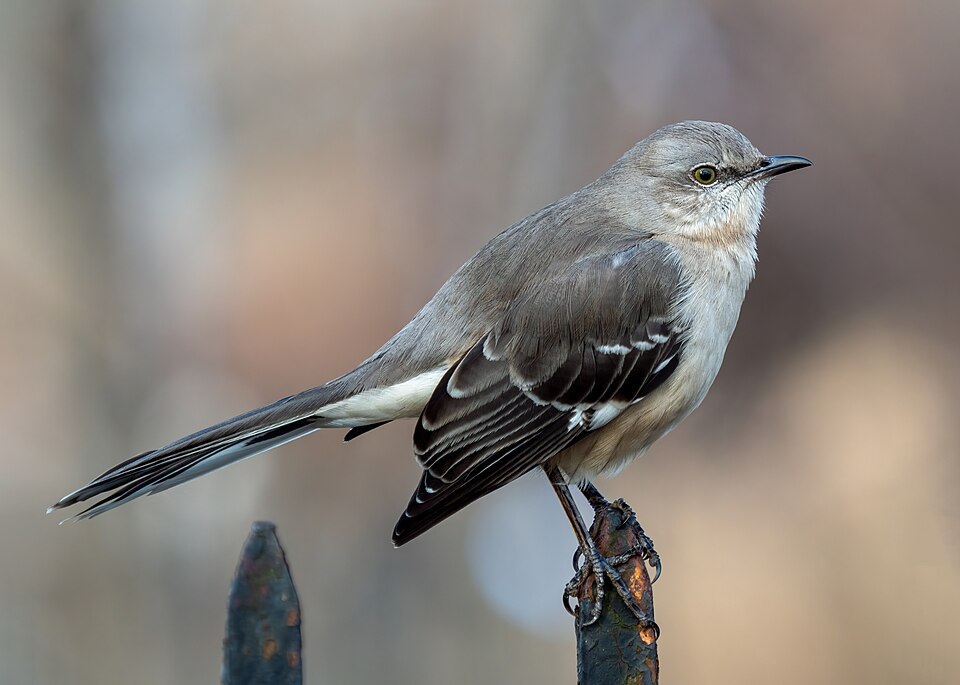
The Northern Mockingbird is one of the most familiar songbirds across the southern and central United States, a slim, long-tailed gray bird that seems to turn up everywhere people do, suburban lawns, parking lots, fence rows, desert washes, and city parks. What it lacks in flashy color it makes up for in personality and voice. A single male can run through dozens of different songs in a sitting, stitching together imitations of other birds, frogs, car alarms, and squeaky gates into a long, rolling performance that can carry on well past dark.
This is a bird of edges and open ground, equally at home in a manicured yard or a tangle of brush. It is fiercely territorial, famous for dive-bombing cats, dogs, hawks, and even people who wander too close to a nest. Beloved enough to be the official state bird of five U.S. states, the mockingbird rewards a little patience: watch one long enough and you'll see it flash its white wing patches, fan its tail, and belt out a medley that no other backyard bird can match.
Northern Mockingbirds are medium-sized, slender songbirds with a long tail they often hold cocked or flick about. The overall impression is of a trim, pale gray bird with a small head, longish legs, and a thin, slightly downcurved bill. In flight, bold white patches in the wings and white outer tail feathers flash dramatically against the gray.
| Overall color | Soft gray above, paler grayish-white below, with no strong streaking or bold markings at rest |
| Wings | Two thin white wingbars and large white patches that flash conspicuously in flight |
| Tail | Long and blackish with white outer feathers, often cocked, fanned, or flicked |
| Eye | Pale yellow to yellowish-orange iris with a faint dark line through the eye |
| Bill | Slim, black, and slightly decurved at the tip |
| Size & shape | Robin-length but much slimmer, with a small head and long legs |
Male vs. female
Males and females look essentially identical in the field, both are gray with white wing patches and white tail edges, and there is no reliable plumage difference you can pick out with binoculars. Males average slightly larger, but not enough to judge on a single bird. Behavior is your best clue: it is almost always the male doing the long, loud, sustained singing (especially the nighttime serenades and the song-flights where a bird leaps into the air flashing its wing patches), while both sexes give harsh calls and defend the territory.
Juveniles
Juvenile mockingbirds look much like adults but are easy to age up close. They show distinct dark spotting or streaking across the breast, a duller grayish-brown cast overall, and a grayish rather than yellow eye. The white wing and tail patches are present but can look less crisp. Within a few weeks these spots fade as the young birds molt into the plain-breasted adult look.
The mockingbird's voice is its calling card. A male strings together long, energetic songs built almost entirely from imitations, borrowed phrases from cardinals, jays, titmice, wrens, and dozens of other species, plus frogs, insects, and mechanical sounds like sirens, squeaky hinges, and car alarms. The giveaway is the structure: each phrase is repeated three to six times before he switches to the next, producing a tireless "cheer-cheer-cheer, tweep-tweep-tweep, churr-churr-churr" that can roll on for many minutes. A good male's repertoire can include well over a hundred distinct phrases, and it grows through his life.
Unmated males are the ones most likely to sing through the night, especially on moonlit nights in spring, a habit that delights some neighbors and exasperates others. Calls include a dry, raspy "chair" or "tchack" scold and a harsh "hew" given when alarmed or chasing off an intruder.
Northern Mockingbirds are found across most of the United States, much of Mexico, and into the Caribbean. They are most abundant in the South and along both coasts, thinning out toward the northern Plains and the northern tier of states. Over the past century the species has expanded its range northward, reaching parts of the upper Midwest, New England, and southern Canada.
Across most of their range they are year-round residents and do not truly migrate. Birds at the northern edge of the range may drift south or shift to milder areas in harsh winters, and individuals sometimes wander well north of their normal range, turning up as exciting rarities. Where winters are mild, the same bird may hold the same territory all year.
Mockingbirds eat a seasonally shifting mix of insects and fruit. In spring and summer they hunt arthropods, beetles, grasshoppers, ants, spiders, caterpillars, and more, typically foraging on the ground or short grass. Watch one feed and you may see its trademark "wing-flashing": it runs a few steps, then jerkily raises its wings to show the white patches, possibly startling insects into moving or signaling to rivals.
From late summer through winter the diet swings heavily toward berries and small fruits. They relish the fruit of holly, dogwood, hawthorn, pokeweed, mulberry, elderberry, multiflora rose, and many ornamental shrubs. A mockingbird will often claim a fruiting bush or holly as a winter food cache and aggressively defend it against robins, waxwings, and other mockingbirds for weeks at a time.
Mockingbirds nest low in dense shrubs, hedges, small trees, or thorny tangles, usually within about ten feet of the ground. The male builds the bulky outer shell of twigs and the female lines the cup with grass, rootlets, and soft material. The female lays a clutch of pale blue-green to greenish eggs heavily spotted with reddish-brown.
The female does most of the incubating, which lasts roughly two weeks, and both parents feed the nestlings. Young leave the nest about twelve days after hatching, before they can fly well, and the parents continue feeding them on the ground and in cover. Pairs are notably productive, often raising two or three broods in a single season in warmer regions. Throughout nesting both adults are relentless defenders, diving at and striking cats, dogs, snakes, hawks, and people who venture too close.
Mockingbirds are common backyard birds, but they're not classic seed-feeder visitors, you won't usually lure one with a tube feeder full of sunflower. The way to draw them in is through fruit and habitat rather than seed.
- Plant native fruiting shrubs and trees, holly, dogwood, hawthorn, elderberry, mulberry, and pokeweed, to provide the berries mockingbirds depend on in fall and winter.
- Offer cut fruit, raisins, or suet on a platform or open tray; mockingbirds will sometimes take apple halves, grapes, and softened raisins, especially in cold weather.
- Keep some open lawn or short grass nearby for ground foraging, bordered by dense shrubs where they can nest and shelter.
- Provide a birdbath or shallow water source, mockingbirds bathe and drink readily and a water feature is a reliable draw.
- Expect territorial behavior: a resident mockingbird may chase other birds from feeders and fruit, and may even spar with its own reflection in windows or car mirrors.
- Avoid pesticides so insects remain available as summer food for adults and growing chicks.
- Loggerhead Shrike: Similar gray-and-white pattern, but stockier with a black mask through the eye and a hooked bill; shrikes perch upright on wires and hunt insects and small prey rather than singing long medleys.
- Gray Catbird: Closely related mimic, but uniformly slate-gray with a black cap and rusty under the tail, and it lacks white wing patches; its song is a rambling string of phrases given once, not repeated, often with a cat-like mew.
- Townsend's Solitaire: Western gray bird of similar size, but rounder-headed with a bold white eye-ring and buffy wing patches instead of white flashes; favors mountain and juniper country.
- Sage Thrasher: Western relative that looks like a smaller, browner mockingbird with a streaked breast and pale eye; found in sagebrush rather than yards and towns.
Why does a mockingbird sing all night long?
Loud nighttime singing is almost always done by unmated males trying to attract a female, and it peaks in spring, especially on bright moonlit nights and in well-lit areas. Once a male pairs up, the night singing usually drops off. It's harmless, if hard to sleep through, closing windows or running a fan to mask the sound is the practical fix.
Can mockingbirds really imitate other sounds, even non-bird noises?
Yes. Northern Mockingbirds are accomplished mimics that copy the songs and calls of dozens of other bird species, plus frogs, insects, and mechanical sounds like car alarms, squeaky gates, and sirens. The tell-tale sign is that each imitated phrase is repeated several times in a row before the bird moves to the next one.
Why is a mockingbird attacking my cat, dog, or even me?
During nesting season mockingbirds are extremely protective and will dive-bomb anything they see as a threat near the nest, including pets and people. It's a temporary behavior that ends once the young fledge and disperse, usually within a couple of weeks. Giving the nest area a wide berth and keeping cats indoors will calm things down.
How do I attract mockingbirds to my yard?
Skip the seed feeders and focus on fruit and habitat. Plant native berry-producing shrubs like holly, dogwood, and elderberry, offer cut fruit, raisins, or suet on an open tray, add a birdbath, and keep some open lawn next to dense shrubs for foraging and nesting.
Are male and female mockingbirds different colors?
No, the sexes look alike, both are gray with white wing patches and white tail edges. You generally can't tell them apart by sight in the field. The bird doing the long, sustained singing and the dramatic song-flights is almost always the male.