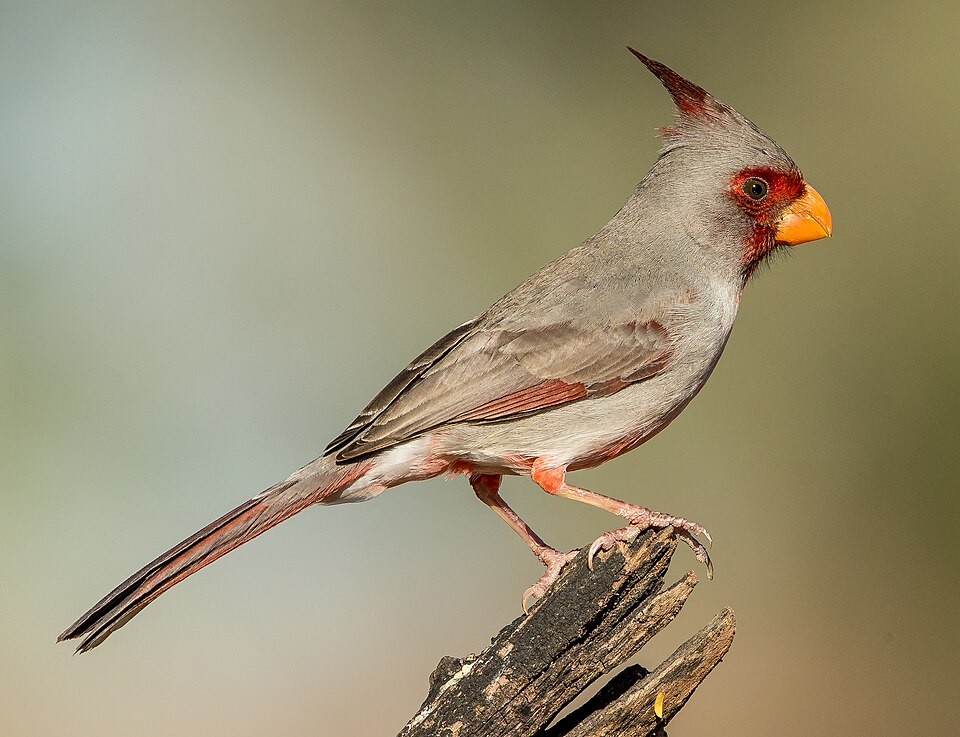
The Pyrrhuloxia is what you might get if you took a Northern Cardinal, dialed back the color, and turned up the desert toughness. This stocky finch-like songbird wears soft gray plumage washed with rosy red down the face, breast, and crest, and it carries a stout, strongly curved yellow bill built for cracking the hard seeds of arid country. It is a true specialist of the American Southwest and northern Mexico, thriving in mesquite thickets, thorn scrub, and brushy desert washes where few other cardinals venture.
Birders sometimes call it the "desert cardinal," and the resemblance to its famous red relative is unmistakable in shape and silhouette. But the Pyrrhuloxia has its own character: it is a bird of the brush, often shy and easily overlooked until it pops up to deliver a clear, ringing whistle from a thorny perch. For anyone birding southern Arizona, New Mexico, or the Rio Grande Valley of Texas, finding a Pyrrhuloxia is one of the signature rewards of the region.
In shape, the Pyrrhuloxia is a near-twin of the Northern Cardinal: a medium-large songbird with a tall, pointed crest, a long tail, and a thick, seed-crushing bill. The giveaway is the overall color scheme. Where the cardinal is brilliant red, the Pyrrhuloxia is mostly cool gray, brightened with patches and washes of rose-red, and the bill is short, deep, and strongly curved like a parrot's rather than the cardinal's straighter triangular bill.
| Overall color | Soft gray body with red highlights, never fully red like a cardinal |
| Bill | Stubby, deeply curved, pale yellow to horn-colored (yellow year-round) |
| Crest | Tall, pointed, often tinged or tipped with red |
| Face & breast | Rosy-red mask around the bill, a red streak down the center of the breast and belly |
| Wings & tail | Red edging on the wings and red in the tail, most visible in flight |
| Size | Roughly the size of a Northern Cardinal, stocky and full-tailed |
Male vs. female
The sexes look broadly similar in gray tone but differ in how much red they show. The male is gray overall with a vivid rose-red face, crest tip, central breast, and a red wash extending down the belly, plus red in the wings and tail. The female is plainer and warmer, a buffy gray-brown with much less red, usually limited to a faint touch in the crest, wings, and tail. The female's curved yellow bill and crest still make her easy to place, but she lacks the bold red mask and breast stripe of the male.
Juveniles
Juvenile Pyrrhuloxias resemble the adult female but are even duller, showing little to no red and a more uniform buffy-gray plumage. Their most reliable clue at this stage is the bill: young birds initially have a darker, grayish bill that has not yet brightened to the adult's yellow, but the same short, distinctly curved shape is already apparent. By their first winter, young males begin acquiring the rosy tones that will mark them as adults.
The Pyrrhuloxia's song is a clear, slurred whistle, often rendered as a liquid whit-whit-whit-whit or a ringing quink-quink-quink that runs down or up the scale. To many ears it sounds like a thinner, slightly more metallic version of the Northern Cardinal's song, sometimes described as a faster, drier cheer-cheer-cheer. Males sing from exposed perches atop mesquite or thorn scrub, especially in the breeding season.
The common call note is a sharp, metallic chink or tik, very similar to the cardinal's distinctive chip and just as useful for locating a hidden bird in dense brush. Both sexes call, and the sound carries well across open desert.
The Pyrrhuloxia is a bird of the southwestern United States and northern Mexico. In the U.S. its range covers southern and central Arizona, southern New Mexico, and southern and western Texas, including the Rio Grande Valley and the Big Bend region. From there it extends south through much of northern and central Mexico, occupying the arid and semi-arid scrublands of the interior.
It is largely a year-round resident and does not undertake true long-distance migration. However, birds may wander or shift locally outside the breeding season, sometimes gathering in loose flocks in winter and occasionally appearing slightly north or east of their normal breeding limits. Within its core range it stays put, tied closely to mesquite, thorn forest, and desert brush.
The Pyrrhuloxia is primarily a seed-eater, and its powerful curved bill is a tool for handling the tough seeds of desert plants. It feeds heavily on the seeds of grasses, weeds, mesquite, and other arid-land vegetation, and it readily takes cactus fruit and other wild fruits when available. In the warmer months it adds a good deal of insect prey, including grasshoppers, beetles, caterpillars, and other invertebrates, which are especially important for feeding nestlings.
It forages mostly on or near the ground and in low brush, hopping through cover and gleaning seeds and insects. Pyrrhuloxias are also known to feed on agricultural seeds and have a long-standing reputation among cotton growers for eating cotton worms, making them a beneficial presence in farm country. In winter they often join loose foraging flocks, sometimes mixing with Northern Cardinals and sparrows.
Pyrrhuloxias nest low in dense, often thorny cover such as mesquite, hackberry, or thick desert shrubs, typically only a few feet off the ground. The female builds a compact, cup-shaped nest of twigs, bark strips, grasses, and rootlets, lined with finer material, well hidden within the protective tangle of branches.
A typical clutch is three to four eggs, pale and finely spotted, which the female incubates for roughly two weeks. Both parents feed the young, which leave the nest after about ten days. In the desert's productive seasons a pair may raise more than one brood. During breeding, Pyrrhuloxias are territorial, but pairs often relax those boundaries in winter and tolerate one another in feeding flocks.
If you live within its southwestern range, the Pyrrhuloxia absolutely can be a backyard and feeder bird, though it tends to be shyer and less consistent than the bold Northern Cardinal. The key is offering the right food and the brushy cover it trusts. Yards near desert washes, mesquite, or thorn scrub have the best odds.
- Offer black-oil sunflower seeds and safflower on platform or hopper feeders, which its heavy bill handles easily.
- Use ground or low platform feeders, since Pyrrhuloxias prefer to forage near the ground rather than at hanging tube feeders.
- Scatter some millet and other small seeds on the ground to mimic its natural weed-seed foraging.
- Provide a low, reliable water source or shallow birdbath, which is a strong draw in dry desert country.
- Keep native thorny shrubs, mesquite, and brushy cover nearby so birds feel safe approaching your yard.
- Be patient in winter, when Pyrrhuloxias form loose flocks and are most likely to visit feeders.
- Northern Cardinal: Males are entirely brilliant red, not gray; the cardinal has a straight orange-red triangular bill, while the Pyrrhuloxia's bill is stubby, curved, and yellow. Female cardinals are warmer brown with a reddish bill.
- Phainopepla: Also a slim, crested desert bird, but the male is glossy jet black with red eyes and white wing patches in flight; it lacks the heavy seed-cracking bill and never shows the Pyrrhuloxia's gray-and-rose pattern.
- Cedar Waxwing: Sleek and crested with a soft gray-brown body, but it has a black mask, waxy red wingtips, and a yellow tail band, and feeds in fruiting flocks rather than cracking seeds in desert brush.
What is the difference between a Pyrrhuloxia and a Northern Cardinal?
The easiest tells are color and bill. A male Northern Cardinal is brilliant red all over with a straight orange-red triangular bill; a Pyrrhuloxia is mostly gray with rosy-red highlights and a short, strongly curved yellow bill. The two are close relatives in the same genus and share the same crested cardinal shape, but the Pyrrhuloxia is the gray 'desert cardinal' of the Southwest.
How do you pronounce Pyrrhuloxia?
It is usually pronounced 'pir-uh-LOK-see-uh.' The unusual name comes from the bird's mix of features that reminded early naturalists of both bullfinches (Pyrrhula) and crossbills (Loxia).
Where can I see a Pyrrhuloxia?
Look in the arid Southwest: southern Arizona, southern New Mexico, and southern and western Texas, plus much of northern Mexico. Search mesquite thickets, desert washes, and thorn scrub. Birding hotspots in southeastern Arizona and the Rio Grande Valley of Texas are reliable spots.
Will Pyrrhuloxias come to bird feeders?
Yes, if you live in their range. They favor black-oil sunflower and safflower seeds, and they prefer feeding on the ground or on low platform feeders near brushy cover. They tend to be shyer than Northern Cardinals and visit most readily in winter when they travel in loose flocks.
Are Pyrrhuloxia and Northern Cardinal related?
Yes. Both belong to the genus Cardinalis, making them very close relatives. They look alike in shape, sing similar whistled songs, and can occasionally be found foraging together in winter within the Pyrrhuloxia's southwestern range.