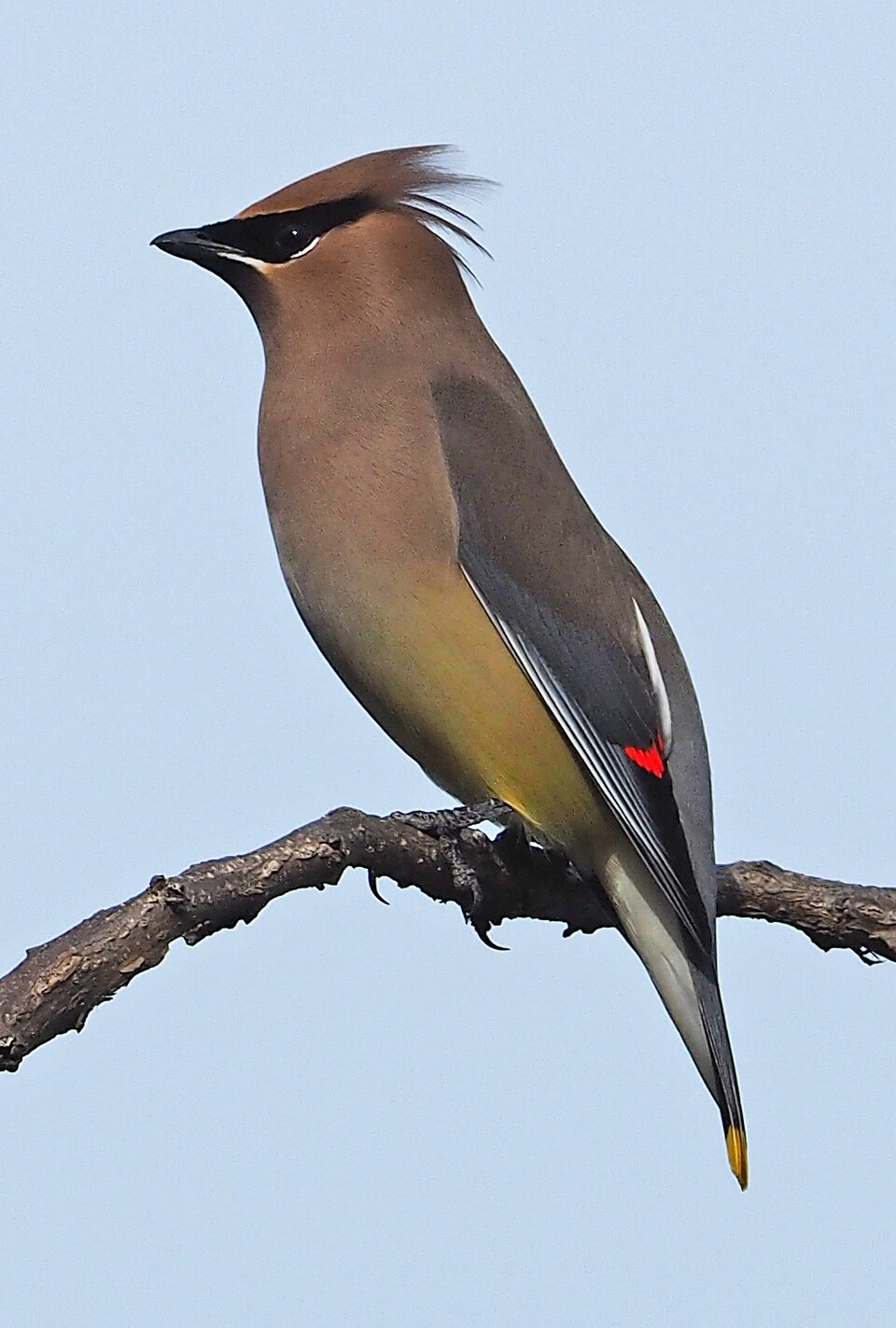
The Cedar Waxwing is one of North America's most elegant songbirds, a soft fawn-brown bird with a swept-back crest, a slim black mask, and a tail that looks as if it were dipped in bright yellow paint. It is the kind of bird that surprises people: many birders never notice one until a chattering flock suddenly descends on a fruiting tree, strips it of berries over the course of a few hours, and moves on. Waxwings are intensely social and almost nomadic outside the breeding season, wandering widely in search of fruit rather than holding fixed winter territories.
Their name comes from the small, waxy red tips on the secondary wing feathers, actual droplets of pigment that look like they were dabbed on with sealing wax. The Cedar Waxwing is one of only three waxwing species in the world and the most widespread in North America. Because so much of its diet is sugary fruit, it is one of the few birds capable of getting tipsy on fermented berries, and intoxicated waxwings are a genuine (if comical) phenomenon in late winter.
Cedar Waxwings are smaller and slimmer than a robin, with a distinctive crested head, a short tail, and a smooth, almost airbrushed look to the plumage. The combination of silky brown tones, a black mask, and the yellow-tipped tail is unlike any other backyard bird, and once you have seen one the species is hard to confuse.
| Crest | Pointed, swept-back crest that the bird raises and lowers; gives a sleek, peaked head profile |
| Mask | Narrow black mask through the eye, bordered with a thin white line above and below |
| Body color | Soft fawn-brown head and breast blending to pale gray on the wings, rump, and tail; pale yellow wash on the belly |
| Tail tip | Bright yellow band across the tip of the tail (occasionally orange in birds that eat introduced honeysuckle berries) |
| Wing tips | Small, waxy red droplets on the tips of the inner wing feathers, diagnostic but not always present |
| Throat | Black chin patch, sharply set off from the smooth brown breast |
Male vs. female
Male and female Cedar Waxwings look nearly identical and cannot be reliably separated in the field. With a bird in the hand, the black chin patch tends to be slightly larger and more sharply defined in males than in females, but the difference is subtle and overlapping. For backyard watching, treat the sexes as alike, both share the crest, mask, brown body, and yellow tail band.
Juveniles
Juvenile Cedar Waxwings look noticeably scruffier and grayer than adults, with blurry brown-and-white streaking down the breast and belly instead of the adults' smooth, clean plumage. They still show the dark mask, but it is fainter, and they often lack the waxy red wing tips entirely. The yellow tail band is present but can be duller. Young birds usually molt into adult-like plumage by their first winter, so the streaky look is mostly seen from late summer into fall.
Cedar Waxwings do not really sing in the usual sense, they have no rich, musical song. Instead they communicate almost constantly with a high, thin, slightly trembling whistle, often written as seeee or tseee. The pitch is so high that some people, especially as they age, have trouble hearing it at all.
A second common call is a buzzier, more insistent trill, bzeee or zree, given when birds are excited or jostling at a fruit source. Because waxwings travel in flocks, you often hear a soft, shivering chorus of these whistles overhead before you ever spot the birds, it is one of the most reliable ways to detect them passing through.
Cedar Waxwings breed across southern Canada and the northern and central United States, favoring open woodlands, forest edges, orchards, riverside trees, and increasingly suburban neighborhoods with ornamental fruit trees. In winter they spread much farther south, throughout most of the United States, Mexico, and Central America, occasionally reaching as far as northern South America.
Their movements are best described as erratic rather than strictly migratory. Because they follow fruit supplies, flocks may be abundant in an area one winter and absent the next. In a single yard you might see waxwings only for a few days each year, timed to whenever the crabapples, hollies, or cedar berries ripen. This wandering, food-driven behavior makes them one of the harder common birds to predict from week to week.
Cedar Waxwings are among the most fruit-dependent birds in North America. They feed heavily on small fleshy fruits and berries, including cedar and juniper berries (the source of their name), serviceberry, dogwood, hawthorn, mountain ash, crabapple, holly, mulberry, and the fruit of many introduced shrubs such as honeysuckle. A flock will work methodically through a fruiting tree, plucking and swallowing berries whole, often hanging acrobatically or fluttering to reach the outermost clusters.
In summer they switch to a more mixed diet, fly-catching for insects over rivers and ponds with surprisingly graceful, almost flycatcher-like sallies. This protein boost is important for feeding nestlings. One charming and well-documented behavior is berry-passing: birds perched in a row will sometimes hand a single berry down the line from bill to bill until one finally eats it. Because they rely so much on sugary fruit, waxwings can become intoxicated on berries that have fermented on the branch, and birds occasionally die from flying into windows while impaired.
Cedar Waxwings are late nesters, often not beginning until June or July when summer fruit is at its peak, a timing that lines up the demanding nestling period with abundant food. The female builds a bulky, somewhat loose cup of grass, twigs, plant fibers, and other material, usually placed on a horizontal limb anywhere from a few feet to high in a tree. The male helps by gathering nesting material, sometimes pilfering it from other birds' nests.
The female lays a clutch of about 3 to 5 pale bluish-gray eggs spotted with dark markings, and incubates them for roughly 12 to 13 days. Both parents feed the young, shifting from insects to fruit as the chicks grow. The young leave the nest around two weeks after hatching. In good years a pair may raise two broods, which partly explains why this species has been doing well and even increasing in many areas.
Cedar Waxwings essentially never come to seed feeders or suet, their digestive systems are built for fruit and insects, not seeds. The way to draw them in is through landscaping rather than feeding. If you want waxwings, think of your yard as a fruit buffet, and be patient: when a wandering flock finds your berries, they can arrive in dramatic numbers and clean a tree out within a day or two.
- Plant native fruiting trees and shrubs such as serviceberry, dogwood, hawthorn, cedar/juniper, mountain ash, and crabapple, these are the strongest waxwing magnets.
- Add winter-persistent berries like holly, winterberry, and native viburnum to attract flocks during the lean months when other food is scarce.
- Provide a clean, moving water source, waxwings readily come to birdbaths and shallow streams to drink and bathe, especially after gorging on dry berries.
- Avoid planting invasive berry shrubs; choose native species instead so you support waxwings without spreading problem plants.
- Be patient and flexible, waxwings are nomadic, so they may visit only briefly when your fruit ripens; a variety of plants fruiting at different times raises your odds.
- Reduce window collisions with decals or screens, since fruit-feeding flocks (sometimes slightly drunk on fermented berries) are prone to striking glass.
- Bohemian Waxwing: Larger and grayer, with rusty undertail coverts and bold white-and-yellow markings in the wing; mostly a far-northern and winter bird, while Cedar Waxwing has a plain pale-yellow belly and white undertail.
- Northern Mockingbird: Also a fruit-eater but is gray, larger, lacks a crest and mask, and shows big white wing patches in flight; song is loud and varied rather than a thin whistle.
- Tufted Titmouse: Shares a crest but is gray above with rusty flanks, has no black mask or yellow tail band, and readily visits seed feeders, which waxwings do not.
Why are Cedar Waxwings in my tree all of a sudden?
A flock has almost certainly found ripe fruit. Waxwings are nomadic and travel in groups searching for berries, so when your crabapple, holly, juniper, or other fruiting tree ripens, a flock can descend, feed heavily for a day or two, and then move on. Their arrival is tied to food, not season, so it can feel very sudden.
Do Cedar Waxwings come to bird feeders?
No, not in the usual sense. They ignore seed and suet feeders because their diet is fruit and insects. The way to attract them is to plant fruiting trees and shrubs and to offer water. A platform with fresh or dried fruit occasionally works, but landscaping is far more reliable.
Can Cedar Waxwings really get drunk?
Yes. Because they eat so much sugary fruit, they sometimes consume berries that have fermented on the branch, especially in late winter. The alcohol can leave them visibly intoxicated, uncoordinated, and prone to flying into windows. In rare cases birds eat enough fermented fruit to die.
What is the difference between a Cedar Waxwing and a Bohemian Waxwing?
Cedar Waxwings are smaller and browner with a pale yellow belly and plain white undertail. Bohemian Waxwings are larger, grayer, show rusty feathers under the tail, and have bold white and yellow flashes in the wing. Bohemians are mostly seen in the far north and during winter irruptions, while Cedar Waxwings are widespread year-round.
What do the red tips on a Cedar Waxwing's wings mean?
They are small droplets of waxy red pigment on the tips of the inner wing feathers, and they give the bird its name. The number and size of these tips tend to increase with age, and research suggests older birds with more red tips may be preferred as mates. Not every bird shows them clearly.