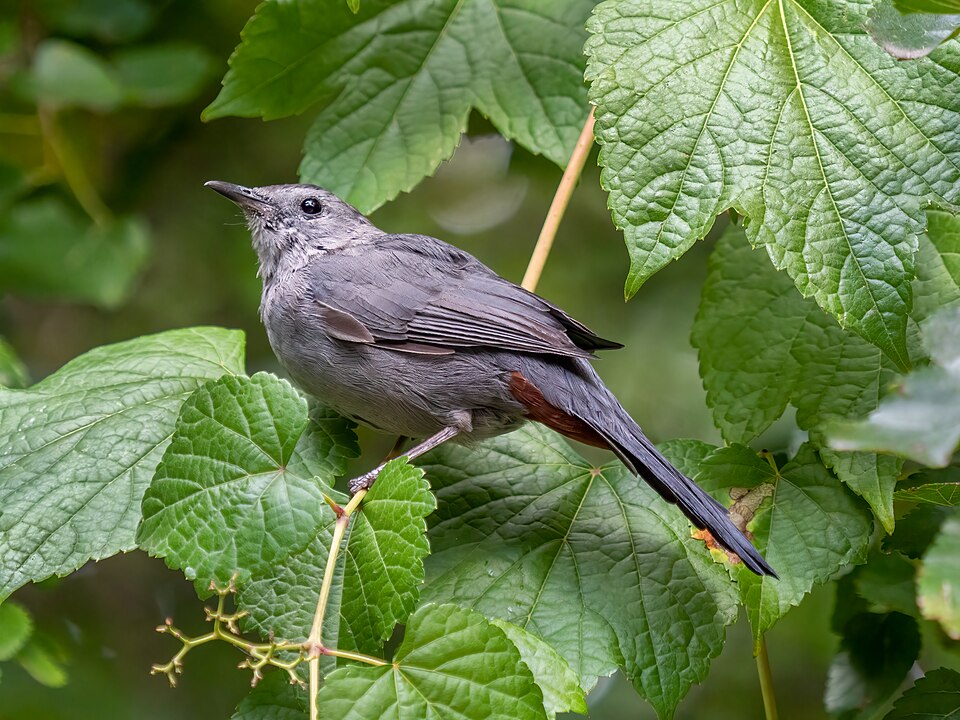
The Gray Catbird is one of those birds you usually hear before you see. Skulking low in a tangle of shrubs, it announces itself with a raspy, drawn-out mew that sounds startlingly like a complaining housecat, the trait that earned it both its English and scientific names. Slim, long-tailed, and dressed almost entirely in soft slate gray, it is a relative of the mockingbirds and thrashers and shares their gift for vocal mimicry, weaving snatches of other birds' songs into long, improvised ramblings.
Catbirds are creatures of edges and thickets, overgrown fencerows, brambly woodland borders, streamside willows, and shrubby suburban yards. Across most of North America east of the Rockies they are a familiar summer sound, and unlike many secretive birds they are also bold and curious, often popping up to investigate an observer who spishes or pauses near their cover. For backyard birders willing to leave a corner of the yard a little wild, the catbird is an approachable, characterful neighbor.
This is a medium-sized, slender songbird with a long, often-cocked tail and a fairly long, slightly rounded bill. In silhouette it recalls a small mockingbird or a robin-shaped thrush, but its lankier proportions and the way it skulks through dense cover are distinctive. The plumage is the easiest clue: a uniform, clean slate gray over nearly the whole body, broken by just two contrasting marks.
| Overall color | Uniform slate gray, slightly darker on the wings and tail; no streaks, bars, or wing bars |
| Crown | Neat black cap, sharply defined against the gray face and forehead |
| Undertail | Distinctive rich chestnut (rufous) patch under the base of the tail, often the clincher |
| Tail | Long, blackish, frequently cocked upward or flicked while perched |
| Bill and legs | Slim, dark bill and dark legs |
| Eye | Dark eye with no obvious ring, giving a plain-faced look |
Male vs. female
Males and females look alike. The sexes are essentially identical in plumage, the same slate gray body, black cap, and chestnut undertail, so you cannot reliably tell them apart in the field by appearance. Males average very slightly larger, but the difference is not visible without a bird in the hand. Behavior offers the best hint during breeding season: the bird singing long, loud, rambling songs from an exposed perch is almost always the male.
Juveniles
Juvenile catbirds look much like adults but are duller and more washed-out, with a less crisply defined cap and often a paler, more buff-tinged undertail rather than bright chestnut. Freshly fledged young can show a faint, pale gape at the corners of the mouth and may appear slightly fluffier and softer in plumage. By late summer and fall, immature birds are difficult to separate from adults in the field.
The catbird's namesake call is unmistakable: a nasal, raspy, downslurred mew or maaa that genuinely sounds like a petulant cat. They give it year-round, often from deep within a thicket, and it is the surest way to confirm the bird's presence even when you can't see it.
The song is a different beast entirely, a long, halting, improvised string of whistles, squeaks, gurgles, nasal notes, and mimicked fragments of other species, delivered in a rambling, almost conversational way. Unlike the Northern Mockingbird, which typically repeats each phrase several times, the catbird usually says each odd note just once before moving on, and the overall effect is more disjointed and harsh than musical. They also produce a sharp, complaining chek and other harsh notes when agitated.
Gray Catbirds breed across most of southern Canada and the central and eastern United States, from the Atlantic coast west to the Rocky Mountains, with a scattered presence in parts of the Pacific Northwest and intermountain West. They are largely absent as breeders from the arid Southwest and the far western coast.
They are medium-distance migrants. Most birds winter along the Gulf Coast and Atlantic coast of the southeastern U.S., through much of Mexico, and into Central America and the Caribbean. A small number linger through winter in the Southeast, especially where berries and dense cover persist. Spring migration brings them north through April and May, and they head south again from late August through October.
Catbirds are omnivores with a strongly seasonal diet. Through the breeding season they eat large quantities of insects and other invertebrates, beetles, ants, caterpillars, grasshoppers, true bugs, and spiders, gleaned from foliage and the ground, often while rummaging through leaf litter beneath shrubs. This animal protein is especially important for feeding nestlings.
From late summer into fall and winter, fruit becomes a major part of their diet. They readily take wild berries and small fruits, including those of dogwood, holly, serviceberry, elderberry, grape, blackberry, cherry, and many others, and this fondness for fruit makes them important seed dispersers. Their preference for berries over seeds is the main reason they are uncommon visitors to traditional seed feeders.
The female builds a bulky, somewhat untidy cup nest hidden low in a dense shrub, vine tangle, or small tree, usually within about three to ten feet of the ground. The outer shell is made of twigs, leaves, grass, and bark strips, sometimes incorporating bits of trash, and it is lined with finer rootlets and plant fibers.
A typical clutch is three to four eggs, a deep, glossy turquoise-blue, occasionally with faint reddish flecks. The female does almost all of the incubation, which lasts about two weeks, and the young leave the nest roughly 10 to 12 days after hatching. Pairs often raise two broods in a season. Notably, catbirds are vigilant defenders against brood parasitism, they recognize and eject the eggs of Brown-headed Cowbirds from their nests, an unusual and effective behavior.
Catbirds are not classic feeder birds, they rarely touch sunflower or mixed seed, but they readily settle into yards that offer dense cover and fruit, and they can become surprisingly tame and approachable. The key is habitat and the right foods rather than a seed feeder.
- Plant native fruiting shrubs such as dogwood, serviceberry, elderberry, viburnum, holly, and brambles, these supply both food and the dense cover catbirds love.
- Leave a wild, shrubby corner with thick tangles and brush; catbirds avoid open, manicured lawns and gravitate to brushy edges.
- Offer fruit at a platform or tray: halved oranges, raisins or currants softened in water, grape jelly, and chopped fruit can all draw them in, especially in spring and summer.
- Provide water: a ground-level birdbath or shallow dish near cover is very attractive, as catbirds bathe readily.
- Try suet or mealworms during the breeding season, live or dried mealworms in particular can tempt insect-hungry adults feeding young.
- Skip pesticides so the insects and caterpillars that catbirds depend on for raising chicks remain available.
- Northern Mockingbird: Paler gray, lacks the black cap and chestnut undertail, and shows bold white wing patches and white outer tail feathers in flight. Repeats each song phrase several times rather than once.
- Brown Thrasher: A close relative but rusty-brown above with heavy dark streaking below, two wing bars, and a yellow eye, not gray. Also sings in repeated phrase pairs.
- Townsend's Solitaire: A western, slimmer gray bird with a bold white eyering, buffy wing patches, and white tail edges; lacks the catbird's black cap and chestnut undertail and favors more open, montane habitat.
Why does a bird in my yard sound like a cat?
That is almost certainly a Gray Catbird. Its raspy, drawn-out mew call is a near-perfect imitation of a complaining cat and is the trait that gives the bird its name. Listen low in dense shrubs or thickets, they usually call from within cover rather than out in the open.
How do I tell a Gray Catbird from a Northern Mockingbird?
The catbird is darker, uniform slate gray with a black cap and a chestnut patch under the tail, and it shows no white in the wings or tail. A mockingbird is paler gray with flashy white wing patches and white outer tail feathers, and it repeats each song phrase several times where the catbird tends to say each note just once.
Will Gray Catbirds come to bird feeders?
Not to seed feeders, generally. Catbirds prefer insects and fruit over seeds, so they are far more likely to visit if you offer halved oranges, raisins, grape jelly, mealworms, or suet, and if you have native fruiting shrubs nearby for natural berries.
Where do Gray Catbirds go in winter?
Most migrate south to the Gulf and Atlantic coasts of the southeastern U.S., Mexico, Central America, and the Caribbean. A small number linger through winter in the Southeast, especially where berries and dense cover are available.
Are Gray Catbirds good or bad for my garden?
They are good neighbors. During the breeding season they eat large numbers of insect pests, including beetles and caterpillars, and in fall they help disperse the seeds of native fruiting plants. They may sample cultivated berries, but their pest control and curious, approachable personality far outweigh any nibbling.