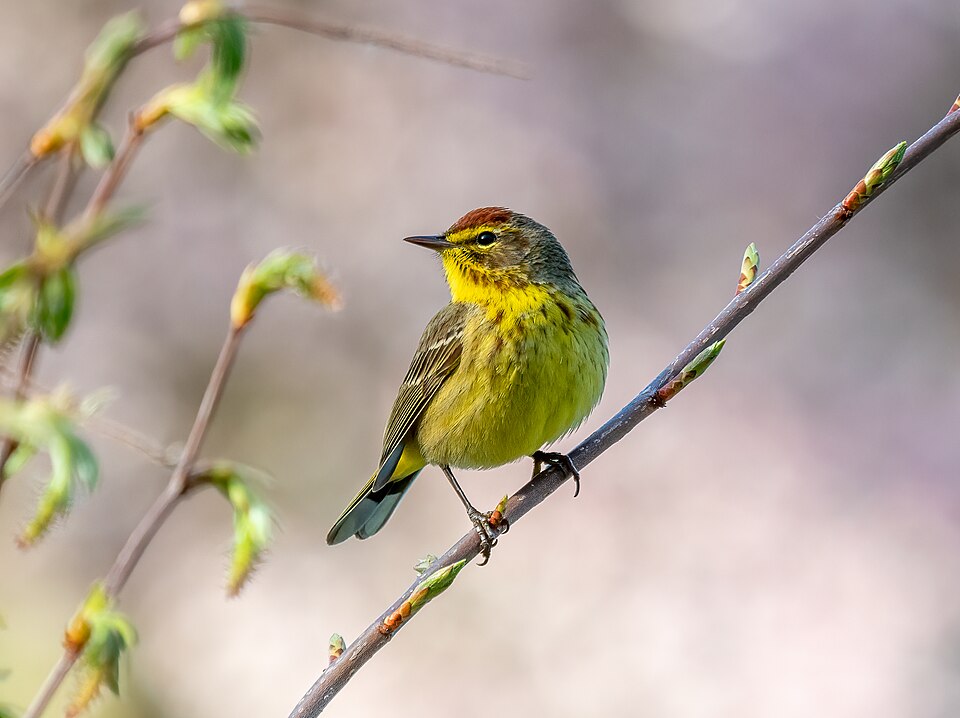
The Palm Warbler is one of the easiest wood-warblers to recognize, not because of dazzling colors but because of a single, unmistakable habit: it pumps its tail up and down almost constantly. Watch a small streaky bird bobbing its rear end as it walks along a fence line, a gravel path, or the weedy edge of a field, and you are almost certainly looking at a Palm Warbler. Despite its tropical-sounding name, this is a bird of cool northern bogs and spruce edges in the breeding season, with the "palm" tag coming from where early naturalists first encountered it on its Caribbean and Florida wintering grounds.
Among warblers, the Palm is refreshingly down-to-earth, both literally and figuratively. While most of its relatives flit through the high canopy, the Palm Warbler spends much of its time on or near the ground, often in open, scrubby, or grassy places where it is easy to see. That accessibility makes it a favorite of beginning birders during spring and fall migration, when flocks move through brushy fields, marsh edges, roadsides, and even suburban lawns across much of eastern and central North America.
The Palm Warbler is a small, slim, long-tailed warbler with a habit that gives it away before you ever check a single field mark. It frequently feeds on the ground or low in shrubs, walks rather than only hopping, and bobs its tail up and down in a steady rhythm. Combine that tail-wagging with yellow under the tail and a thin streaky look, and identification falls into place quickly.
| Tail behavior | Constant up-and-down tail pumping, the single most reliable field mark, visible even at a distance |
| Undertail coverts | Bright yellow beneath the tail in all plumages, a key clue on otherwise drab fall birds |
| Cap | Rusty chestnut crown in breeding plumage; duller and browner in fall and winter |
| Eyebrow & throat | Pale to yellow supercilium (eyebrow stripe); yellow throat in 'Yellow' eastern birds, whiter in 'Western' birds |
| Underparts | Faint reddish streaking down the sides of the breast; overall washed-out streaky appearance |
| Habitat & posture | Forages low or on the ground in open, weedy, or brushy areas rather than high in the canopy |
Male vs. female
Male and female Palm Warblers look essentially alike, and in the field they are not reliably separable. Breeding males may average slightly brighter, with a more sharply defined rusty cap and richer yellow below, but the overlap is broad and many females match males closely. There are two recognized subspecies groups that differ more obviously than the sexes do: the "Yellow" Palm Warbler of the East is yellow across the entire underside, while the duller "Western" Palm Warbler shows a whitish belly contrasting with its yellow undertail. Both groups still wag their tails and wear the same rusty breeding cap.
Juveniles
Fall immatures and nonbreeding adults are much drabber than spring birds. The rusty cap fades to a plain brown, the upperparts turn a muted grayish- or olive-brown, and the streaking on the breast becomes faint and blurry. At this season many beginners overlook the bird entirely or struggle to name it, but the bright yellow undertail coverts and the relentless tail-pumping remain dependable even on the dullest individual. Juveniles fresh out of the nest are buffy and softly streaked, and quickly molt toward the nonbreeding look before migrating south.
The Palm Warbler's song is a simple, dry, buzzy trill, a loose, slightly musical series often written as zee-zee-zee-zee-zee. It is weaker and less ringing than a Chipping Sparrow's trill and somewhat buzzier and slower, with the notes sometimes sounding a touch lazy or unevenly paced. It is not a showy song, and on the breeding grounds it can be easy to overlook against the sounds of a busy bog.
During migration you are far more likely to hear its call than its song: a sharp, dry tsick or chip note, often given as birds forage along the ground or flush from weedy edges. In flight, migrants give a thin, high seep. The combination of these soft chips, the tail-bobbing, and the open habitat usually clinches the identification long before any singing occurs.
Palm Warblers breed across the boreal zone of Canada and the far northern edge of the United States, favoring open, wet ground such as spruce bogs, muskeg, and the shrubby margins of peatlands. The breeding range stretches from the Maritime provinces and northern New England westward across central Canada toward the Northwest Territories and into parts of Alaska's interior.
They are strongly migratory and notably hardy for a warbler, being among the earliest spring and latest fall migrants. They winter mainly in the southeastern United States, especially Florida and the Gulf Coast, as well as the Caribbean, the Yucatan, and parts of Central America. During migration they pass through much of eastern and central North America, where brushy fields, marsh edges, lawns, and roadside scrub make them one of the more conspicuous and widespread migrant warblers.
Palm Warblers are primarily insectivores, taking small beetles, flies, ants, caterpillars, gnats, and other arthropods, along with spiders. Their feeding style sets them apart from most warblers: they spend much of their time on the ground or in low vegetation, walking and bobbing as they pick prey from the soil surface, grass stems, and leaf litter. They will also make short flycatching sallies after flying insects and glean from low branches and weed tops.
In fall and winter, when insects are scarcer, they broaden their diet to include small berries, seeds, and other plant matter. On the wintering grounds they readily forage in open lawns, weedy lots, and the edges of wetlands, often in loose association with other ground-feeding songbirds.
Palm Warblers nest on or very near the ground, an unusual trait among wood-warblers. The nest is a neat open cup built of grasses, weed stems, bark strips, and sedges, lined with finer materials such as fine grass and feathers, and is typically tucked into a clump of moss, at the base of a small spruce or tamarack, or hidden among low vegetation in a bog. This ground-level placement keeps the nest concealed in the dense, wet habitat the birds favor.
The female builds the nest and incubates the clutch, with the male helping to feed the young. Like many boreal songbirds, Palm Warblers generally raise a single brood per season, taking advantage of the short but productive northern summer before heading south early in fall.
The Palm Warbler is not a feeder bird in the usual sense, it will not visit a seed feeder or suet cage the way a chickadee or finch does. But it is one of the more approachable warblers, and you can absolutely encourage it to drop into your yard during migration if your property offers the open, low, weedy habitat it prefers.
- Leave a weedy edge. A patch of unmowed grass, weeds, or brushy border gives migrating Palm Warblers the low, open foraging ground they seek.
- Provide water. A ground-level or low birdbath, especially one with moving or dripping water, can draw them in to drink and bathe.
- Plant native shrubs and berry producers. Bayberry, wax myrtle, and similar fruiting plants offer fall and winter food, particularly in the Southeast where they winter.
- Skip the pesticides. A chemical-free lawn and garden supports the ground insects and spiders that make up the bulk of their diet.
- Watch in spring and fall. Your best odds are during migration, scan lawns, garden edges, and brush piles for a small streaky bird bobbing its tail.
- Keep some open ground. Unlike canopy warblers, Palm Warblers like to feed right on the surface, so a bit of bare or short-grass area near cover is ideal.
- Prairie Warbler: Also wags its tail, but is brighter yellow below with bold black side streaks and dark face markings, and lacks the rusty cap; favors scrubby thickets rather than open ground.
- Yellow-rumped Warbler: Shares fall habitat and a yellowish look, but shows a bright yellow rump patch (not yellow undertail), is bulkier, and does not constantly pump its tail.
- Cape May Warbler: Streaky like a dull Palm in fall, but feeds in trees rather than on the ground, lacks the steady tail-bobbing, and shows a thinner bill and finer breast streaks.
- Pine Warbler: Dull fall birds can look similar, but Pine Warblers are plumper, lack streaking on the back, stay in pines, and do not wag their tails.
Why does the Palm Warbler wag its tail?
The constant up-and-down tail pumping is a natural, habitual behavior rather than a response to any single trigger. Ornithologists think tail movements like this may help flush hidden insect prey or serve as a signal to other birds, but whatever the reason, it is so persistent that it is the single best way to identify a Palm Warbler at a glance.
Will Palm Warblers come to a bird feeder?
Not really. They are insect and ground foragers, so they ignore seed and suet feeders. You are far more likely to attract them with a weedy or brushy yard edge, a low birdbath, and a pesticide-free lawn where they can hunt insects on the ground during migration.
Where does the Palm Warbler get its name if it doesn't live in palm trees?
The name is a bit of a misnomer. Early naturalists described the bird from specimens collected on its Caribbean and Florida wintering grounds, where palms are common, so the 'palm' label stuck. In reality it breeds in cold northern bogs and spruce country, nowhere near a palm tree.
What is the difference between a 'Yellow' and 'Western' Palm Warbler?
They are two subspecies groups. The 'Yellow' Palm Warbler of eastern Canada is yellow across its entire underside, while the duller 'Western' Palm Warbler has a whitish belly that contrasts with its yellow undertail coverts. Both share the rusty breeding cap and the tail-wagging habit.
When is the best time to see a Palm Warbler?
Spring and fall migration are your best windows across most of North America. Palm Warblers are among the earliest spring migrants and latest fall migrants, so look for them in April and again from late September into October, foraging on lawns, field edges, and brushy roadsides. In the Southeast and Caribbean they are common all winter.