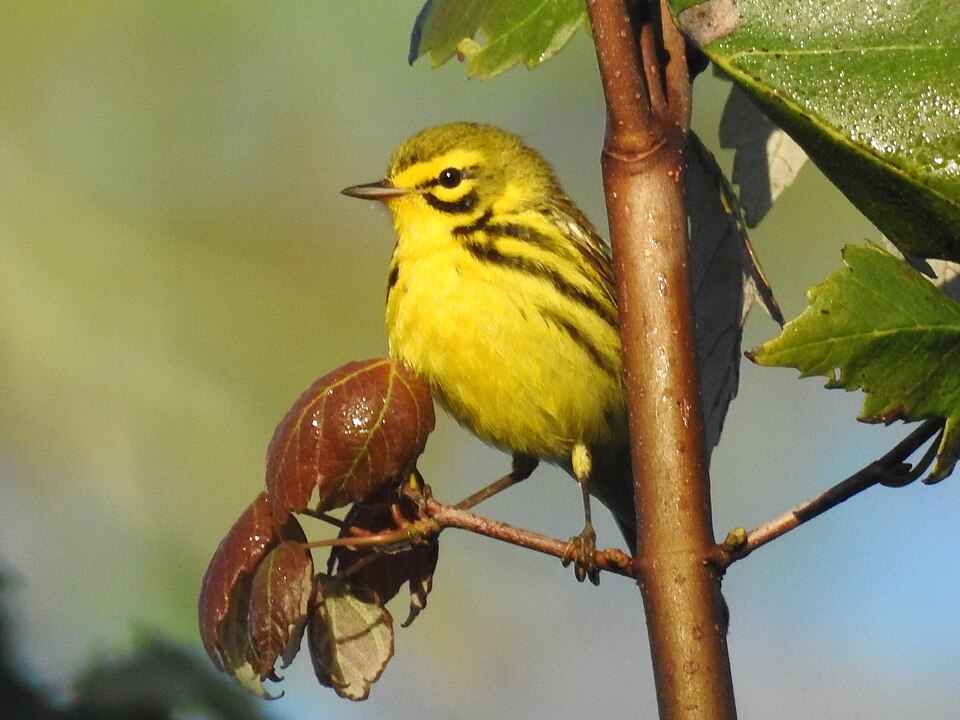
The Prairie Warbler is one of those birds whose name is a small joke on birders: it almost never lives on prairies. Instead, this bright little wood-warbler haunts scrubby second-growth, overgrown old fields, pine barrens, mangroves, and brushy clearings across the eastern United States. The name dates to a time when "prairie" was loosely applied to brushy openings, and it stuck. What you actually get is a sunny yellow bird with bold black accents that loves edges, sunlight, and tangled young growth.
It is a bird worth seeking out, both because it is genuinely handsome and because it has a personality. The Prairie Warbler bobs and pumps its tail almost constantly, sings a distinctive rising buzz that carries across a brushy field, and forages low enough that patient watchers usually get good looks. Its populations have declined over recent decades as old farm fields mature back into forest, making the scrubby habitats it depends on harder to find. Where the habitat is right, though, it can be one of the most reliable and rewarding warblers of the breeding season.
This is a small, slender warbler with a longish tail that it habitually wags and pumps. The overall impression is of a yellow bird with crisp black markings on the face and flanks, and a touch of warm color on the back. Size and shape are typical warbler, but the constant tail motion and the habit of foraging low in scrub are strong clues even before you see the field marks clearly.
| Underparts | Bright yellow below with bold black streaks confined to the sides and flanks, not across the breast |
| Face | Yellow face cut by a black line through the eye and a curving black crescent below the eye |
| Back | Olive-green, with chestnut or rufous streaks down the back (best seen on adult males) |
| Tail | Longish, frequently bobbed and pumped; shows white spots in the outer feathers |
| Wing | Two thin, pale yellowish wingbars, often faint |
| Behavior | Forages low in shrubs and scrub, constantly wagging its tail |
Male vs. female
The sexes look broadly similar, but adult males are the boldest birds: the black face lines are crisp and dark, the flank streaking is heavy, and the chestnut streaks on the back are well marked. Females are a softer version of the same pattern, with grayer, less contrasting face markings, thinner flank streaks, and reduced or nearly absent chestnut on the back. With a good look the back streaking is often the easiest clincher, since it is strongest on males and weakest on females and young birds.
Juveniles
Immature and first-fall birds are duller and grayer overall, with a washed-out face pattern, muted yellow underparts, and faint or absent flank streaking. First-fall females in particular can look quite plain, showing little more than a soft yellowish wash below, a vague pale eyering or face pattern, and no obvious back streaks. Even so, the persistent tail-wagging and the bird's preference for low scrubby cover usually give it away.
The song is the easiest way to find this bird and one of the most distinctive of any eastern warbler: a series of buzzy notes that climbs steadily up the scale, often written as zee-zee-zee-zee-zee-zee-zee, rising higher and faster toward the end. Once you have it in your ear, that ascending zippered buzz is unmistakable and carries well across a brushy field.
Calls include a sharp, slightly musical chip or tsip used in contact and mild alarm. Males sing persistently through the breeding season, often from an exposed perch on top of a shrub or sapling, which makes a singing bird relatively easy to track down compared with many skulking warblers.
Prairie Warblers breed across much of the eastern United States, from the Great Lakes and New England south through the Appalachians and the Southeast, favoring scrubby old fields, regenerating clearcuts, pine barrens, and dry brushy hillsides. A distinct, non-migratory population lives year-round in the mangroves of Florida and the Florida Keys.
Most birds are migratory, leaving the breeding grounds in late summer and fall to winter in the Caribbean, the Bahamas, and along the coasts of Florida and parts of Central America and the West Indies. Spring migrants return to the southern states as early as March and reach the northern breeding range through April and May.
Prairie Warblers are primarily insect eaters. They glean caterpillars, beetles, true bugs, spiders, and other small invertebrates from leaves, twigs, and the outer branches of shrubs and saplings. Much of their foraging happens low, within a few feet to a dozen feet off the ground, in keeping with their love of scrubby habitat.
Foraging is active and acrobatic: the bird hops along branches, peers under leaves, hovers briefly to pluck prey from foliage, and sometimes sallies out to snatch flying insects. The constant tail-pumping is thought to help flush or startle hidden prey into moving. In winter, especially in mangrove and tropical habitats, the diet remains mostly insects and spiders.
The nest is a tidy, compact cup built in a shrub or small tree, usually fairly low to the ground in dense scrubby cover. The female does most of the building, weaving plant fibers, bark strips, and grasses and lining the cup with finer material such as plant down, hair, and feathers.
A typical clutch is three to five eggs, pale with darker speckling concentrated toward the larger end. The female incubates for roughly eleven to fifteen days, and both parents feed the nestlings, which leave the nest in another week to ten days. Prairie Warblers frequently fall victim to Brown-headed Cowbird brood parasitism, and pairs will sometimes raise more than one brood in a season where conditions allow.
The Prairie Warbler is not a feeder bird, so you won't lure it in with seed or suet. It is an insect-eating habitat specialist, and the way to "attract" it is to offer the kind of place it needs: sunny, scrubby, early-successional growth. If you have acreage or live near old fields, brushy edges, or regenerating woodland, you have a real chance at hosting them in spring and summer.
- Protect or create early-successional habitat, overgrown fields, brushy edges, and young regenerating woods are exactly what this species needs.
- Resist the urge to mow or clear every brushy patch; scrubby tangles and saplings are prime breeding cover, not waste ground.
- Keep native shrubs and young trees that support caterpillars and other insects, the warbler's main food.
- Avoid broad-spectrum insecticides, which remove the prey base these birds depend on.
- Listen for the rising buzzy song in May and June along sunny brushy edges, that's your best cue that they are present.
- In Florida, look for the resident population in mangrove habitat, where they live year-round.
- Magnolia Warbler: Also yellow below with streaks, but streaks form a heavy 'necklace' across the breast, and it shows a broad white tail band and gray crown rather than a tail-wagging, low-scrub habit.
- Yellow Warbler: Uniformly yellow with reddish breast streaks on males; lacks the black face lines and chestnut back streaks, and does not pump its tail the way a Prairie Warbler does.
- Palm Warbler: Another habitual tail-wagger, but browner overall with a rusty cap (in breeding plumage) and a yellow undertail; favors ground and open edges rather than the Prairie's leafy scrub face pattern.
- Pine Warbler: Similar yellowish tones but plainer faced, bigger billed, and lacking bold black face lines and flank streaks; sticks to pines rather than low scrub.
Why is it called a Prairie Warbler if it doesn't live on prairies?
The name is a historical accident. When the bird was described, 'prairie' was used loosely for brushy openings and scrubby clearings, which is exactly the kind of habitat it favors. It actually avoids true open grassland, preferring scrub, old fields, pine barrens, and mangroves.
What does a Prairie Warbler's song sound like?
It's a distinctive series of buzzy notes that rises steadily up the scale, often written as zee-zee-zee-zee climbing higher and faster toward the end. Once learned, that ascending buzz is one of the easiest warbler songs to recognize.
How do I tell a Prairie Warbler from a Yellow Warbler?
Look at the face and back. The Prairie Warbler has bold black face lines (through and below the eye) and chestnut streaks on the back, plus it constantly wags its tail. The Yellow Warbler is more uniformly yellow with reddish breast streaks and lacks the black face markings and tail-pumping habit.
Will Prairie Warblers come to my bird feeder?
No. They eat insects and spiders, not seed or suet, so feeders won't attract them. The way to host them is to provide scrubby, early-successional habitat such as brushy edges and young regenerating growth.
Are Prairie Warblers endangered?
They are listed as Least Concern overall, but populations have declined significantly over recent decades. The main reason is loss of the scrubby, early-successional habitat they need as old fields mature back into forest. They also suffer heavily from cowbird nest parasitism.