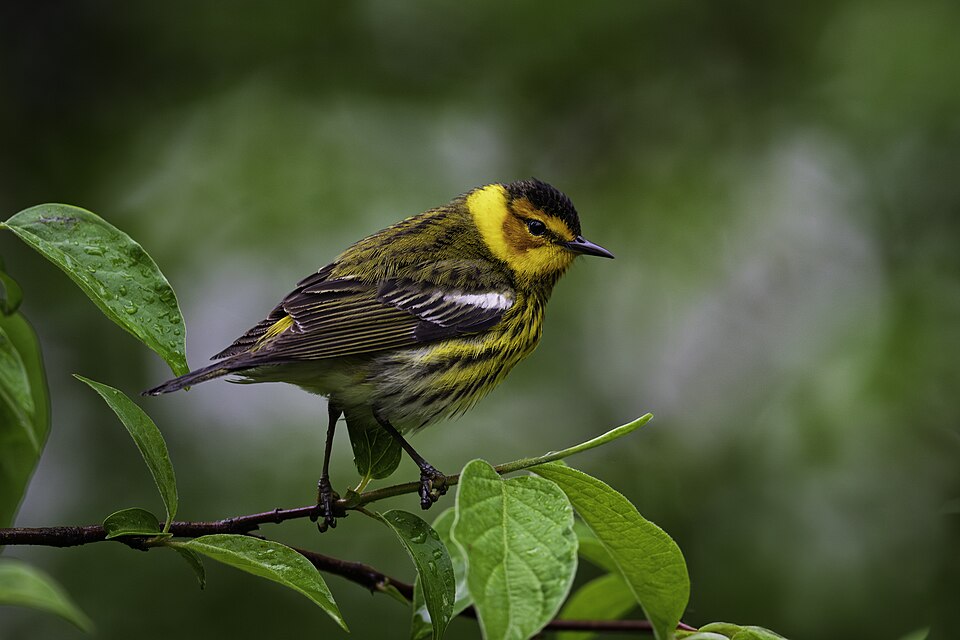
The Cape May Warbler is one of those birds whose name fits it poorly: it was first collected near Cape May, New Jersey, but it doesn't breed there and may go decades without showing up. Its true home is the great northern spruce-fir forest stretching across Canada, where its fortunes rise and fall with one tiny insect, the spruce budworm. When budworm outbreaks erupt, Cape May Warblers raise big families and their numbers swell; when the outbreaks crash, so do they. Few songbirds are so tightly bound to a single food source.
In spring a breeding male is a small jewel: a chestnut cheek patch framed by yellow, a finely streaked tiger-striped breast, and a flash of yellow at the neck. It is also one of the few warblers built to drink. Its tongue is semi-tubular and slightly curled at the tip, an adaptation almost unique among wood-warblers, letting it sip nectar on the wintering grounds and lap sap and fruit juice the rest of the year. For backyard birders, it's mostly a thrilling migration bird, glimpsed high in a flowering tree or among warbler-flecked treetops in May and again in fall.
This is a small, compact warbler with a fairly short tail and a thin, slightly downcurved bill. On migration it often forages high in the canopy, so the first thing many birders notice is its streaky underparts and a yellowish or greenish rump as it shifts among the leaves. Breeding males are unmistakable; females and fall birds are far plainer and take more practice to nail down.
| Breeding male face | Bright chestnut cheek patch surrounded by yellow, the single best field mark |
| Underparts | Yellow breast finely streaked with black, giving a 'tiger-striped' look |
| Wing | Bold white wing patch (male) or two thin wingbars (female) |
| Rump | Yellow-green rump and yellow neck-side patch, visible as it moves |
| Bill | Thin, sharp, slightly decurved, finer than most warblers |
| Tail | Short, with white spots in the outer tail feathers |
Male vs. female
The sexes look quite different in breeding plumage. The male is the showy one: chestnut cheeks, a yellow collar and breast washed in heavy black streaks, a yellow-green crown and rump, and a large white panel in the wing. The female is a muted version of the same pattern, she keeps the streaked yellowish underparts and the yellow neck-side patch, but lacks the chestnut cheek, shows two narrow white wingbars instead of a solid patch, and is generally grayer and greener overall. The yellowish rump and faint streaking are good shared marks that help separate even dull birds from other warblers.
Juveniles
Fall immatures are the real identification challenge and a classic "confusing fall warbler." They are gray-green above and dingy whitish to pale yellow below, with diffuse blurry streaking on the sides and a plain face lacking the chestnut. The key is to look for the yellow-green patch on the side of the neck and rump, the fine streaking, the thin pointed bill, and the unstreaked dull undertail. Even the drabbest individual usually shows a hint of greenish-yellow on the neck sides that points you to Cape May.
The song is extraordinarily high and thin, a series of very short, sharp notes on nearly one pitch, often written as seet-seet-seet-seet or tsee-tsee-tsee-tsee. It is so high-frequency that many birders, especially as hearing ages, simply can't hear it; it sits right at the upper edge of human range and is easy to overlook even in a quiet spruce woods.
Call notes are equally high, thin, sibilant tsip or see notes given in migration and on the wintering grounds. Because the song carries so little and the notes are so faint, this species is often detected by sight long before sound.
Cape May Warblers breed across the boreal forest of Canada, from the Northwest Territories and Alberta east through Ontario, Quebec, and the Maritimes, dipping into the northern edge of the United States in places like Minnesota, Michigan, Maine, and northern New England. They favor mature spruce and balsam fir, especially where spruce budworm is active.
They are long-distance migrants that winter primarily in the West Indies, the Greater Antilles, Bahamas, and surrounding islands, with smaller numbers reaching the Caribbean coast and southern Florida. During migration they pass through much of the eastern United States, and they are seen in good numbers in spring (chiefly May) and fall (late August into October). Numbers in any given year can vary dramatically with budworm-driven population swings.
On the breeding grounds, Cape May Warblers are insect specialists, and spruce budworm caterpillars are the prize. During outbreaks they gorge on budworm and raise unusually large broods, which is why their populations track this insect so closely. They glean caterpillars, beetles, flies, and other arthropods from spruce and fir foliage, often working high in the crown.
What sets this warbler apart is its unusual semi-tubular, slightly curled tongue, which lets it drink. In migration and on the wintering grounds it readily takes nectar from flowers, sips sap from sapsucker wells, and laps the juice of fruit and berries. This sweet tooth makes it one of the most likely warblers to be drawn to flowering trees and even to nectar or fruit offerings.
Nesting takes place high in conifers. The female builds a compact cup of moss, fine twigs, and grasses lined with hair and feathers, typically placed near the top of a spruce or fir, often tight against the trunk and well concealed in dense foliage, frequently 30 to 60 feet up or higher. The high, hidden placement makes the nest one of the harder warbler nests to find.
Clutches are relatively large for a warbler, especially during budworm years, when extra food allows females to lay more eggs and fledge more young. The female does the incubating, and both parents feed the nestlings. Pairs typically raise a single brood per season in the short northern summer.
The Cape May Warbler is not a typical seed-feeder bird, but it is one of the more "attractable" warblers because of its sweet tooth. You won't get it on a sunflower feeder, but you can improve your odds during migration with the right plantings and offerings.
- Plant or keep flowering and fruiting trees and shrubs, migrants are drawn to nectar and ripening fruit far more than to feeders.
- Offer oranges, grape jelly, or a nectar (sugar-water) feeder; unlike most warblers, Cape May will occasionally sip from these, especially in spring.
- Leave a shallow, moving water source like a dripper or fountain, warblers respond strongly to the sound of dripping water.
- Keep mature conifers and a diversity of native plants that host insects, which the bird hunts during stopovers.
- Watch for them around sapsucker wells, where they lap sap, a reliable spot in spring.
- Time your watching for May and again late August through October, when migrants move through.
- Yellow-rumped Warbler: Also shows a yellow rump and side patches, but is larger, lacks the fine tiger-striping on a yellow breast, and shows a clean yellow flank patch rather than a chestnut cheek.
- Magnolia Warbler: Heavily streaked yellow underparts too, but has a gray head, white eye-arc/eyeline, and a distinctive black-and-white tail pattern with a white tail band.
- Palm Warbler: Streaky and yellowish below with a rusty cap in spring, but constantly pumps its tail and forages low and on the ground, unlike the canopy-loving Cape May.
- Pine Warbler: Dull fall Pines can look similar, but Pine Warblers are larger, have a thicker bill, plainer faces, and lack the yellow-green neck patch and fine breast streaking.
Why is it called a Cape May Warbler if it doesn't live at Cape May?
The species was first described from a specimen collected near Cape May, New Jersey, in the early 1800s, and the name stuck. In reality it only passes through that area on migration and doesn't breed there, it nests far to the north in Canada's boreal spruce forests. After its naming, it reportedly wasn't recorded at Cape May again for many decades.
How do I tell a Cape May Warbler from a Yellow-rumped Warbler?
Both show a yellowish rump, but the Cape May has finely streaked 'tiger-striped' yellow underparts and, in breeding males, a bright chestnut cheek patch. The Yellow-rumped is larger and grayer, with bold yellow patches on the crown, sides, and rump and a cleaner, less heavily streaked breast. The thin, slightly downcurved bill of the Cape May is also a good clue.
Will a Cape May Warbler come to my feeder?
It won't eat seed, but it's one of the few warblers that may visit a nectar (hummingbird) feeder, orange halves, or grape jelly, thanks to its specialized tongue. Your best bets are flowering and fruiting plants, a water dripper, and watching during spring and fall migration rather than expecting it at a standard seed feeder.
When is the best time to see a Cape May Warbler?
During migration. In spring, May is prime time across the eastern U.S. as birds head to the boreal forest. In fall, look from late August through October. Outside migration, breeders are in northern Canada's conifer forests and wintering birds are in the West Indies.
Why do Cape May Warbler numbers change so much from year to year?
Their populations are tied to spruce budworm outbreaks. When budworm caterpillars are abundant, Cape May Warblers feast, raise larger-than-usual broods, and their numbers boom. When outbreaks collapse, food becomes scarce and their numbers drop, so you may see many one year and few the next.