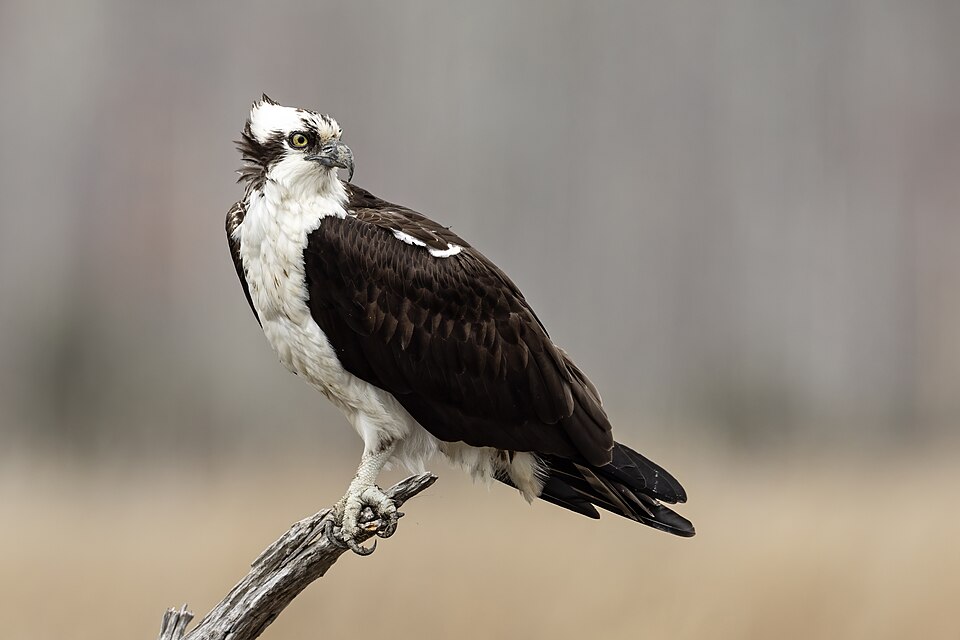
The Osprey is one of the most widespread birds of prey on Earth, found on every continent except Antarctica, and almost always near water. Unmistakable in flight with its long, crooked wings and dark wrist patches, it is a large raptor built for a single specialty: catching live fish. Watch a coastline, reservoir, or slow river long enough and you may see one hovering on beating wings before folding up and crashing feet-first into the surface, often disappearing in a burst of spray.
Once devastated across North America and Europe by the pesticide DDT, which thinned their eggshells, Ospreys have made one of the great conservation comebacks. Bans on DDT and the spread of artificial nesting platforms have allowed populations to rebound dramatically, and today the bird is a familiar sight on channel markers, utility poles, and purpose-built nest poles in wetlands and along shorelines. Birders love them for being big, dramatic, and easy to find once you know where to look.
The Osprey is a large raptor with a distinctive flight silhouette: long, narrow wings held with a noticeable bend at the wrist, giving an M or gull-like shape when seen head-on. It is brown above and strikingly white below, with a white head crossed by a broad dark stripe through the eye.
| Upperparts | Uniform dark brown back and wings, contrasting sharply with the white underside |
| Head | White crown and face with a bold dark brown line running through and behind the yellow eye |
| Underwing | Pale, with a prominent dark patch at the wrist (carpal) and barred flight feathers |
| Wing shape | Long and angled, bent at the wrist; often held in a shallow M or gull-wing in flight |
| Breast | White, often with a faint brownish necklace band (heavier in females) |
| Feet | Pale, powerful, with a reversible outer toe and spiny soles for gripping slippery fish |
Male vs. female
Males and females look very similar and are best told apart by size and the breast pattern. Females are noticeably larger and heavier, and most show a more pronounced brown "necklace" of streaking across the upper breast. Males tend to have a cleaner, whiter breast with little or no necklace, and a slimmer build. The difference is easiest to judge when a pair is together at the nest; on a lone bird, size is hard to gauge and the necklace is the more reliable clue.
Juveniles
Juvenile Ospreys closely resemble adults but look subtly scaly above: the brown back and wing feathers are tipped with buff or pale edges, giving a spangled, freckled appearance that wears away by their first spring. Young birds also show a more orange-red eye rather than the bright yellow of adults, and the dark necklace tends to be more diffuse. These differences are best seen at close range or in good photos.
Ospreys are vocal around the nest, and their calls are far more delicate than you might expect from such a large raptor. The most common sound is a series of clear, high, whistled notes, often rendered cheep-cheep-cheep or yewk-yewk-yewk, rising slightly in pitch and intensity. When alarmed by an intruder near the nest, birds give a sharper, more insistent rising whistle sometimes described as a "guard call."
A distinctive vocalization is the slow, plaintive "sky-dance" call males give during courtship flights, a drawn-out, almost mournful whistling as they hang and flutter high overhead carrying a fish or nesting material. Once you learn the thin, piping quality of Osprey calls, they carry surprisingly far across open water.
The Osprey is nearly cosmopolitan, breeding across North America, Europe, Asia, and Australia, and wintering into Central and South America, Africa, and southern Asia. In North America it breeds from Alaska and Canada south through much of the United States wherever there is suitable water and nesting structure, with strong populations along the Atlantic and Gulf coasts, the Great Lakes, and western rivers and reservoirs.
Most northern Ospreys are strongly migratory, leaving breeding grounds in late summer and fall to winter in the tropics; satellite-tracked birds make remarkable journeys of thousands of miles, with some crossing open ocean. Populations in Florida, the Gulf Coast, and other mild regions are largely resident year-round. Spring migrants typically return to northern breeding sites between March and May.
The Osprey is almost entirely a fish-eater, and it is superbly adapted for the job. It hunts by flying or hovering 30 to 100 feet over open water, scanning for fish near the surface, then plunging feet-first in a dramatic dive, sometimes submerging completely. Reversible outer toes and rough, spiny pads on the soles let it grip slippery prey, and it carries fish head-forward to cut wind resistance as it flies off to a perch or nest.
It takes a wide variety of fish depending on what is locally abundant, generally favoring those weighing a few ounces up to about a pound. Ospreys hunt fresh and salt water alike: coastal bays, estuaries, lakes, rivers, and reservoirs. After a successful catch, a bird will often shake off water in mid-air with a quick shudder before settling to eat. Fish make up the overwhelming majority of the diet, with only rare reports of other small prey.
Ospreys build large, bulky stick nests in exposed, elevated sites with a commanding view: dead trees, cliffs, and increasingly human structures like utility poles, channel markers, cell towers, and dedicated nesting platforms. Pairs often reuse and add to the same nest year after year, and long-established nests can grow into enormous mounds of sticks lined with bark, grass, seaweed, and an assortment of found debris.
The female typically lays three eggs (sometimes two to four), cream colored and heavily blotched with brown. Both parents share duties, with the female doing most of the incubating while the male delivers fish, though incubation lasts roughly five weeks and the young fledge about seven to eight weeks after hatching. Ospreys generally raise a single brood per year and often mate for life, returning to the same nest site and partner across seasons.
The Osprey is not a backyard or feeder bird in any conventional sense, since it eats only live fish caught from open water. You won't draw one to a seed feeder or suet cage. But if you live near a lake, river, estuary, or coast, there are real ways to encourage and enjoy them.
- If you own or manage waterfront property near suitable fishing waters, install an Osprey nesting platform on a tall pole well away from disturbance; these are responsible for much of the species' recovery.
- Leave dead trees and tall snags standing near water where safe, as they make ideal natural nest and perch sites.
- Support clean, healthy fish populations by protecting wetlands and reducing pollution and runoff, since Ospreys need abundant surface-feeding fish.
- Watch from a respectful distance and avoid disturbing active nests, especially during incubation and early chick-rearing when adults are most sensitive.
- Visit reservoirs, coastal bays, and large rivers in spring and summer; scan channel markers, snags, and platforms where Ospreys habitually perch and nest.
- Bald Eagle: Much larger and bulkier with broad plank-like wings; adults have a fully white head and tail, and immatures are mottled but lack the Osprey's clean white underparts and dark wrist patches.
- Northern Harrier: Slimmer with a long tail and a bold white rump patch; flies low over marshes with wings in a shallow V, rather than hovering high over open water.
- Red-tailed Hawk: A soaring buteo with broad rounded wings and a short tail; lacks the bent-wing silhouette, dark eye stripe, and white underparts, and is not tied to water.
- Great Black-backed Gull: Can suggest an Osprey at a distance over water, but gulls have unbarred wings, no dark wrist patch, and a very different flight; check head and underwing pattern.
Is an Osprey an eagle or a hawk?
Neither, exactly. The Osprey is so distinctive that it is placed in its own family, Pandionidae, separate from true hawks and eagles. It is sometimes called the 'fish hawk' or 'sea hawk,' but genetically it stands apart as the sole living member of its genus, Pandion.
How can I tell an Osprey from a Bald Eagle?
Ospreys are smaller and slimmer with crooked, bent wings, clean white underparts, and a dark stripe through the eye. Bald Eagles are far bulkier with flat, plank-like wings; adults have an all-white head and tail, while young eagles are dark and mottled. Ospreys also hover and plunge for fish, which eagles rarely do.
Do Ospreys eat anything besides fish?
Almost never. Fish make up the overwhelming majority of an Osprey's diet, and their toes, talons, and oily, water-shedding feathers are all specialized for catching slippery prey from open water. Other prey is taken only very rarely when fish are unavailable.
Why do Ospreys carry fish facing forward?
After a catch, an Osprey shifts its grip so the fish points head-first into the wind. This streamlines the load and reduces drag, making the fish easier to carry over long distances back to a perch or nest.
Will an Osprey come to a backyard bird feeder?
No. Ospreys eat only live fish and ignore seed, suet, and other feeder foods. The best way to attract them is to live near productive water and provide a tall nesting platform or leave dead snags standing for perching and nesting.