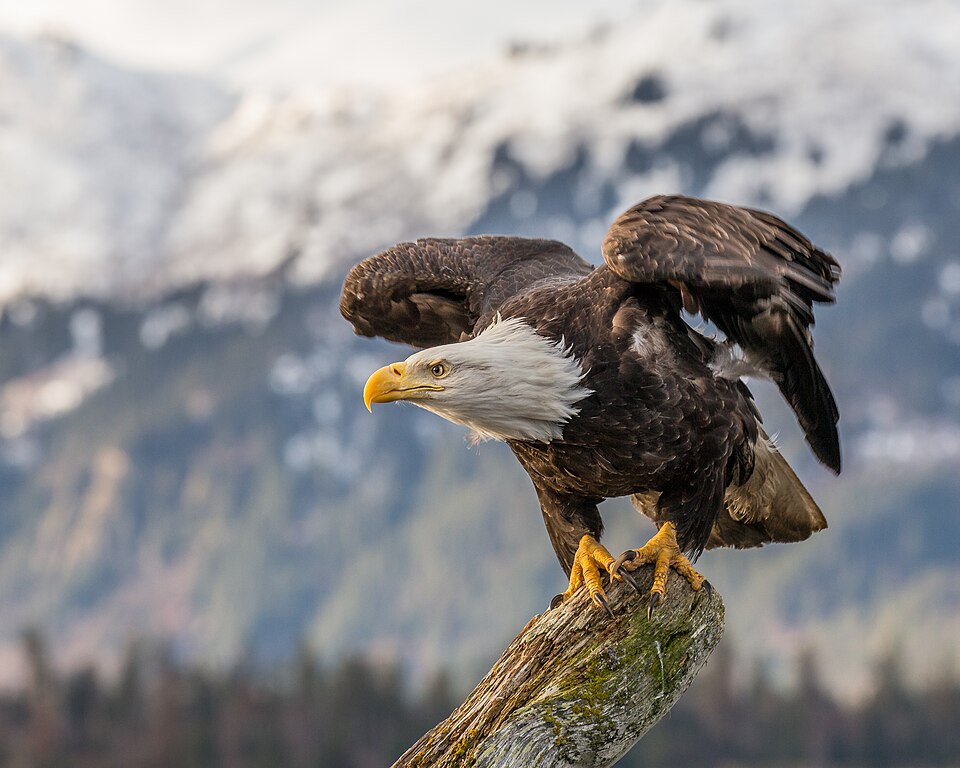
Few birds are as instantly recognizable as the adult Bald Eagle, with its snowy-white head and tail set against a dark chocolate-brown body and a heavy, hooked yellow bill. Despite the name, the bird is not bald at all; the word comes from an old meaning of "white-headed." It is a sea eagle, a member of the genus Haliaeetus, and it lives its life close to water, where fish make up the bulk of its diet. For most of North America, spotting one soaring over a lake, river, or coastline is a genuine thrill, even though the species has become far more common in recent decades.
The Bald Eagle's story is also one of conservation's great successes. Hit hard by hunting, habitat loss, and especially the pesticide DDT, which thinned eggshells and crashed nesting success, the species nearly vanished from the lower 48 states by the mid-twentieth century. After DDT was banned and protections were put in place, populations rebounded dramatically, and the bird was removed from the U.S. endangered species list in 2007. Today eagles nest in every mainland state and are a familiar sight along many waterways, reservoirs, and coasts.
This is a massive raptor with a large head, a heavy bill, and broad, plank-like wings held flat in soaring flight. The size alone usually rules out most other birds. Adults are unmistakable, but the brown, mottled juveniles fool many people and take a full four to five years to earn the classic white head and tail.
| Head & tail (adult) | Clean white head and white tail contrast sharply with the dark brown body and wings. |
| Bill & eyes | Large, deep, hooked bill is bright yellow, matching the yellow eyes and feet of adults. |
| Size | One of the largest birds in North America; females are noticeably bigger than males. |
| Wings in flight | Broad and rectangular, held flat (not in a V) when soaring, with long 'fingered' primaries. |
| Body (adult) | Uniform dark chocolate-brown body and wing coverts with no pale patches. |
| Juvenile | Dark overall with messy white blotches on the underwings and belly; dark bill and eyes. |
Male vs. female
Males and females look identical in plumage; both adults have the white head and tail and dark body. The only reliable difference in the field is size: females are noticeably larger and heavier than males, often by around a quarter to a third in bulk. When a pair is perched side by side at a nest, the size gap can be obvious, with the female outweighing her mate, but a lone bird usually cannot be sexed without a comparison.
Juveniles
Young Bald Eagles look nothing like the adults and are a frequent source of confusion. First-year birds are dark brown overall with irregular white mottling splashed across the belly, underwings, and back, plus a dark bill and dark eyes. Over the next several years they pass through messy, blotchy "transitional" plumages, often showing a pale belly, a dark band through the eye, and a whitening tail before finally acquiring the full white head and tail and yellow bill at four to five years of age.
For such an imposing bird, the Bald Eagle's voice is famously underwhelming. It does not give the powerful, ringing scream that movies and commercials attach to it; that dramatic cry is almost always a dubbed-in Red-tailed Hawk. Instead, eagles produce a thin, high, stuttering series of chirps and whistles, often written as kleek-kik-kik-kik or a weak, creaky kee-kee-kee.
Calls are most often heard around the nest or when birds interact, including a chattering greeting between mates and a more rapid call during territorial disputes. The overall effect is surprisingly gull-like or even gosling-like, far softer and squeakier than the regal appearance would suggest.
Bald Eagles are found only in North America, ranging from Alaska and Canada south through the lower 48 states into northern Mexico. They are tied to water and reach their highest densities in Alaska, the Pacific Northwest, the Great Lakes, the Chesapeake Bay region, and Florida. Coastlines, large rivers, lakes, and reservoirs all hold birds.
Movements depend on the freezing of water. Eagles that nest in the far north move south in winter when lakes and rivers ice over, while many in milder regions stay put year-round. In winter, large numbers concentrate at open water below dams and at salmon runs, and dozens may gather where food is abundant, making cold-weather river stretches some of the best places to see them.
Fish are the heart of the Bald Eagle's diet, and the bird is built to snatch them from at or near the surface with its long talons. It hunts from a high perch or while soaring, swooping down to grab prey without fully submerging. Common catches include salmon, trout, catfish, shad, and other fish, along with waterfowl and water birds, small mammals, and turtles.
Eagles are also unapologetic opportunists. They readily scavenge carrion and feast on winter-killed fish and animal carcasses, and they are notorious pirates, harassing Ospreys and other birds until they drop their catch. This kleptoparasitism, combined with their willingness to eat carrion, is part of why Benjamin Franklin famously grumbled about the bird's "bad moral character."
Bald Eagles build the largest tree nests of any North American bird. A pair typically chooses a tall, sturdy tree near water and adds sticks year after year, so an old nest can grow to enormous size, several feet across and weighing as much as a small car after many seasons of use. Both members of the pair, which usually mate for life, help build and maintain the nest, lining the bowl with softer grass, moss, and other material.
The female lays one to three eggs, most often two, which both parents incubate for about 35 days. The young grow quickly and fledge at around 10 to 12 weeks, though the parents continue to feed and watch over them for some time afterward. Pairs raise a single brood per year and often return to the same nest territory season after season.
The Bald Eagle is not a backyard or feeder bird, and there is no birdseed or feeder that will bring one to your yard. It is a large predator that needs open water and ample fish, so attracting eagles is really about being near the right habitat rather than setting out food.
- Live or visit near water. Lakes, rivers, reservoirs, and coastlines with healthy fish populations are where eagles spend their time.
- Look in winter at open water. Below dams, at salmon runs, and along unfrozen river stretches, eagles often concentrate in surprising numbers.
- Protect large trees near shorelines. If you own waterfront property, leaving tall, sturdy perch and nest trees standing is the single best thing you can do.
- Never put out meat or fish to bait them. Feeding raptors habituates them to people, draws them to roadsides, and is illegal in many places.
- Scan high and watch for mobbing. Crows and gulls noisily harassing a big dark bird overhead are often pointing you straight to an eagle.
- Golden Eagle: A true eagle of open and mountainous country; adults are all dark brown with a golden nape and never have a white head or tail. Juvenile Goldens show clean white patches at the base of the flight feathers and tail, unlike the messy, blotchy white of young Bald Eagles.
- Osprey: Also a fish-eater near water but much smaller and slimmer, with a white belly, a dark eye stripe on a white head, and wings held in a distinctive M-shaped kink in flight.
- Turkey Vulture: Often mistaken for a soaring eagle at a distance, but it holds its wings in a shallow V (dihedral), teeters as it soars, and has a tiny bare red head and two-toned underwings.
- Red-tailed Hawk: Much smaller with a shorter, broader tail; its piercing scream is the call wrongly attributed to the Bald Eagle in films and ads.
Are Bald Eagles actually bald?
No. Their heads are fully feathered in white. The name comes from an older meaning of 'bald' that meant 'white-headed' or marked with white, not hairless.
Why doesn't a Bald Eagle sound powerful like in the movies?
The dramatic scream you hear in films and commercials is almost always a Red-tailed Hawk dubbed over the eagle. Real Bald Eagles give thin, high, stuttering chirps and whistles that sound surprisingly weak for such a large bird.
How can I tell a juvenile Bald Eagle from a Golden Eagle?
Young Bald Eagles are dark with messy, irregular white blotches scattered over the belly and underwings. Juvenile Golden Eagles are cleaner, with sharply defined white patches at the base of the flight feathers and a white-based tail, plus a golden wash on the nape.
When does a Bald Eagle get its white head?
Not until it is about four to five years old. Until then, immatures go through several years of brown, blotchy plumages before finally developing the clean white head and tail and bright yellow bill of an adult.
What do Bald Eagles eat?
Mostly fish, which they snatch from at or near the water's surface. They also take waterfowl, small mammals, and turtles, scavenge carrion, and often steal fish from Ospreys and other birds.