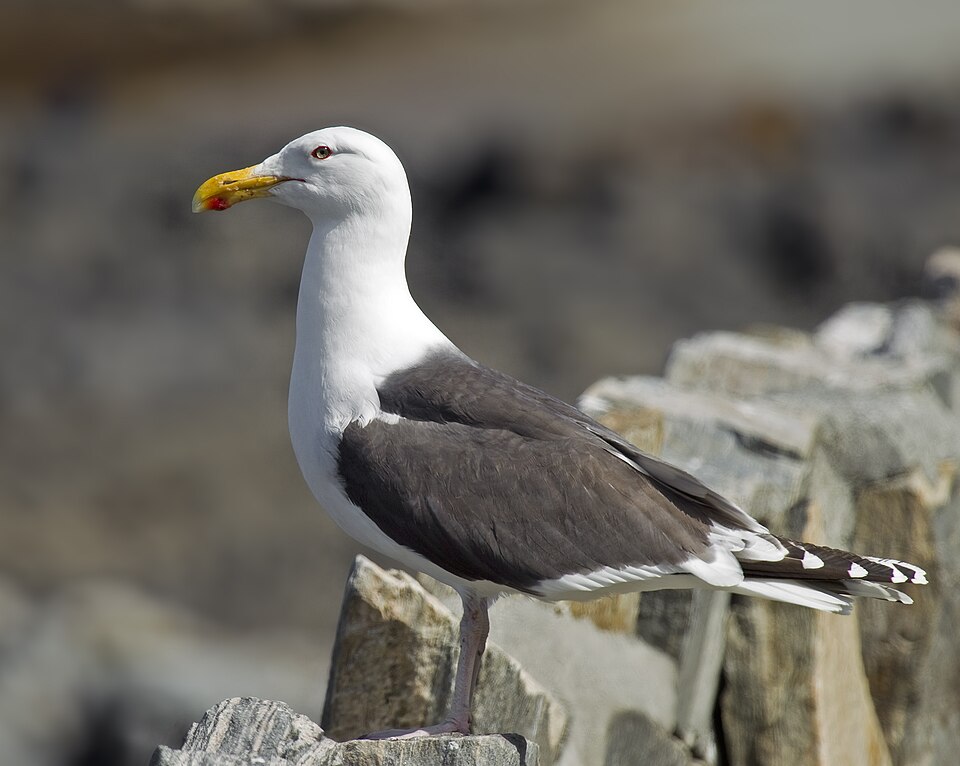
The Great Black-backed Gull is the heavyweight of the gull world, the largest gull on Earth, with a wingspan that can top five and a half feet and a build closer to a small goose than to the dainty gulls people picture stealing fries at the beach. Adults are unmistakable up close: a brilliant white head and body set against a slate-black back and wings, anchored by a massive yellow bill with a red spot. Birders sometimes nickname it the "GBBG" or simply "the boss," because where it shows up, smaller gulls give way.
This is a bird of the cold North Atlantic. It patrols rocky coastlines, harbors, estuaries, and offshore islands on both sides of the ocean, from eastern Canada and the northeastern United States across to Iceland, the British Isles, and Scandinavia. Powerful and opportunistic, it is as comfortable scavenging a fish carcass on a jetty as it is killing and swallowing a puffin whole. Once heavily persecuted, it rebounded strongly through the twentieth century and is now a familiar, if intimidating, presence along northern shores.
Size is the first clue and often all you need. A Great Black-backed Gull towers over Herring Gulls in a mixed flock, standing taller, broader-chested, and notably bigger-headed, with a heavy, almost bull-necked profile. The wingbeats are slow and deliberate, and on the ground the bird looks blocky and deep-bellied. Pair that brute size with a truly black back and you have one of the more straightforward large gulls to name.
| Back & wings | Adults show a genuinely black (slate-black) mantle, darker than any other large gull in the North Atlantic |
| Bill | Very large, deep yellow with a bright red spot near the tip of the lower mandible |
| Legs | Pale pink, a useful split from yellow-legged dark-backed gulls of other regions |
| Head & body | Clean white, with little or no streaking even in winter, giving a crisp, contrasty look |
| Wingtips | Black primaries with bold white spots ('mirrors'), the outermost tips broadly white |
| Overall size | Massive, clearly larger and bulkier than nearby Herring Gulls, with a heavy head and chest |
Male vs. female
Males and females look identical in plumage, same black back, white body, yellow bill, and pink legs, so you cannot reliably sex them by color in the field. The difference is size and structure: males average noticeably larger, with heavier, deeper bills and bulkier heads, while females are a touch smaller and finer-featured. This is most obvious when a mated pair stands side by side, but for a lone bird, sexing by eye is guesswork.
Juveniles
Young Great Black-backed Gulls take about four years to reach full adult plumage and look very different along the way. First-year birds are checkered black-and-white above with a crisply patterned, almost "frosty" back, a clean whitish head, an all-dark bill, and a sharply defined black tail band against a white rump, a cleaner, more contrasting look than the muddy brown young Herring Gulls. As they age, the black mantle feathers come in gradually and the bill begins to pale from the base, so second- and third-year birds show a patchwork of black, gray, and brown before settling into the clean adult pattern.
The voice matches the bird: deep, hoarse, and commanding. The signature call is a guttural, far-carrying laugh often written as kaa-ga-ga or owk-owk-owk, noticeably lower and rougher than the higher, more bugling cry of a Herring Gull. When agitated or defending a nest, it gives short, barking uk or kow notes.
During the dramatic "long call" display, head thrown back, then bowed forward, it delivers a slow series of deep, throaty laughs that carry across a harbor. Overall, if a gull's call sounds surprisingly deep and gravelly, almost dog-like, you are likely hearing a Great Black-backed.
The Great Black-backed Gull is a North Atlantic specialist. In North America it breeds from Labrador, Newfoundland, and the Canadian Maritimes south along the coast through New England to the mid-Atlantic, with the breeding range having expanded southward over the past century. On the European side it nests around Iceland, the Faroes, the British Isles, the coast of France, and across Scandinavia and northwestern Russia.
It is only partially migratory. Northernmost breeders move south for winter, spreading down the Atlantic Seaboard as far as Florida and along European coasts into Iberia, while many birds in milder areas stay put year-round. In winter it is largely coastal but also gathers at harbors, landfills, and large reservoirs and rivers a short way inland. It is genuinely rare away from the coast in most of the interior of the continent.
Few birds are less picky. The Great Black-backed Gull is a powerful generalist predator and scavenger that eats fish, crabs, shellfish, marine worms, carrion, and refuse, and it readily steals food from other birds (kleptoparasitism) rather than catching its own. It will drop mussels and crabs onto rocks to crack them open and patrols the tide line and fishing harbors for anything edible.
What sets it apart is its appetite for live prey. It regularly kills and swallows whole the eggs, chicks, and even adults of other seabirds, puffins, terns, smaller gulls, ducklings, and will take rats, fish discards behind trawlers, and the unguarded young of just about anything in a colony. On seabird islands it is a significant predator, and a single Great Black-backed can hold a stretch of beach or breakwater as its personal territory.
Great Black-backed Gulls nest on the ground, typically on rocky islands, coastal cliffs, salt-marsh hummocks, or the gravel rooftops of waterfront buildings. They often nest singly or in loose, scattered groups rather than dense colonies, and a dominant pair will frequently claim the highest, most commanding spot, sometimes right in the middle of a Herring Gull colony, where they prey on their neighbors' chicks. Both members of the pair build the nest, a bulky scrape lined with grass, seaweed, and debris.
The female lays a typical clutch of three olive-brown, dark-blotched eggs, and both parents share incubation for roughly four weeks. The chicks are mobile soon after hatching but stay near the nest, fed by both adults, and they fledge at around seven to eight weeks. Pairs raise a single brood per year and are long-lived, often returning to the same territory season after season; banded birds have lived well past twenty years.
This is not a backyard or feeder bird, and you should not try to attract it. The Great Black-backed Gull is a coastal predator that finds its own food in harbors, on beaches, and at sea, it has no use for a seed feeder, and deliberately feeding gulls causes real problems. If you want to enjoy them, the move is to go where they already are.
- Head to the coast in winter. Harbors, jetties, fishing piers, and breakwaters along the northern Atlantic are reliable spots, especially where boats clean their catch.
- Scan landfills and large reservoirs. In winter, gull flocks gather at open water and dumps inland of the coast, and the GBBG often stands out as the biggest bird present.
- Look for the bully. In a mixed gull flock, find the largest, blackest-backed bird that other gulls avoid, that behavior alone often pins the ID.
- Do not feed them. Tossing bread or scraps trains gulls to mob people and harms the birds; enjoy them at a distance instead.
- Bring a scope to seabird islands. From a boat tour or a coastal overlook you can watch their predatory side as they patrol tern and puffin colonies.
- Herring Gull: Smaller and slimmer with a pale gray (not black) back and yellow legs; lacks the brute size and bull head of the Great Black-backed.
- Lesser Black-backed Gull: Much smaller and slighter with a dark slate-gray back (paler than truly black) and bright yellow legs rather than pink.
- Great Black-backed Gull is sometimes confused with Slaty-backed Gull: A Pacific species with a slightly paler back, pink legs, and a different wingtip pattern; ranges barely overlap.
What is the largest gull in the world?
The Great Black-backed Gull is the largest gull species in the world, reaching up to about 31 inches long with a wingspan that can exceed five and a half feet. It dwarfs familiar species like the Herring Gull and even bullies them away from food.
How do I tell a Great Black-backed Gull from a Herring Gull?
Look at size and back color. The Great Black-backed is much larger and bulkier with a genuinely black back, a massive yellow bill, and pink legs. The Herring Gull is smaller and slimmer with a pale gray back and yellow legs.
Do Great Black-backed Gulls eat other birds?
Yes. They are powerful predators that regularly kill and swallow other seabirds whole, including puffins, terns, ducklings, and the chicks and eggs of smaller gulls. On seabird islands they can be a serious predator of colony nestlings.
Why are the legs pink instead of yellow?
Pink legs are a normal field mark for the Great Black-backed Gull and a handy way to separate it from the similar-looking Lesser Black-backed Gull, which has bright yellow legs. The pink shows on adults and most immatures.
Where can I see a Great Black-backed Gull?
They are coastal birds of the North Atlantic. In North America, look along the shoreline from Atlantic Canada south through New England and the mid-Atlantic, especially around harbors, jetties, and fishing piers in winter. They are also common around the British Isles and Scandinavia.