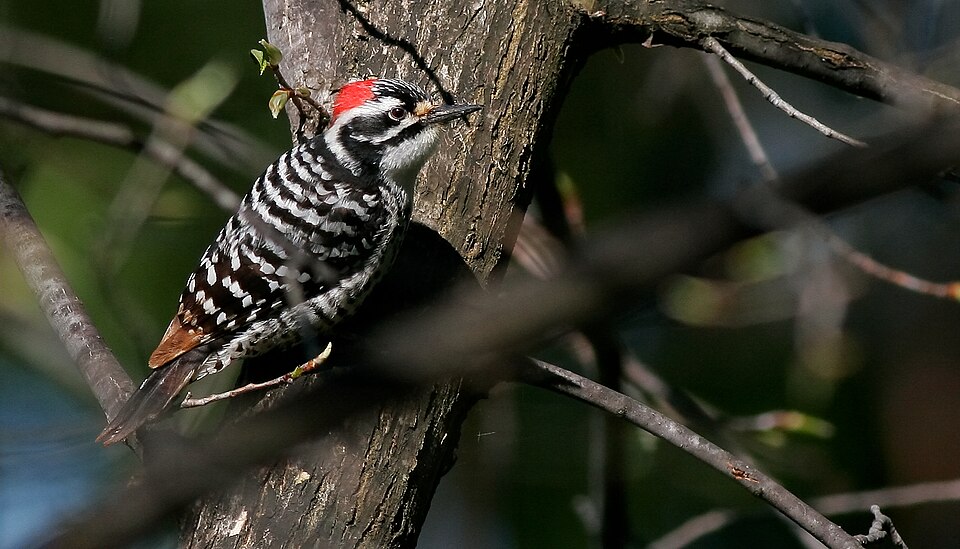
Nuttall's Woodpecker is a small, neatly barred black-and-white woodpecker that is almost synonymous with California's oak woodlands. Roughly the size of a Downy Woodpecker but longer-tailed and busier in manner, it spends its days hitching up trunks and clambering along the undersides of oak limbs, tapping and probing the bark for insects. For many residents of the Golden State, the dry rattle of a Nuttall's working through a live oak is one of the most familiar woodland sounds.
The species was named for the English-American naturalist Thomas Nuttall, and it has one of the most restricted ranges of any North American woodpecker, found almost entirely within California with a narrow toehold in northern Baja California. It is closely tied to oaks but is no fussy specialist when it comes to feeding: it readily works willows, sycamores, and streamside trees, and it has adapted comfortably to suburban neighborhoods and parks where mature trees remain. Where its range bumps against that of the very similar Ladder-backed Woodpecker, the two occasionally hybridize.
This is a compact woodpecker with a relatively long tail, a straight chisel-tipped bill, and the upright, climbing posture typical of the family. The back is crisply barred or "laddered" in black and white, the underparts are pale and lightly spotted, and the face wears a bold black-and-white pattern. Size and silhouette place it between a Downy and a Hairy Woodpecker.
| Back | Black with narrow white horizontal bars (a ladder pattern), but the upper back near the neck is solid black |
| Face | Bold black-and-white stripes; broad black malar (mustache) and a striped cheek |
| Underparts | Whitish to grayish, washed buff, with black spotting along the sides and flanks |
| Crown | Black in both sexes; males show a red patch on the back of the head |
| Bill | Straight, chisel-tipped, and fairly long for the bird's size |
| Outer tail | White with black barring, often visible as it spreads the tail against a trunk |
Male vs. female
The sexes look alike except on the head. The male has a distinct red patch across the back of the crown and nape, while the front of the crown stays black. The female lacks any red entirely, showing an all-black crown. This is the single most reliable way to sex a Nuttall's Woodpecker in the field, and it is usually easy to see when the bird turns its head while foraging.
Juveniles
Juveniles look messier and less crisply marked than adults, with somewhat duller, smudgier barring and underparts. Notably, young birds of both sexes often show some red on the crown, typically toward the front and center rather than the clean rear-of-crown patch of adult males. This juvenile red fades and reorganizes as the bird molts into adult plumage, so a red-fronted youngster should not be confused for a separate species.
The most distinctive vocalization is a loud, rolling rattle that drops slightly in pitch and slows toward the end, often written as prrrrrt or a descending kweek-kweek-kweek-kweek series. It is louder and more musical than the comparable call of the Ladder-backed Woodpecker. A common contact note is a sharp, single pit or pitik, sometimes doubled, given as the bird moves through the canopy.
Like all woodpeckers, Nuttall's also "sings" by drumming. Its drum is a short, steady burst against a resonant branch or trunk, used to advertise territory and attract a mate, most often in late winter and spring. Pairs frequently stay in loose contact through soft rattles and calls as they forage near one another.
Nuttall's Woodpecker is a year-round resident with one of the smallest ranges of any U.S. woodpecker. It is found through most of California west of the deserts and the high Sierra, from the foothills and oak woodlands of the interior to wooded canyons, riparian corridors, and suburban areas near the coast. Its range extends just south into northwestern Baja California, Mexico.
The species is essentially non-migratory; individuals hold territories throughout the year and do not undertake long seasonal movements. There may be modest local shifts in elevation or habitat use after breeding, but a Nuttall's seen in summer is very likely to be in the same neighborhood come winter. Where its eastern edge meets desert scrub, it gives way to the closely related Ladder-backed Woodpecker.
Nuttall's Woodpecker is primarily an insectivore. It gleans, probes, and flakes bark to find beetle larvae, ants, caterpillars, true bugs, and other arthropods, often working along the undersides and outer branches of oaks where many other woodpeckers seldom go. It taps and excavates only shallowly compared with larger woodpeckers, relying as much on surface gleaning as on hammering.
While insects dominate the diet, the species also takes some plant material, including berries, small fruits, and occasionally seeds. Despite living among oaks, it is not a heavy acorn eater the way the Acorn Woodpecker is; its oak association is more about the rich insect life and foraging surfaces that oaks provide than about the acorns themselves.
Nuttall's Woodpeckers are cavity nesters. The pair excavates a fresh hole each year, usually in a dead limb or the soft, decaying wood of a willow, oak, sycamore, alder, or cottonwood, often along a stream or in a wooded canyon. The entrance is small and round, and the cavity is unlined except for the wood chips left at the bottom.
Both parents share the work. They excavate together, take turns incubating the eggs (the male typically handles the night shift), and both feed the nestlings. The young remain in the cavity for several weeks before fledging, after which the adults continue to feed and guide them for a time as they learn to forage on their own.
Nuttall's Woodpecker is not primarily a feeder bird, but it does visit yards within its range, especially those with mature oaks, willows, or sycamores nearby. With the right offerings and habitat, backyard birders in California have a genuine chance of hosting one.
- Offer suet, the single most reliable draw; plain or insect-blend suet in a cage feeder is best.
- Keep or plant native oaks, willows, and sycamores, which provide the bark-foraging surfaces and insects this species depends on.
- Leave dead limbs and snags standing where safe; they supply both foraging sites and potential nest cavities.
- Provide a shallow, moving water source such as a dripper or birdbath, which woodpeckers will use to drink and bathe.
- Try shelled peanuts or peanut butter blends as a secondary food; avoid relying on seed feeders, which this bird largely ignores.
- Skip insecticides on trees and shrubs, since the insects you spray are exactly what draws and feeds this woodpecker.
- Ladder-backed Woodpecker: Nearly identical but a desert bird; has more extensive white barring reaching the upper back, a more buff face, and red covering the whole crown in males. Ranges barely overlap.
- Downy Woodpecker: Has a solid white back stripe (not laddered), cleaner white underparts, and a tiny stubby bill; male's red is a small rear patch.
- Hairy Woodpecker: Larger with a long, stout bill and a solid white back; lacks the black-and-white ladder pattern entirely.
- Acorn Woodpecker: Shares oak woodlands but is unmistakable, with a clownish white-and-black face, red cap, and habit of storing acorns in granary trees.
How do I tell a Nuttall's Woodpecker from a Downy Woodpecker?
Look at the back. Nuttall's has a black-and-white ladder (horizontal barring), while Downy has a clean white stripe down the center of the back. Nuttall's also has a bolder striped face and a longer bill, and in California oak woodlands it is the more likely of the two on outer oak limbs.
Where can I see a Nuttall's Woodpecker?
Almost exclusively in California, plus a sliver of northwestern Baja California. Look in oak woodlands, riparian corridors with willows and sycamores, wooded foothill canyons, and even suburban parks and yards with mature trees throughout the year.
Do Nuttall's Woodpeckers come to bird feeders?
They can, though they are not dedicated feeder birds. Suet is the best bet, with peanuts and peanut-butter blends as secondary options. They largely ignore seed feeders, so habitat with oaks and willows matters more than the feeder itself.
How can I tell a male from a female Nuttall's Woodpecker?
Check the back of the head. Males have a red patch across the rear crown and nape; females have an entirely black crown with no red. Juveniles of both sexes can show some red toward the front of the crown, which can be confusing until they molt.
What sound does a Nuttall's Woodpecker make?
Its signature call is a loud, rolling rattle that descends and slows at the end, plus sharp single pit notes as it forages. It also drums in short steady bursts in late winter and spring to claim territory and attract a mate.