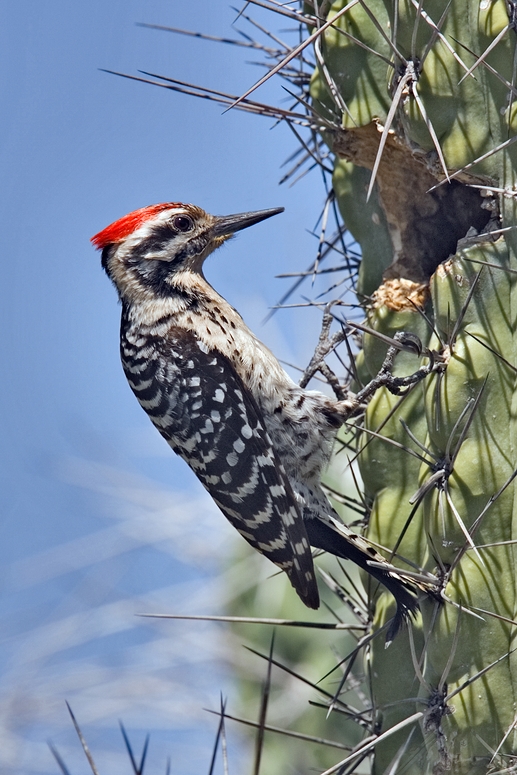
The Ladder-backed Woodpecker is the little black-and-white woodpecker of the arid Southwest, a bird perfectly at home among cactus, mesquite, and creosote where you might not expect to find a woodpecker at all. Its back is crossed by neat horizontal bars that look exactly like the rungs of a ladder, which is where the name comes from. At barely the size of a Downy Woodpecker, it is easy to overlook until you hear its sharp pik call ringing out across the desert scrub or catch it hitching up the trunk of a Joshua tree.
This is a true desert specialist, and for birders in Texas, New Mexico, Arizona, and southern California it is one of the most reliable woodpeckers of dry country. It thrives in habitats that hold few other woodpeckers, thornscrub, agave and yucca stands, riparian washes, and even suburban neighborhoods with mature desert landscaping. Where its range overlaps with the very similar Nuttall's Woodpecker in California, sorting the two out is a classic field-guide puzzle, but across most of its range the Ladder-backed is simply the small woodpecker of the cactus country.
This is a small, compact woodpecker with a relatively short bill and a stiff, propped tail. The clinching field mark is the back: a bold pattern of black-and-white horizontal barring that runs like a ladder from the shoulders down. The face is boldly striped in black and white, and the underparts are dingy white to buff, lightly spotted and barred along the flanks.
| Back | Crisp black-and-white horizontal barring, the diagnostic ladder pattern running the length of the back |
| Face | Bold black-and-white striped face with a distinctive pattern of stripes through the eye and across the cheek |
| Crown | Males show a red crown (often with black flecking at the front); females have a solid black crown |
| Underparts | Dingy white to pale buff, finely spotted on the breast and barred along the flanks |
| Size & shape | Small and compact, about Downy-sized, with a fairly short bill and stiff propped tail |
| Outer tail | White outer tail feathers barred with black, visible as the bird hitches and flies |
Male vs. female
Males and females are easy to tell apart with a clear look at the head. The male wears a red crown, bright red across the back of the crown, usually with some black-and-white flecking toward the forehead, so the red can look like a red cap pushed back on the head. The female lacks any red entirely; her crown is solid glossy black. Otherwise the sexes are alike in size, the ladder-backed pattern, and the striped face, so a quick glance at the top of the head is all you need.
Juveniles
Juveniles look much like adults but appear a bit duller and more loosely patterned, with somewhat messier barring on the back and underparts. Interestingly, both young males and young females can show some dull red on the crown when they first fledge, so a red-tinged crown on a scruffy summer bird does not necessarily mean it is a male. By their first winter, females have molted to the clean black crown and males to the brighter, more defined red, making them easy to sex again.
The most common call is a sharp, crisp pik or jik, very similar to a Downy Woodpecker's note but often drier and harder, a good sound to learn since it is usually what reveals the bird. When agitated or interacting, it gives a descending, rattling whinny that tumbles down in pitch, a ji-ji-ji-ji-jeer that trails off, much like other small woodpeckers in the genus.
Both sexes also drum on dead limbs, cactus ribs, and resonant snags. The drum is a short, fairly even roll, not as long or as musical as a sapsucker's, used to advertise territory and attract mates, mostly in late winter and spring.
The Ladder-backed Woodpecker is a year-round resident across the arid Southwest, from southeastern California, southern Nevada, and Arizona east through New Mexico and much of Texas, then south through most of Mexico into Central America as far as Nicaragua. It reaches the edges of southwestern Oklahoma and the southern Great Plains as well. Within the United States it is essentially a bird of the desert Southwest and the Mexican borderlands.
This is a non-migratory species, birds hold their territories all year, so a pair you find in summer is likely the same pair you can return to in winter. There is little seasonal movement beyond local wandering by young birds dispersing to find their own ground.
Ladder-backed Woodpeckers eat mostly insects and other small invertebrates, especially the larvae of wood-boring beetles, ants, caterpillars, and the eggs and larvae they pry from bark crevices, dead branches, agave and yucca stalks, and the woody ribs of cactus. They forage by hitching along trunks and limbs, probing, flaking off bark, and tapping to locate hidden grubs, but they spend a lot more time than most woodpeckers working small twigs, stems, and even low shrubs and cactus rather than big tree trunks, an adaptation to a land with few large trees.
They also take some plant material, including cactus fruit and occasionally seeds, and will sip at the sap and pulp of agave. This flexible, opportunistic diet is part of what lets them thrive in country too dry and sparse for most woodpeckers.
Like all woodpeckers, Ladder-backeds are cavity nesters and excavate a fresh hole each year. The pair chisels a cavity in a dead branch or trunk, in the woody stalk of an agave or yucca, in a mesquite or willow, in fence posts, and sometimes even in large cactus or utility poles. The entrance is small and round, and the cavity is unlined except for a bed of wood chips left at the bottom.
The female typically lays 2-5 white eggs, often around 3-4. Both parents share incubation, which lasts about 13 days, and both feed the nestlings. Young fledge a few weeks after hatching and may stay near the parents briefly before dispersing. Most pairs raise a single brood per year, occasionally attempting a second in the southern part of the range.
Yes, within its desert range, the Ladder-backed Woodpecker will visit yards, especially where native desert plants are kept. It is not as feeder-focused as a Downy, but it does come to suet and a few other offerings, particularly in winter and in neighborhoods bordered by natural scrub.
- Offer suet, it is the single best draw, especially in cooler months. A no-melt suet holds up better in desert heat.
- Provide shelled peanuts, peanut butter blends, or sunflower seed; ladder-backeds will sample these even though insects are their staple.
- Keep native desert vegetation, mesquite, agave, yucca, ocotillo, and cactus, which supplies the insects and nesting stalks they actually depend on.
- Leave dead limbs and snags standing where it is safe to do so; they are prime foraging and nest-excavation sites.
- Put up a small woodpecker nest box with a roughly 1.25-inch entrance hole on a mesquite or post; they will sometimes accept one.
- Provide a shallow water source or dripper, reliable water is a powerful magnet for any bird in arid country.
- Nuttall's Woodpecker: Nearly identical, but a California oak-woodland specialist with more black on the upper back and a different face pattern; the two overlap narrowly in southern California, where habitat (oak vs. desert) is the best clue.
- Downy Woodpecker: Similar size and tiny bill, but Downy has a solid white back patch (no ladder barring) and a plain white face; rare in true desert habitats.
- Hairy Woodpecker: Larger with a much longer bill and a clean white back stripe rather than ladder barring; prefers more wooded country.
- Gila Woodpecker: Shares desert range but is much larger, with a tan head and underparts and zebra-barred back; males show a small red crown patch.
How do I tell a Ladder-backed Woodpecker from a Downy Woodpecker?
Look at the back. The Ladder-backed has bold black-and-white horizontal barring (the ladder) across its entire back, while the Downy has a solid white stripe down the center of its back. The Ladder-backed also has a more boldly striped face. Habitat helps too: in the desert Southwest, the small woodpecker you see is far more likely to be a Ladder-backed.
Is it a male or female Ladder-backed Woodpecker?
Check the crown. Males have a red crown (often flecked with black toward the forehead), and females have a solid black crown. Everything else about the two looks the same.
Where do Ladder-backed Woodpeckers live?
They are year-round residents of the arid Southwest, southeastern California, Arizona, New Mexico, much of Texas, and the southern edge of the Great Plains, and range south through most of Mexico into Central America. They favor desert scrub, thornscrub, mesquite, agave and yucca stands, and desert washes.
Will Ladder-backed Woodpeckers come to a backyard feeder?
They can, especially to suet, and also to peanuts and sunflower in some yards. They are most likely to visit homes that border desert scrub and keep native plants. They spend most of their time foraging for insects on cactus, agave stalks, and small branches, so they are less feeder-dependent than a Downy.
What sound does a Ladder-backed Woodpecker make?
Its common call is a sharp, hard pik or jik note, much like a Downy's but drier. When excited it gives a descending rattling whinny that drops in pitch. Both sexes also drum short, even rolls on dead branches and cactus ribs in late winter and spring.
Do Ladder-backed Woodpeckers nest in cactus?
They can. They excavate fresh cavities each year in dead branches, mesquite, willow, fence posts, and the woody stalks of agave and yucca, and they will sometimes use large cactus. The cavity is unlined apart from a bed of wood chips, and both parents incubate the 2-5 white eggs.