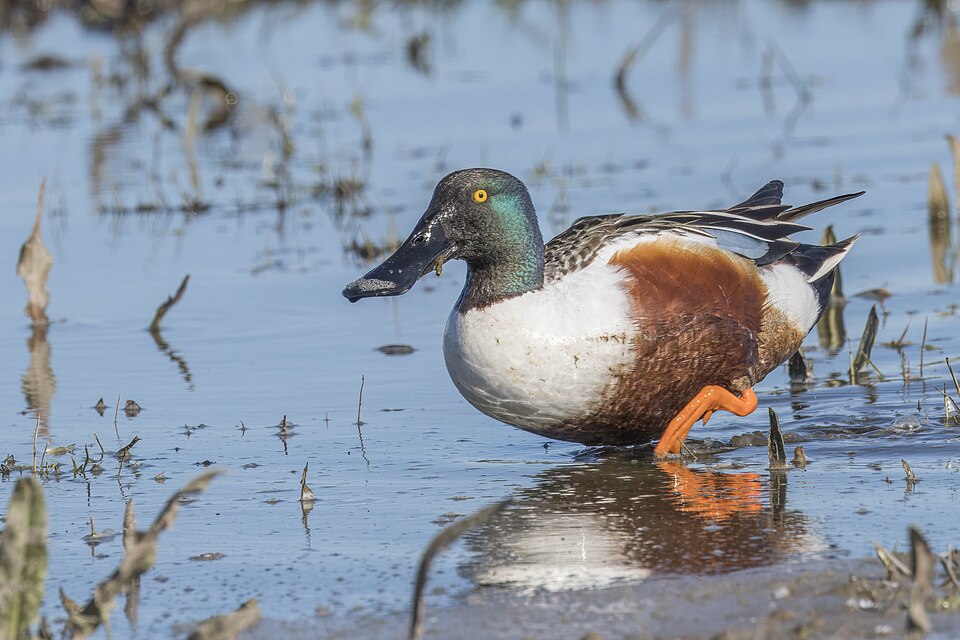
Few ducks are as instantly recognizable as the Northern Shoveler. Even a beginner squinting across a marsh can pick it out by its bill alone, an oversized, spoon-shaped affair that looks almost comically large for the bird's head. That bill is not just for show. It is lined with hundreds of fine comb-like structures called lamellae that let the shoveler strain tiny aquatic creatures and seeds straight out of the water, a feeding style that sets it apart from nearly every other North American dabbler.
Breeding males are unmistakable in good light: a bottle-green head, a white chest, and warm chestnut flanks make for one of the boldest color combinations on the water. Females and young birds are mottled brown like many ducks, but the giant bill always gives them away. Shovelers are widespread across the Northern Hemisphere, breeding on shallow prairie wetlands and wintering on marshes, flooded fields, and sewage lagoons from the southern United States to Central America, Africa, and southern Asia. They are abundant and adaptable, and a patient look at a winter pond will often turn up a flotilla of them circling slowly, bills down, feeding in their unmistakable way.
The Northern Shoveler is a medium-sized dabbling duck, a touch smaller and lower-slung than a Mallard, with a front-heavy profile created by that enormous bill. On the water it tends to ride low with the bill angled down toward the surface, and in flight the head looks pulled down and forward, giving it a distinctly "nose-heavy" silhouette.
| Bill | Huge, long, spatula-shaped and widening toward the tip; the single best field mark on any plumage |
| Breeding male head | Glossy iridescent green, often looking dark until light catches it |
| Body (male) | White breast and rump contrasting with bright chestnut sides and belly |
| Eye | Bright yellow in adult males; brown in females and young |
| Wing patch | Powder-blue forewing with a green speculum, flashed in flight (shared with Blue-winged Teal) |
| Female | Mottled warm brown overall, with an orange-tinged bill and the same oversized shape |
Male vs. female
Breeding males are easy: green head, white chest, chestnut flanks, and a piercing yellow eye. Females are mottled brown and resemble several other female dabblers, but the bill settles it instantly, being far larger and broader than any other duck's. Female shovelers also show a warm orange wash along the edges of the dark bill, and the same powder-blue patch on the forewing as the male. In late summer and early fall, males molt into a drab "eclipse" plumage that looks female-like, but they keep the yellow eye and the blue wing patch, and traces of chestnut and gray often linger to betray them.
Juveniles
Juvenile Northern Shovelers look much like adult females, mottled brown and streaky, but tend to be plainer and grayer with less distinct markings. Young males begin acquiring adult color through their first fall and winter, often appearing in a patchy in-between state with partial chestnut on the flanks, blotches of green coming in on the head, and an eye that is gradually brightening from brown toward yellow. The giant bill is full-sized early on, so even scruffy young birds are easy to name.
Northern Shovelers are not especially vocal, and they lack the loud, ringing quack of a female Mallard. The drake gives a soft, low, two-note call often written as took-took or thunk-thunk, a muffled, woody sound that carries surprisingly far on calm water. It is most often heard during courtship in late winter and spring.
The female gives a quiet, raspy quack and a descending series of quack notes when flushed or with young, thinner and less forceful than a Mallard's. In feeding flocks the most common sound is simply the wet, sucking, slurping noise of dozens of bills sieving the surface together.
The Northern Shoveler is a long-distance migrant with a vast range across the Northern Hemisphere. In North America it breeds mainly across the prairie pothole region of the northern Great Plains and the Canadian prairies, north into Alaska and the boreal west, favoring shallow, productive wetlands. It winters across the southern United States, Mexico, and Central America, and is common on coastal marshes, freshwater impoundments, and even managed wastewater ponds.
Old World populations breed across northern Europe and Asia and winter south to Africa, the Middle East, the Indian subcontinent, and Southeast Asia. Spring and fall migration brings big concentrations to staging wetlands; outside the breeding season shovelers are highly social and often gather in tight, slowly rotating feeding flocks.
The shoveler's whole body is built around its feeding method. The broad bill and dense lamellae act as a sieve: the duck swims forward with its bill skimming the surface or just below it, pumping water through and filtering out tiny floating food. Its diet leans heavily on small aquatic invertebrates such as water fleas, copepods, insect larvae, and tiny crustaceans, along with seeds and bits of aquatic vegetation. Animal matter becomes especially important for females building eggs.
Shovelers often feed in a remarkable cooperative behavior, with a group swimming nose-to-tail in a tight circle. The spinning stirs up food from below and concentrates it for the whole flock. They will also up-end like other dabblers in shallow water, but the surface-straining, head-down skim is by far their signature move.
Northern Shovelers nest on the ground, usually in short grass or low vegetation within a few hundred feet of water. The female chooses the site and builds a simple shallow scrape, lining it with grasses and a thick layer of her own down feathers for insulation. Nests are often surprisingly exposed compared with those of some other ducks.
She lays a clutch of roughly 9 to 12 pale buff or olive eggs and incubates them alone for about 23 to 25 days. The drake typically abandons the female partway through incubation. Ducklings are precocial, leaving the nest within a day of hatching and feeding themselves under the hen's watch, fledging at roughly six to seven weeks of age. Shovelers raise a single brood per year, with renesting if an early clutch is lost.
The Northern Shoveler is a wetland duck, not a backyard or feeder bird, so you will not lure it to a seed feeder. That said, you can absolutely attract or encounter them with the right water habitat and a little effort.
- Look for shallow, food-rich water. Shovelers favor shallow marshes, flooded fields, retention ponds, and even wastewater treatment lagoons where tiny invertebrates are abundant.
- Time it for migration and winter. Across most of the lower United States, the easiest time to find them is from fall through early spring when wintering flocks gather.
- If you manage a pond, keep portions shallow and avoid steep, hard edges; productive, slightly mucky shallows full of invertebrates are what they want.
- Skip the bread. Their filter-feeding diet of tiny aquatic life means handouts do nothing for them; let them feed naturally.
- Watch for the spinning flocks. A slowly rotating circle of head-down ducks is a near-certain sign of feeding shovelers and a great way to confirm an ID at a distance.
- Mallard: Male also has a green head, but the Mallard is bulkier with a yellow (not green) head sheen difference, a normal-sized bill, and a gray body with chestnut breast, the reverse of the shoveler's white-breast, chestnut-flanks pattern.
- Blue-winged Teal: Shares the powder-blue forewing patch, but is much smaller, has a normal small bill, and the male shows a slate-gray head with a white facial crescent rather than a green head.
- Cinnamon Teal: Male is rich rusty-red overall and also shows a blue wing patch, but it is far smaller with a normal-length bill; female teal are tiny next to a shoveler and lack the giant spatulate bill.
- Gadwall: Female-plumaged shovelers can suggest a Gadwall at a glance, but Gadwall have a slim normal bill, a white belly patch, and a square white speculum rather than the shoveler's blue forewing and oversized bill.
How do I identify a Northern Shoveler?
Look at the bill first. The Northern Shoveler has a huge, long, spoon-shaped bill that is wider at the tip, unlike any other North American duck. Breeding males add a green head, white chest, and chestnut sides; females are mottled brown but keep the giant bill.
Why does the Northern Shoveler have such a big bill?
The oversized bill is a built-in strainer. Its edges are lined with fine comb-like lamellae that filter tiny invertebrates, seeds, and plankton out of the water as the duck skims along the surface, letting it feed on prey too small for most other ducks.
What is the difference between a Northern Shoveler and a Mallard?
Both males have green heads, but the shoveler has an enormous spatula-shaped bill and a white breast with bright chestnut flanks, while the Mallard has a normal yellow bill, a chestnut breast, and a gray body. Shovelers also ride lower with the bill angled downward.
Where do Northern Shovelers live?
They breed on shallow prairie and northern wetlands across western North America, Europe, and Asia, and winter on marshes, ponds, and flooded fields across the southern United States, Mexico, Central America, Africa, and southern Asia.
Why do Northern Shovelers swim in circles?
It is a cooperative feeding tactic. By swimming nose-to-tail in a tight rotating group, the flock stirs up food from below and concentrates tiny invertebrates near the surface, where each duck can strain them out with its bill.