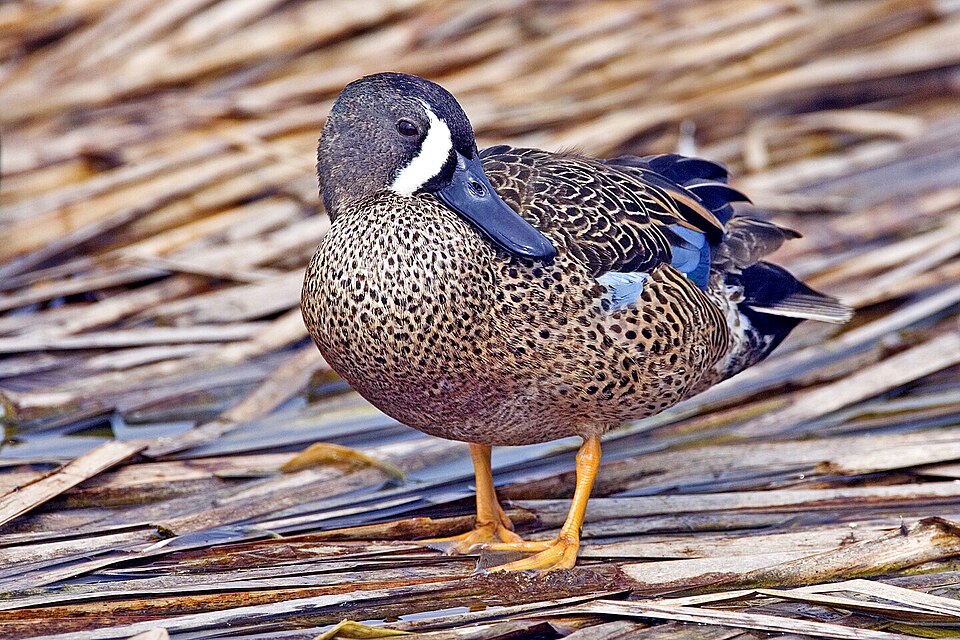
The Blue-winged Teal is one of North America's smallest and most abundant dabbling ducks, a compact bird that punches well above its weight in long-distance travel. Despite weighing little more than a pound, it is among the most migratory of all our waterfowl, with many birds wintering deep into Central and South America. In spring and fall, small, tight flocks twist and bank low over marshes with a buoyant, almost shorebird-like quickness that sets them apart from heavier ducks.
Look for them on shallow, weedy ponds, flooded fields, prairie potholes, and the muddy edges of marshes, where they tip forward to feed in just a few inches of water. The breeding male's slate-blue head crossed by a bold white facial crescent is unmistakable in good light, but the powder-blue forewing patch that gives the species its name shows on both sexes, flashing brightly in flight. They are early fall migrants and late spring arrivals, so birders in the northern states often see them bookending the colder months.
This is a small, slim, short-necked duck with a fine, dark bill that looks slightly large for the head. On the water it sits low and trim; in flight it appears fast, agile, and small-winged, often traveling in compact bunches that turn as one. The pale blue upperwing coverts are the species' calling card and are visible at a distance whenever the wings are spread.
| Size & shape | Small, compact dabbler with a thin neck and a relatively long, dark bill; noticeably smaller than a Mallard. |
| Breeding male | Slate-gray head with a bold white vertical crescent in front of the eye; warm tan, dark-spotted body and a white patch on the flank near the tail. |
| Female & eclipse male | Mottled warm brown overall with a plain face, dark eyeline, and a pale spot at the base of the bill. |
| Wing patch | Large chalky powder-blue forewing patch on both sexes, set off by a green speculum and a white border, conspicuous in flight. |
| Bill & legs | Bill dark gray to black and fairly long; legs and feet yellowish to dull orange. |
| Flight style | Fast, twisting, low flight in small tight flocks; wingbeats quick and shorebird-like. |
Male vs. female
In breeding plumage the sexes are easy to separate. The male wears a slate-blue head split by a clean white crescent in front of the eye, with a finely spotted tan body and a tell-tale white flank patch near the black rear. The female is plainly mottled brown with a darker eyeline and a small pale loral spot at the base of the bill, lacking any blue-gray on the head. From late summer into fall the male molts into a drab, female-like eclipse plumage and loses the white crescent, but he keeps a brighter, more uniformly powder-blue forewing and often a yellowish, less heavily streaked look; his eye also tends to be a warmer red-brown.
Juveniles
Juveniles closely resemble the adult female, with warm brown, mottled body feathers, a plain face marked by a dark line through the eye, and a pale spot near the bill base. Young birds are typically a touch buffier and more crisply patterned than worn adults, and they show the same blue forewing patch in flight, which makes any drab Blue-winged Teal best confirmed by that wing flash rather than by body plumage alone.
Blue-winged Teal are not loud, and they lack the carrying quacks of larger ducks. The drake gives a thin, high, whistled tsee-tsee or peeping note, soft and almost squeaky, often during courtship or as flocks mill about. It carries surprisingly poorly for such an alert little bird.
The hen produces a weak, evenly spaced quacking and a soft kuk-kuk-kuk series, much fainter and higher than a female Mallard's hearty quack. Around feeding flocks you may hear low conversational peeps and clucks, but in general these are quiet ducks whose presence is usually given away by the whir of wings rather than by voice.
Blue-winged Teal breed across much of central and northern North America, with the heart of the population in the prairie pothole region of the northern Great Plains and the Canadian prairies, extending east through the Great Lakes and into the Northeast, and more thinly into parts of the West. They favor shallow seasonal wetlands and prairie marshes for nesting.
They are among the longest-distance migrants of our ducks. Most leave the northern breeding grounds early, often by late summer and early fall, and winter from the Gulf Coast and Florida south through Mexico, the Caribbean, and Central America, with substantial numbers reaching northern South America. They return north relatively late in spring. Because of this timing, birders in the upper Midwest and Northeast see them mainly as migrants and summer breeders rather than winter birds.
This is a dabbling duck that feeds in shallow water, picking food from the surface and from just below it, tipping up and straining items through its fine-lamellated bill rather than diving. The diet shifts with the season: aquatic invertebrates such as midge larvae, snails, small crustaceans, and other bugs are heavily taken in spring and during the breeding season, especially by females building up reserves for egg-laying.
Through the rest of the year the diet leans more heavily on plant material, including the seeds of sedges, smartweeds, pondweeds, and grasses, along with bits of aquatic vegetation and waste grain in flooded fields. Because they feed in very shallow water and muddy margins, Blue-winged Teal are quick to take advantage of temporarily flooded fields, drawdowns, and the soft edges of drying wetlands.
Blue-winged Teal nest on the ground, usually in dense grass or sedge meadows near water but sometimes a surprising distance from the nearest wetland. The female builds a shallow scrape lined with grasses and a thick layer of down, well concealed by surrounding vegetation. She alone selects the site, incubates, and tends the brood.
A typical clutch is on the larger side for a small duck, and incubation lasts a little over three weeks. The downy ducklings leave the nest within a day of hatching and are led by the female to wetlands where they feed themselves, mostly on tiny invertebrates. Pairs raise a single brood per season, and the male typically departs to molt once incubation is well underway, leaving the female to rear the young on her own.
The Blue-winged Teal is not a backyard or feeder bird, and it will not visit seed feeders or birdbaths. It is a wetland duck, so attracting it is really about habitat rather than food offerings, and that mostly applies to those with access to ponds, marshy ground, or larger acreage.
- Provide or protect shallow, weedy wetlands: teal feed in just a few inches of water along muddy, vegetated edges, so steep-banked deep ponds hold little appeal.
- Leave dense grass and sedge cover near water undisturbed through spring and early summer, as females nest on the ground in thick vegetation.
- Encourage native aquatic and emergent plants like smartweeds, sedges, and pondweeds that supply both seeds and the invertebrates teal eat.
- If you manage a pond or field, consider seasonal shallow flooding or drawdowns in spring and fall, which create the muddy feeding flats migrating teal seek out.
- To actually see them, visit marshes, prairie potholes, and flooded fields during spring and fall migration, and scan small fast flocks for the blue wing flash.
- Cinnamon Teal: Drake is rich rusty-red overall with red eyes and no white facial crescent; females are nearly identical to female Blue-winged but average a slightly longer, more spatulate bill and warmer tones. Both share the powder-blue forewing.
- Green-winged Teal: Even smaller, with a short bill and a green (not blue) wing speculum; breeding males show a chestnut head with a green eye patch, and the forewing is gray-brown rather than powder blue.
- Northern Shoveler: Shares the same blue forewing patch, but is much larger with an oversized spatula-shaped bill; breeding males have a green head and rusty flanks, never the white facial crescent of a drake Blue-winged.
- Mallard: Far larger and bulkier with a loud quack and a blue (not powder-blue) speculum bordered in white; lacks the small size, fine bill, and pale forewing of a teal.
How do I tell a Blue-winged Teal from a Cinnamon Teal?
In breeding plumage the males are easy: a Cinnamon Teal drake is solid rusty-red with red eyes, while a Blue-winged drake has a slate-gray head with a bold white crescent. Females and eclipse birds are very tough, as both show the powder-blue forewing; Cinnamon Teal average a slightly longer, more shovel-like bill and warmer, plainer faces. Range and habitat help, since Cinnamon Teal are mainly western birds.
Why is it called a Blue-winged Teal if it looks mostly brown?
The name comes from the large chalky powder-blue patch on the upperwing coverts, which is mostly hidden when the bird is sitting but flashes brightly the moment it spreads its wings in flight. Both males and females show it, so the blue wing is often the surest way to identify a drab bird.
When is the best time to see Blue-winged Teal?
They are early fall and late spring migrants, so the prime windows are roughly late summer through early fall and again in mid to late spring. In the northern states they are common breeders in summer, but they largely leave before winter, heading to the Gulf Coast, Mexico, and points farther south.
Will Blue-winged Teal come to a backyard or feeder?
No. They are wetland dabbling ducks that feed in shallow water and will not visit seed feeders or typical backyard setups. The only way to attract them is to provide or protect shallow, weedy wetlands and grassy nesting cover, and even then they are mostly seen by visiting marshes and flooded fields during migration.
Are Blue-winged Teal good fliers?
Yes, remarkably so. They fly fast and erratically in small tight flocks, twisting and banking low over the water with quick, almost shorebird-like wingbeats. They are also among the most migratory of North American ducks, with many traveling thousands of miles to winter in Central and South America.