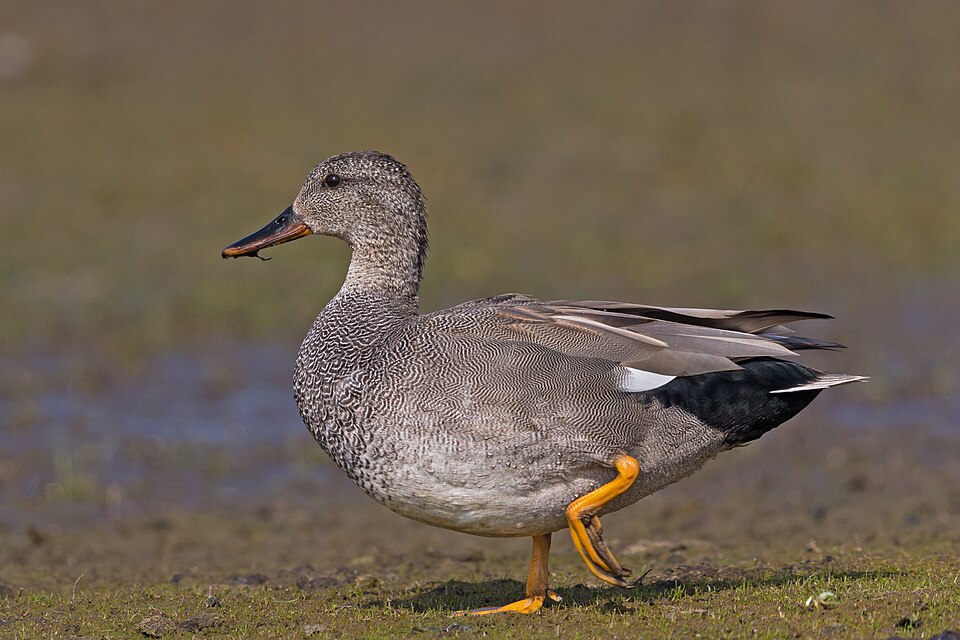
The Gadwall is the duck that rewards a second look. At a glance it reads as just another brown dabbler bobbing among Mallards on a city pond, but study the drake for a moment and you'll find one of the most elegantly understated birds in North America: a finely vermiculated gray body, warm chestnut and black scapulars, and a crisp jet-black stern that stands out like an exclamation point. Birders sometimes call it the "gentleman's duck" for its quiet, tailored good looks. The species belongs to the genus Mareca, the same group as wigeons, and shares their habit of grazing and stealing food from other waterbirds.
Gadwall are creatures of shallow freshwater wetlands across the Northern Hemisphere. In North America their stronghold is the Prairie Pothole Region of the northern Great Plains and Canadian prairies, but they have expanded their breeding range steadily over the past several decades and now nest in many areas where they were once scarce. Hardy and adaptable, they take readily to created wetlands, sewage lagoons, and reservoirs, which has helped fuel a long-term population increase that bucks the trend of many declining waterfowl.
The Gadwall is a medium-sized dabbling duck, a touch smaller and slimmer than a Mallard, with a fairly squarish head and a relatively steep forehead. On the water it sits a little higher in front than many ducks, and its overall impression is of a plain, neatly proportioned bird. The single most reliable mark in flight, on both sexes, is a small white patch in the inner wing (the white speculum), no other North American dabbling duck shows pure white there.
| White speculum | A square white patch on the trailing edge of the inner wing, visible in flight and often as a sliver at rest. Diagnostic for both sexes. |
| Male body | Finely barred gray (vermiculated), with chestnut and black on the wing shoulder and a sharply contrasting black rear end. |
| Female plumage | Mottled warm brown, very Mallard-like, but with a thinner, more orange-sided bill and a steeper forehead. |
| Bill | Male's is dark gray; female's is gray with clean orange edges along the sides. |
| Head shape | Rounded to slightly squared with a steep forehead, giving a more compact look than a Mallard. |
| Size | 18-22 in long; clearly smaller and trimmer than a Mallard, larger than a teal. |
Male vs. female
In breeding plumage the sexes are easy to separate. The drake is the gray, finely patterned bird with the black rear and dark bill, while the hen is mottled brown with an orange-sided bill. The catch is summer: from roughly mid-summer into early fall, drakes molt into a dull "eclipse" plumage that closely resembles the female, and at that season the cleanest clues are the male's darker, plainer bill and the chestnut tones retained in the wing. At all seasons the white wing patch shows on both sexes, so a flushed brown Gadwall flashing white can still be told from a Mallard hen, which shows a blue speculum bordered with white.
Juveniles
Juvenile Gadwall look much like adult females, mottled warm brown overall, but tend to be more heavily and coarsely streaked below, with a somewhat plainer, less crisply patterned appearance. Young males begin showing hints of gray vermiculation and the developing black rear through their first fall and winter, gradually acquiring full adult-like plumage. The white wing patch is present from an early age, making it a dependable family mark even on scruffy young birds.
Gadwall are not loud ducks, but they are surprisingly vocal in courtship. The drake gives a distinctive short, low, burping or croaking nheck or mep, sometimes likened to a soft, nasal grunt, often paired with a thin, reedy whistle. These two notes together, a guttural croak followed by a high whistle, are characteristic of displaying males in late winter and spring.
The female sounds much more like a Mallard, giving a descending series of quack notes, though typically higher-pitched and softer. In a mixed flock, picking out the male's odd little burp-and-whistle is one of the better ways to confirm Gadwall by ear.
Gadwall breed across the northern Great Plains, the Canadian prairies, the Great Basin, and patchily eastward, with the Prairie Pothole Region holding the bulk of the continental population. Their breeding range has expanded notably in recent decades, including into parts of the East and the Atlantic seaboard. They also breed widely across Europe and Asia.
In winter they shift south to the southern United States, especially the Gulf Coast, the lower Mississippi Valley, the Central Valley of California, and inland reservoirs, as well as Mexico. Across the milder parts of their range, including many urban ponds and refuges, Gadwall can be found year-round wherever open water and shallow marsh persist.
Gadwall are unusual among dabbling ducks for being largely vegetarian: aquatic plants, leaves, stems, and seeds of pondweeds, algae, and submerged vegetation, make up the great majority of their diet outside the breeding season. They feed mostly by dabbling and up-ending in shallow water, tipping forward to reach submerged greens, and they graze on land as well.
One of their most entertaining habits is kleptoparasitism: Gadwall frequently associate with diving birds such as American Coots and various diving ducks, waiting at the surface to snatch the vegetation those birds bring up from deeper water. During the breeding season, and especially for laying females and growing ducklings, the diet shifts to include more protein in the form of aquatic insects, crustaceans, and other invertebrates.
Gadwall nest on the ground, typically in dense grasses or other low cover, often on islands or peninsulas where predators are less of a threat, a preference that makes them ready beneficiaries of managed wetland islands. The hen builds the nest as a shallow scrape lined with grasses and a generous layer of down, and she alone incubates the eggs while the drake departs to molt. They are relatively late nesters compared with many prairie ducks.
A typical clutch is around 8 to 11 creamy or pale eggs, with the female incubating for roughly 24 to 27 days. The precocial ducklings leave the nest within a day of hatching and feed themselves under the hen's watch, fledging in about seven to eight weeks. Gadwall normally raise a single brood per year.
Gadwall are wild waterfowl, not backyard feeder birds, so you won't lure them with a seed feeder. But if you have or can visit the right water, they're very approachable, and a few simple things make wetlands and large ponds attractive to them.
- Provide or seek out shallow, vegetated freshwater, Gadwall favor ponds and marshes rich in submerged aquatic plants, not deep open water.
- If you manage a pond, encourage native aquatic vegetation rather than clearing it; that greenery is their main food.
- Undisturbed, vegetated edges and small islands give hens safe nesting cover away from predators.
- Look for them among Mallards, coots, and wigeons on city park ponds and refuges, they readily join mixed flocks.
- Visit refuges and managed wetlands in fall and winter, when migrants concentrate on open water.
- Avoid feeding bread; if a pond hosts wild ducks, healthy natural vegetation serves them far better.
- Mallard: Female Mallards are very similar to female Gadwall but are larger, show a blue (not white) speculum bordered with white, and have a more orange bill.
- American Wigeon: A close relative with similar grazing habits; males show a white forehead and green eye-stripe, and the body is warmer brown, lacking the Gadwall's gray vermiculation and black rear.
- Northern Pintail: Females can look similar in brown plumage but pintails are slimmer with a long neck, long pointed tail, and a plain gray bill; no white wing patch.
- Gray Teal: An Old World relative that overlaps in some regions; much smaller and shows a green-and-white speculum rather than the Gadwall's pure white patch.
How do you tell a Gadwall from a Mallard?
The drake Gadwall is gray rather than green-headed, with a black rear and dark bill. The biggest tell for both sexes is the white wing patch, Mallards show a blue speculum bordered with white, while Gadwall show a square white patch. Gadwall are also a bit smaller and trimmer with a steeper forehead.
Why is the Gadwall sometimes called the 'gray duck'?
Because the male's body is finely barred gray, lacking the bold colors of many drakes. That muted, tailored look, gray body, black stern, is what earns it nicknames like 'gray duck' or 'gentleman's duck.'
What does a Gadwall eat?
Mostly aquatic plants, pondweeds, algae, and seeds, which makes it one of the more vegetarian dabbling ducks. It often steals vegetation that diving birds like coots bring to the surface. During breeding, females and ducklings also eat insects and other invertebrates for protein.
Are Gadwall rare?
No, they're common and their population has actually been increasing over recent decades, partly because they readily use created wetlands and reservoirs. They can be easy to overlook because they blend in among Mallards and other dabblers.
Where can I see a Gadwall?
Look on shallow freshwater ponds, marshes, refuges, and even city park lakes, often mixed in with Mallards, coots, and wigeons. They breed across the northern plains and prairies and winter across the southern U.S. and Mexico, with year-round populations in milder areas.