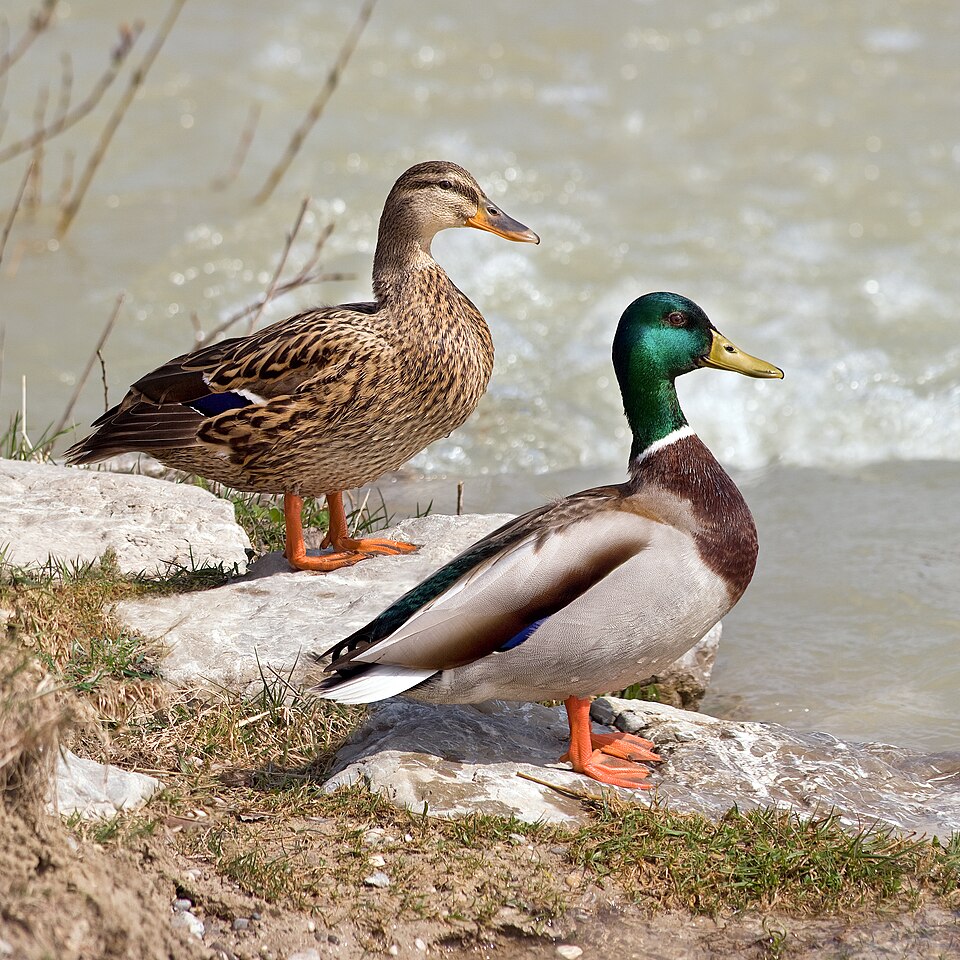
If you have ever tossed a piece of bread toward a pond (please use cracked corn or peas instead) or watched ducks paddle across a city park, you almost certainly know the Mallard. It is the default duck of the Northern Hemisphere, equally at home on a wild prairie marsh, a suburban retention pond, or a fountain in the middle of a busy plaza. The glossy green-headed drake is one of the most instantly recognizable birds in the world, and the species is so widespread that it serves as the ancestor of nearly all domestic ducks.
Beyond its familiarity, the Mallard matters because it is the benchmark dabbling duck against which birders learn every other species. Its sheer adaptability, its willingness to hybridize, and its booming populations make it a conservation success story even as it raises tricky questions where it mixes with more localized native ducks. Learn the Mallard well and you have a reference point for spotting the rarer, shyer waterfowl that share its wetlands.
The Mallard is a large, heavy-bodied dabbling duck with a long, broad bill and a rounded head. It sits high on the water, tips forward to feed (tail in the air, head down), and springs almost vertically into the air when flushed rather than running across the surface like diving ducks. Both sexes share one reliable clincher: a bright blue-purple wing patch, the speculum, bordered front and back by crisp white bars.
| Male head | Glossy iridescent green that flashes blue or purple in different light, sharply set off from a chestnut breast by a thin white neck ring |
| Bill | Drake's bill is bright yellow to olive-yellow; hen's is orange blotched with dark brown or black |
| Speculum | Blue to violet wing patch bordered by two white bars, visible in both sexes at rest and in flight |
| Female body | Mottled warm brown overall, paler face with a dark eye-line, giving a streaky, sparrow-like camouflage |
| Drake tail | Pale gray-and-white tail with distinctive black, upward-curling central feathers (the drake curl) |
| Size and shape | Large, bulky, long-billed; floats high and dabbles rather than dives |
Male vs. female
In breeding plumage the sexes are easy to separate. The drake wears the iconic emerald-green head, white neck ring, rich chestnut breast, gray flanks, black rear, and yellow bill, finished with the curled black tail feathers. The hen is dressed in subtle mottled brown for camouflage on the nest, with an orange-and-black bill and a plainer face marked by a dark line through the eye. From midsummer into early fall, watch out for the drake's "eclipse" plumage, when he molts into a dull female-like brown and temporarily loses his green head; even then his yellowish bill and overall tone give him away, and both sexes always show that white-bordered blue speculum.
Juveniles
Ducklings are classic fuzzy yellow-and-brown, with a dark cap, a dark line through the eye, and dark stripes down the back. Within a couple of months juveniles resemble adult females, wearing mottled brown body feathers and showing the white-bordered blue speculum once their flight feathers grow in. Young drakes begin developing hints of their adult colors through fall and into their first winter, when the green head gradually emerges and the bill brightens toward yellow.
The loud, descending quack-quack-quack that most people picture when they think of any duck is actually the call of the female Mallard. Hens give a far-carrying, laughing series of quacks, often a rapid quack-quack-quack-quack that tapers off, used to keep contact and to scold. The classic "decrescendo call" is a string of two to ten notes that start loud and trail away.
Drakes are much quieter and never give that ringing quack. Instead the male produces a soft, raspy, reedy rhaeb or a low whistled jeeb, easy to overlook in a noisy flock. During courtship males add quiet grunts and a sharp whistle while flicking their bills and heads.
The Mallard is one of the most widely distributed ducks on Earth, breeding across nearly all of North America, Europe, and temperate Asia, and introduced or naturalized in places like New Zealand, Australia, and parts of South America. In North America it nests from Alaska and northern Canada south through most of the United States.
Northern populations are strongly migratory, moving south in fall to spend the winter wherever water stays open, often gathering in huge flocks on lakes, flooded fields, and coastal marshes. In milder regions and in cities, however, Mallards are year-round residents, and many park populations barely move at all as long as people keep ponds ice-free and food available.
Mallards are dabbling ducks and true omnivores. They feed at the surface and tip up to reach underwater, straining seeds, aquatic plants, and small invertebrates through comb-like lamellae along the edges of the bill. Their diet shifts seasonally: seeds, acorns, waste grain, and plant material dominate in fall and winter, while protein-rich insects, snails, crustaceans, and worms become important in spring and summer, especially for laying females and growing ducklings.
They readily forage on land too, walking through stubble fields to glean spilled corn and wheat, and grazing on grasses and tender shoots. This dietary flexibility is a big reason the species thrives almost anywhere there is shallow water.
The female chooses the nest site and builds it on the ground, usually well hidden in grass or reeds near water, though Mallards will also nest surprising distances from the nearest pond and occasionally in raised planters or hay bales. She forms a simple bowl of grasses and plant matter, then lines it with soft down plucked from her own breast, pulling it over the eggs to insulate them when she leaves to feed.
A typical clutch is 7 to 13 creamy to greenish-buff eggs. The hen incubates alone for about 26 to 30 days while the drake generally departs to molt. The ducklings are precocial, leaving the nest within a day of hatching and following their mother to water, where they feed themselves while she leads and guards them. They fledge at roughly seven to eight weeks.
Mallards are not seed-feeder birds, but if you have a pond, a wet ditch, or even a large shallow water feature, they are one of the easiest waterfowl to welcome. The key is water and natural food rather than handouts; bread is nutritionally poor and can foul the water and harm ducks.
- Provide open, shallow water with gently sloping edges where ducks can walk in and out; even a small backyard pond can draw a pair in spring.
- Let native sedges, rushes, and pondside grasses grow at the margins for cover, food, and potential nesting sites.
- If you feed, offer cracked corn, oats, peas, or chopped lettuce sparingly, never bread, crackers, or processed snacks.
- Skip the duck-feeding when a pair shows nesting interest so they stay wild and self-sufficient rather than dependent.
- Keep dogs and cats away from the water's edge in spring, since ground nests and ducklings are extremely vulnerable.
- Avoid pesticides near water so the insects, snails, and aquatic plants ducklings rely on remain plentiful.
- American Black Duck: Both sexes resemble a very dark female Mallard with a violet (not white-bordered) speculum and a sharply paler head contrasting with the dark body; the bill lacks the female Mallard's dark blotching.
- Mottled Duck: A southern, warmer-brown look-alike of the female Mallard with an unmarked yellow-to-olive bill, a plain buffy throat, and little or no white edging on the speculum.
- Gadwall: Drake is gray and brown with a black rear and a small white speculum patch; the hen looks like a slimmer female Mallard but shows that white wing patch and an orange-edged dark bill.
- Northern Shoveler: Drake also has a green head, but its huge spatulate bill, white breast, and chestnut sides are unmistakable, and it sits lower with the bill angled downward.
Why do only female Mallards quack?
The loud, classic quack is the female's contact and alarm call. Males don't quack at all; they make a soft, raspy, reedy sound that is easy to miss in a noisy flock.
Why does a male Mallard sometimes look brown like a female?
From midsummer into early fall, drakes molt into a dull, female-like 'eclipse' plumage and briefly lose their green heads while they replace flight feathers. You can still tell them by their yellowish bill and the blue, white-bordered wing patch.
Should I feed Mallards bread?
No. Bread, crackers, and chips are junk food for ducks; they offer little nutrition, can deform growing wings, and pollute the water. Offer cracked corn, oats, peas, or chopped greens in small amounts instead, or simply let them forage naturally.
Where do Mallards build their nests?
The female builds a hidden ground nest lined with her own down, usually in grass or reeds near water, though sometimes a surprising distance away or in odd spots like garden planters. She incubates the eggs alone for about a month.
How do I tell a Mallard from a similar duck like an American Black Duck or Mottled Duck?
Look at the wing patch and bill. A Mallard's blue speculum is bordered by white on both edges. American Black Ducks are much darker with a violet speculum lacking white borders, and Mottled Ducks are warm brown with a clean, unmarked yellow bill.