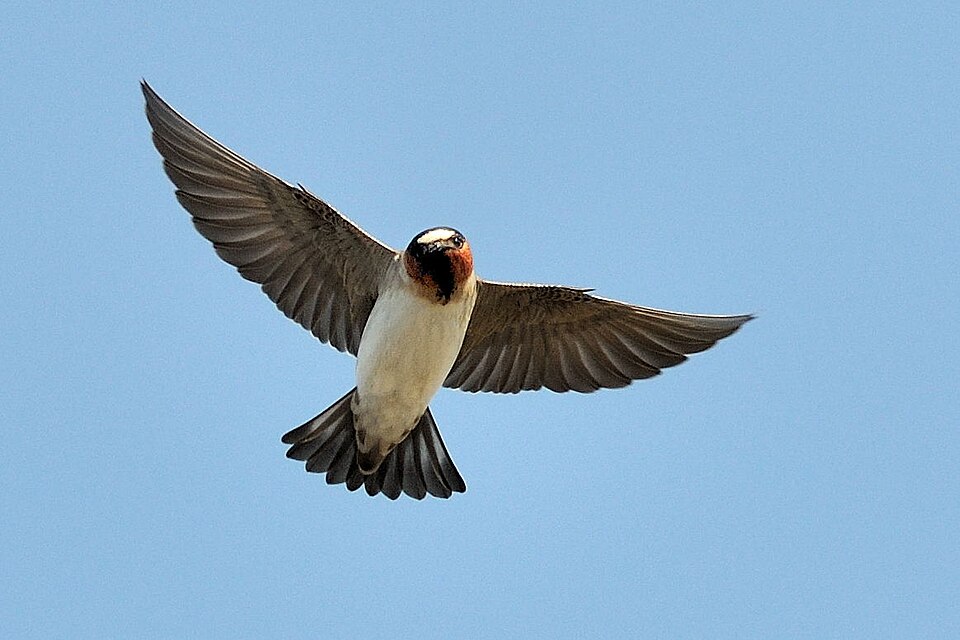
The Cliff Swallow is one of North America's most sociable birds, a compact, square-tailed swallow that nests in dense colonies of gourd-shaped mud houses plastered under bridges, highway overpasses, culverts, and the eaves of barns. Where a single pair might once have tucked a nest under a canyon ledge or river bluff, modern Cliff Swallows often gather by the hundreds or even thousands, turning a concrete underpass into a buzzing, mud-spattered metropolis. They are the famous "swallows of Capistrano," whose seasonal return to a California mission became a celebrated symbol of spring.
For backyard birders, Cliff Swallows are more often seen than visited. They feed almost entirely on the wing, coursing over fields, water, and open country in loose, swirling flocks, scooping up flying insects. You are most likely to notice them as a cloud of stocky little swallows wheeling around a bridge in summer, or as a colony of muddy nests packed shoulder to shoulder beneath an overpass. Learning to separate them from the more familiar Barn Swallow is one of the satisfying small puzzles of warm-weather birding.
Cliff Swallows are small, chunky swallows with broad-based, pointed wings and a short, square-tipped tail (never deeply forked). In flight they look stockier and more compact than other swallows, with a fluttery, gliding style and frequent banking turns. The combination of a pale buff rump patch and a squared tail is the quickest way to clinch the identification.
| Tail | Short and square-tipped, with no streamers or fork, the single best field mark separating it from Barn Swallow |
| Rump | Pale buffy-orange patch that contrasts with the dark back and tail, obvious in flight from behind |
| Face & throat | Brick-red to chestnut face and throat with a dark patch in the center of the throat |
| Forehead | Pale creamy-white forehead patch (a key mark; the Cave Swallow shows a buff forehead and pale throat instead) |
| Upperparts | Dark steely blue-black crown and back, with whitish streaking on the back |
| Underparts | Whitish to pale gray belly and breast, cleaner-looking than the warmer underparts of Barn Swallow |
Male vs. female
Male and female Cliff Swallows look essentially identical in the field. Both sexes share the buff rump, square tail, chestnut face, and pale forehead, and there is no reliable plumage difference that a birder can use with binoculars. In the hand, researchers sometimes find females slightly duller or note breeding condition, but for ordinary observation you should treat the sexes as alike.
Juveniles
Juvenile Cliff Swallows are noticeably duller and more variable than adults. They show a browner, less glossy back, a muted or smudgy face pattern, and often a paler, less sharply defined throat, sometimes whitish rather than rich chestnut. The pale forehead and buff rump are usually still visible but less crisp. This drabber, blotchy-faced look in mid- to late summer can briefly confuse birders, since some young birds show enough buff on the face to suggest a Cave Swallow; rump color and overall structure remain the safest guides.
Cliff Swallows are not melodic singers. Their vocalizations are a steady stream of low, grating, creaky chatter, a series of squeaky churr and vrrt notes often described as sounding like a rusty hinge or a soft, rough purr. Around a colony the combined chatter of many birds produces a continuous, conversational buzz.
The most distinctive sound is the alarm call, a sharp nyew or keer given when a predator approaches the colony, which can set off a chorus from neighboring nests. They also give squeaky contact calls in flight. Notably, Cliff Swallows use specific "recognition" calls that help parents and chicks find each other among hundreds of nearly identical mud nests.
Cliff Swallows are long-distance migrants that breed across most of North America, from Alaska and central Canada south through nearly all of the United States and into Mexico, wherever suitable nesting walls and open foraging habitat exist. They are absent or sparse only in the southeastern coastal plain and parts of the desert Southwest as breeders. The expansion of bridges, culverts, and buildings has actually allowed the species to spread into areas that lacked natural cliffs.
In late summer they gather into large flocks and head south, wintering in southern South America, chiefly in Argentina, Bolivia, Paraguay, and Brazil. This makes their round-trip one of the longer migrations among North American songbirds. Spring arrival is famously punctual at long-established colonies, and birders across the continent watch for the first returning birds from March in the south to May in the far north.
Cliff Swallows are aerial insectivores that feed almost exclusively on flying insects caught in mid-air. Their diet is dominated by true bugs, flies, beetles, flying ants, bees and wasps, and other small insects, which they take while coursing over fields, marshes, ponds, and rivers. They often forage in loose flocks at moderate height, wheeling and gliding rather than the low, swooping flight of Barn Swallows.
They are highly social foragers and even use the colony as an "information center": birds that have found a rich swarm of insects are followed by colony-mates to the food source. In cold, wet weather when flying insects are scarce, Cliff Swallows can suffer, sometimes clustering for warmth or temporarily abandoning nesting attempts until conditions improve.
Nesting is where Cliff Swallows are truly remarkable. They build enclosed, gourd- or retort-shaped nests out of mud pellets, hundreds to over a thousand mouthfuls of mud carried one beakful at a time from a puddle or muddy shoreline. The finished nest is a rounded mud jug with a narrow entrance tunnel, attached to a vertical wall beneath an overhang: a cliff face, bridge, culvert, dam, or barn eave. Pairs nest in tight colonies, often packing nests so closely that they share walls, and a large colony can hold hundreds or even thousands of nests.
Both members of a pair gather mud and build the nest, then line it with grass and feathers. The female lays a clutch of eggs and both parents incubate and feed the young. Cliff Swallows are well known for brood parasitism within their own species, females sometimes lay eggs in a neighbor's nest, or even carry an egg in their bill from their own nest to another. House Sparrows frequently usurp finished nests, and infestations of nest parasites such as swallow bugs can push colonies to relocate between years.
Cliff Swallows are not feeder birds and cannot be drawn in with seed, suet, or fruit, since they eat only flying insects caught on the wing. You attract them by offering nesting opportunities and good foraging habitat rather than food. If you live near open country, water, or fields, you may be able to encourage a colony on a barn, outbuilding, or large structure.
- Provide a rough vertical wall under an overhang, a barn eave, garage gable, or large outbuilding, where mud nests can grip. Smooth, painted surfaces are harder for them to use.
- Keep a source of wet mud nearby in spring, such as a damp shoreline, puddle, or a deliberately muddied patch of bare soil, which gives nest-builders the material they need.
- Maintain open foraging space, fields, pasture, ponds, or marshy ground produce the flying insects they depend on.
- Avoid pesticides that knock down flying-insect populations; a healthy bug supply is what keeps a swallow colony fed.
- If you want them, tolerate the mud and droppings below the colony, a board or tray under nests can catch debris without disturbing the birds.
- Be aware that nests of native swallows are federally protected once eggs or young are present; if you do not want a colony, deter building before nesting begins, not after.
- Barn Swallow: Has a long, deeply forked tail with streamers and a uniformly dark blue back with no pale rump; underparts are warmer orange-buff. Square tail and buff rump separate Cliff Swallow.
- Cave Swallow: Very similar shape and buff rump, but shows a pale buff throat and a darker chestnut forehead, essentially the reverse of Cliff Swallow's chestnut throat and pale forehead.
- Northern Rough-winged Swallow: Plain brown above with a dingy throat, no buff rump, no chestnut face, and a square but uniform brown tail; lacks the colorful face pattern of Cliff Swallow.
- Tree Swallow: Clean white underparts and iridescent blue-green upperparts with no buff rump or chestnut face; nests in cavities and boxes rather than building mud nests.
What is the difference between a Cliff Swallow and a Barn Swallow?
The fastest way to tell them apart is the tail and rump. Cliff Swallows have a short, square tail and a pale buffy-orange rump patch, while Barn Swallows have a long, deeply forked tail with streamers, a dark blue back with no pale rump, and warmer orange underparts. Cliff Swallows also build enclosed mud nests in dense colonies; Barn Swallows build open cup nests, usually singly or in small groups.
Are the swallows of Capistrano Cliff Swallows?
Yes. The famous "swallows of Capistrano" that traditionally return to Mission San Juan Capistrano in California each spring are Cliff Swallows. Their reliable seasonal arrival from wintering grounds in South America made the colony a celebrated symbol of spring, though the birds have shifted to other nearby sites in recent decades as the mission changed.
How do I get rid of Cliff Swallow nests on my house?
Because Cliff Swallows are native migratory birds, their active nests with eggs or young are protected by federal law, and you cannot remove them during nesting. The legal and effective approach is prevention before the breeding season: install netting, slick or angled surfaces, or other deterrents under the eaves before the birds arrive in spring so they cannot attach mud nests. Once a nesting attempt is underway, you generally must wait until it is finished and the birds have left.
Do Cliff Swallows come to bird feeders?
No. Cliff Swallows eat only flying insects caught in the air, so they never visit seed, suet, or fruit feeders. The way to attract them is to provide nesting walls under overhangs, a nearby source of wet mud in spring, and pesticide-free open habitat with plenty of flying insects.
Why do Cliff Swallows nest in such large colonies?
Colonial nesting offers safety in numbers and shared information. Many alert birds spot predators sooner, and the colony acts as an "information center" where birds follow successful foragers to insect swarms. The trade-offs are competition for nest sites, occasional egg-dumping in neighbors' nests, and a buildup of nest parasites, which sometimes forces a whole colony to relocate in later years.
What does a Cliff Swallow nest look like?
It is an enclosed, gourd- or jug-shaped structure built entirely from small mud pellets, with a narrow entrance hole or short tunnel near the top. The nests are plastered onto vertical surfaces beneath an overhang, cliffs, bridges, culverts, dams, and barn eaves, and are packed closely together in colonies, often sharing walls with neighboring nests.