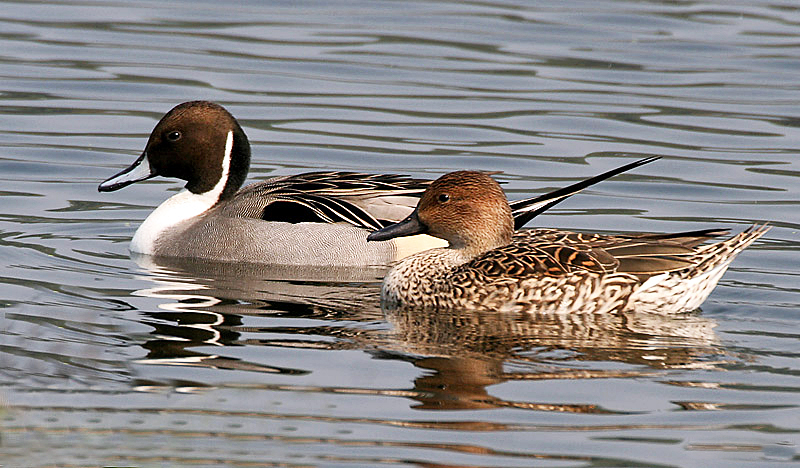
The Northern Pintail is one of the most graceful ducks in the world, a slim, long-necked dabbler that looks built for speed even when it is just paddling across a flooded field. Breeding males are unmistakable, with a smooth chocolate-brown head, a clean white breast that sends a thin white finger up the side of the neck, and a pair of long, central tail feathers that taper to a fine point and give the bird its name. Females and non-breeding males are far plainer, but they keep the same elegant, stretched-out silhouette that sets pintails apart from chunkier ducks like Mallards.
Pintails are birds of open country: prairie potholes, shallow marshes, flooded grain stubble, coastal estuaries, and large refuge impoundments. They breed across the northern reaches of North America, Europe, and Asia, then pour south in huge flocks each fall. Once one of the most abundant ducks on the continent, North American pintail numbers have fallen substantially over the past several decades, largely because of the loss of prairie wetlands and the early mowing of grasslands where hens nest. They remain a familiar and beloved sight to waterfowl watchers and hunters alike, but they are a species many conservationists keep a close eye on.
Think long and lean. A pintail's profile is the quickest way to name it: a slender body, a notably long and slim neck, a small rounded head, and a pointed tail held above the water. Even at a distance, that stretched, tapered shape stands out among the rounder, dumpier silhouettes of most other dabbling ducks.
| Shape | Slim, elongated body with a long thin neck, small head, and a pointed tail held clear of the water |
| Male head & neck | Rich chocolate-brown head with a clean white breast and a narrow white stripe running up each side of the neck |
| Male tail | Two long, black, needle-like central tail feathers (the namesake "pin") in breeding plumage |
| Female | Mottled warm brown overall, plain unmarked tan head, gray bill, and a shorter but still pointed tail |
| In flight | Long neck and slim wings; a single white trailing edge on the speculum and a bronze-green inner wing patch |
| Bill | Slim gray bill, bluish-gray along the sides in males |
Male vs. female
The sexes are easy to tell apart in breeding plumage. The drake is the showy one: a dark brown head, gleaming white breast and neck stripe, finely vermiculated gray flanks, a creamy patch near the rear, and those famous long black tail pins. The female is a study in subtle browns and tans, mottled and barred all over, with a plain unmarked face and a gray bill. She lacks the long tail pins, though her tail is still more pointed than most other female dabblers. In late summer the drake molts into a drab "eclipse" plumage that closely resembles the female, keeping only hints of his gray bill and cleaner patterning to give him away.
Juveniles
Juvenile pintails look much like adult females: warm brown, streaked and spotted, with a plain face and a slim build. Young birds tend to look slightly scruffier and more uniformly streaked below than adult hens, and they lack any long tail feathers. Through their first fall, young males gradually acquire grayer, cleaner body feathering and a bit more length to the tail, but they will not show the full splendor of adult breeding plumage until later in their first winter into spring.
Pintails are not loud, musical birds, but the drake has a distinctive voice. The male gives a soft, far-carrying, mellow whistle, often written as a two-note prrip-prrip or a wheezy proop, sometimes described as a flutey or trainwhistle-like kwee. It is a pleasant, almost gentle sound that carries well across open water on a calm day.
The female is the noisier of the pair when agitated. She gives a hoarse, descending quack and a series of low, rolling qua-quack notes, lower and rougher than a Mallard hen's loud, ringing call. During courtship, small groups of displaying drakes whistle and stretch their necks while hens mutter and chase.
The Northern Pintail is one of the most widespread ducks on Earth, breeding across the northern tier of North America, Europe, and Asia. In North America, the heart of the breeding range is the prairie pothole region of the northern Great Plains and prairie Canada, with large numbers also nesting across Alaska and the Arctic and subarctic. It is among the earliest ducks to head north in spring, often arriving on the breeding grounds while ponds are still rimmed with ice.
In fall and winter, pintails migrate south in great numbers to the southern United States, Mexico, and Central America, with major concentrations in California's Central Valley, the Gulf Coast, and the Mississippi and Pacific flyways. Birds also winter widely across Europe, Africa, the Middle East, and southern Asia. Wintering flocks favor flooded rice and grain fields, shallow freshwater marshes, and coastal estuaries and lagoons, where thousands may gather.
Northern Pintails are classic dabblers, feeding by tipping forward to reach down with their long necks rather than diving. The long neck is a real advantage: pintails can reach food in deeper water than many other puddle ducks, and they will also up-end fully, tail to the sky, to graze the bottom. They sift mud and shallow water for seeds, sift small invertebrates, and pluck plant material as they go.
Their diet shifts with the seasons. In fall and winter they lean heavily on plant foods, especially the seeds of marsh plants, sedges, smartweeds, and waste grain such as rice, corn, and barley left in harvested fields, where huge flocks often forage. During the breeding season, and for laying females in particular, they eat far more animal matter, including aquatic insects, snails, small crustaceans, and worms to fuel egg production.
Pintails nest on the ground, often surprisingly far from water, in low grass, stubble, or sparse prairie vegetation. The hen does the work of nest site selection and building, scraping a shallow bowl on the ground and lining it with grasses and a generous layer of down. Their habit of nesting in short or open cover, including farmed fields, leaves nests especially vulnerable to predators and to early-season mowing and tilling, which is one reason the species has struggled in agricultural landscapes.
The female lays a clutch of roughly 6 to 12 pale greenish to buff eggs and incubates them on her own for about three weeks. The drake departs once incubation is underway and plays no part in raising the brood. The ducklings are precocial: down-covered and able to leave the nest, swim, and feed themselves within a day of hatching, following the hen to wetland cover where she tends them until they fledge.
The Northern Pintail is a wetland and field bird, not a backyard or feeder visitor, so you will not draw one to a seed feeder or a small garden bath. That said, if you have water and the right setting, you can absolutely improve your chances of hosting or seeing them.
- Provide or protect shallow water. Pintails favor shallow, open wetlands, flooded fields, and pond edges rather than deep water, so seasonally flooded shallows are the magnet.
- Leave grain and weedy seeds. Unharvested or flood-irrigated grain stubble and natural moist-soil plants (smartweeds, sedges) provide the seeds wintering flocks seek out.
- Keep disturbance low. These are wary birds; quiet, undisturbed water with open sightlines lets flocks settle and feed.
- Visit national wildlife refuges and managed marshes. If you want to see them reliably, refuge impoundments and flooded rice country in winter are far better than any backyard.
- Look early and in open country. Scan large flat wetlands and flooded fields at dawn; the slim silhouette and long neck stand out even among thousands of other ducks.
- Mallard: Bulkier and rounder with a shorter neck and tail; breeding drake has a green head and yellow bill, lacking the pintail's brown head, white neck stripe, and long tail pins.
- Gadwall: A grayer, plainer dabbler with a square head and a small white speculum patch; lacks the pintail's slim long neck and pointed tail.
- Northern Shoveler: Similar size but unmistakable huge spatula-shaped bill and a heavy front-loaded look; pintail has a slim gray bill and an elegant, tapered build.
- American Wigeon: Rounder body and short bluish bill; male shows a white forehead and green eye stripe rather than the pintail's solid brown head and white neck stripe.
Why is it called a pintail?
It is named for the two long, slender, needle-like central tail feathers of the breeding male, which taper to a fine point and stick up above the water like a pin. Females and eclipse males have a shorter but still pointed tail.
How can I tell a Northern Pintail from a Mallard?
Look at the shape and the head. A pintail is slimmer, with a longer, thinner neck and a pointed tail, while a Mallard is bulkier and rounder. The drake pintail has a chocolate-brown head with a white neck stripe; the drake Mallard has a glossy green head and yellow bill.
Are Northern Pintails endangered?
They are listed as Least Concern globally and remain common, but North American populations have declined substantially over recent decades, mainly due to loss of prairie wetlands and grassland nesting habitat. They are a species conservationists watch closely.
Where do Northern Pintails live in winter?
They winter across the southern United States, Mexico, and Central America, with big concentrations in California's Central Valley and along the Gulf Coast, plus wide wintering ranges in Europe, Africa, and southern Asia. They favor flooded fields, shallow marshes, and coastal estuaries.
What do Northern Pintails eat?
Mostly plant seeds and waste grain in fall and winter, including rice, corn, and marsh plant seeds. Breeding females eat more animal matter such as aquatic insects, snails, and crustaceans to fuel egg-laying. They dabble and up-end rather than dive.