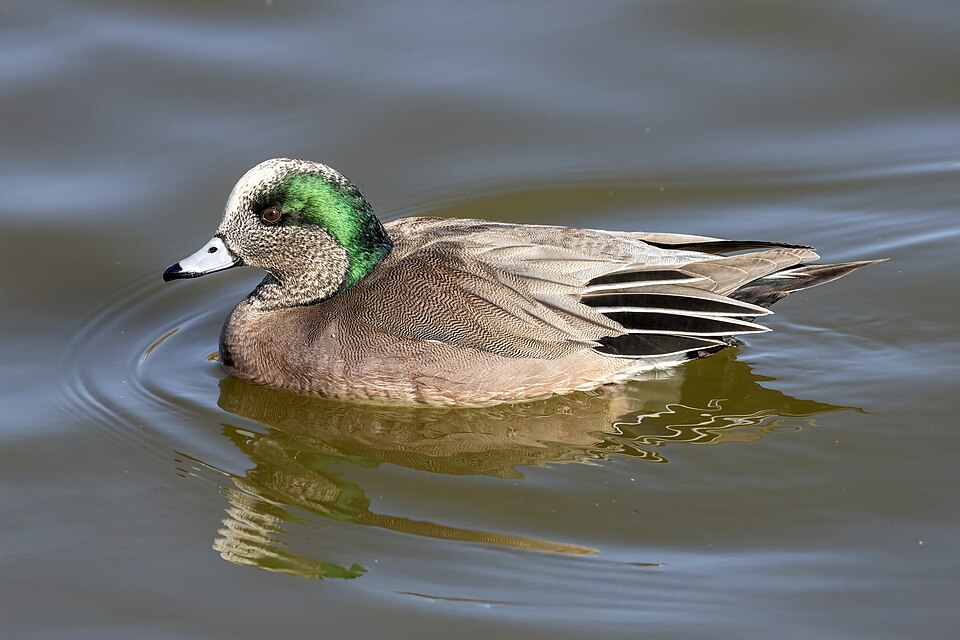
The American Wigeon is a medium-sized dabbling duck that often behaves more like a goose than a typical pond duck. While mallards and teal tip up to feed on submerged plants, wigeon spend a lot of their time grazing on land, nibbling short grass on lawns, golf courses, pasture, and the margins of lakes. This grazing habit, combined with the drake's clean white crown and bold green eye-patch, makes it one of the more distinctive ducks of North America's wetlands and parks in winter.
Once widely called "baldpate" for the male's pale forehead, the American Wigeon is a familiar sight from coastal estuaries to inland reservoirs. It is also notorious among hunters and birders alike as a sociable "kleptoparasite," frequently associating with diving ducks and coots to snatch the aquatic plants those species haul up from deeper water. With its high, squeaky three-note whistle and tight, fast-flying flocks, the wigeon brings a lot of personality to a winter waterscape.
Look for a compact, round-headed dabbling duck with a short, pale blue-gray bill tipped in black and a steep forehead that gives the head a slightly "pinched" or rounded profile. In flight, a large white patch on the upper forewing (the shoulder) is the strongest field mark, flashing brightly on the drake.
| Male head | Gray-speckled face with a broad iridescent green stripe sweeping back from the eye and a gleaming white-to-cream crown and forehead |
| Bill | Short, pale blue-gray with a sharply defined black tip, distinctly small for a dabbling duck |
| Body (male) | Warm pinkish-brown breast and flanks, a clean white patch on the rear flank, and black under the tail |
| Wing in flight | Bold white patch on the inner upper forewing (gray and duller on females); green speculum bordered with black |
| Female | Warm gray-brown overall with a grayish, finely speckled head that contrasts subtly with a warmer body, and the same small black-tipped bill |
| Size & shape | Smaller and rounder-headed than a mallard, with a short neck and a pointed tail held slightly up at rest |
Male vs. female
Breeding males are unmistakable: the green eye-stripe and white crown stand out at a distance, set against a finely gray-speckled face and a warm pinkish-brown body with a tidy white patch ahead of the black undertail. Females are far plainer, overall warm gray-brown with a grayish, lightly speckled head that contrasts a little with the rusty-toned flanks. The best shared clue for both sexes is the small, pale blue-gray bill with a crisp black tip, which separates them from most other dabbling ducks. In late summer, eclipse-plumage males look much like females but keep a hint of the white wing patch and a warmer, more rufous body.
Juveniles
Juveniles and immatures resemble adult females, warm brown and softly mottled, with that telltale small black-tipped bill. Young males begin showing scattered green feathers around the eye and a paler forehead through their first fall and winter, and by their first spring most have acquired a recognizable, if slightly less crisp, version of the adult drake's pattern. On the water, a flock of "brown" wigeon in autumn is usually a mix of true females and not-yet-finished young males.
The American Wigeon is one of the most vocal winter ducks, and the drake's call is the giveaway: a high, squeaky, almost rubber-ducky whistle of three notes, often written as whew-WHEW-whew, with the middle note loudest. Flocks on the water keep up a constant, cheerful chorus of these whistles that carries well across open marsh.
Females are much less musical, giving a low, harsh, somewhat grating quack or growl, coarser and throatier than a mallard hen's voice. When a flock flushes, the airy whistles of the males mix with the rush of fast wingbeats, a sound experienced birders learn to pick out before they even see the birds.
American Wigeon breed across a huge swath of the northern continent, through Alaska and much of Canada, and into the northern Great Plains and Intermountain West of the United States, favoring shallow wetlands, prairie potholes, and marshy lake edges. They are strongly migratory, and the bulk of the population shifts south for winter.
In the cold months they spread across the southern and coastal United States, Mexico, and Central America, packing into coastal bays and estuaries, freshwater marshes, flooded fields, reservoirs, and city park ponds. They are common on both the Pacific and Atlantic flyways and are one of the more likely "grass-grazing" ducks you'll find on a manicured lawn near water in winter. Vagrants turn up regularly in Europe, where birders watch wigeon flocks closely for this American cousin.
The American Wigeon is unusual among dabbling ducks for how much vegetation it eats and how much grazing it does on dry land. It readily walks ashore to crop short grasses, clover, and other green shoots, and on the water it feeds on the leaves and stems of aquatic plants like pondweeds, wigeon grass, eelgrass, and algae. In the breeding season it takes more aquatic invertebrates, insects, snails, and the like, especially females needing protein for egg-laying.
One of its most famous behaviors is stealing food from other birds. Wigeon often loiter among diving ducks (such as canvasbacks and redheads) and American Coots, then dart in to grab the tender plants those species bring up from depths the wigeon cannot reach itself. This opportunistic "let someone else do the diving" strategy is a hallmark of the species on deeper lakes and coastal waters.
American Wigeon nest on the ground, usually well away from the water's edge, often hidden in tall grass, weeds, or brushy cover in a dry upland field or meadow, sometimes a surprising distance from the nearest wetland. The hen builds a shallow scrape, lines it with grasses and a generous layer of her own down, and conceals it within the surrounding vegetation.
The female lays a clutch of roughly 6 to 12 creamy-white eggs and does all the incubation, which lasts about three and a half weeks. The drake typically departs as incubation gets underway, leaving the hen to raise the brood alone. The downy ducklings are precocial, they leave the nest soon after hatching and feed themselves under the hen's watch, fledging in roughly six to seven weeks.
The American Wigeon is not a seed-feeder bird, so you won't lure one to a backyard feeder, but if you live near water with open lawn, it's one of the most "attractable" wild ducks because of its grazing habit.
- If you have a pond, lake, or estuary nearby, maintain short, open grass right down to the shoreline, wigeon love to graze mowed lawns and shoreline turf in winter.
- Skip the bread. If you want to support ducks responsibly, offer cracked corn, oats, or chopped greens like lettuce and peas sparingly, and never as a substitute for natural foraging.
- Protect or plant native aquatic vegetation such as pondweeds and wigeon grass; healthy submerged plants are the wigeon's preferred natural food.
- Keep a stretch of undisturbed, quiet open water where flocks can rest and roost away from dogs and foot traffic.
- Watch your local park ponds and golf-course water hazards in winter, these grazed lawns beside water are classic wigeon magnets, no feeder required.
- Eurasian Wigeon: Old World counterpart; drake has a rusty-cinnamon head with a buffy crown and gray body, no green eye-stripe or white forehead. Females are very hard to separate, but show warmer rufous tones.
- Gadwall: Similar size and gray-brown females, but Gadwall has a steeper bill, a small white speculum (not green), and males are plain gray with a black rear, lacking the wigeon's white crown and green eye-patch.
- Mallard: Larger and longer-bodied with a bigger yellow (male) or orange-and-black (female) bill; lacks the wigeon's small pale bill, white crown, and prominent white forewing patch.
- Northern Pintail: Slimmer and longer-necked with a long pointed tail; female is grayer and more elegant, and the bill is longer and all-gray rather than short with a black tip.
Why is the American Wigeon called a baldpate?
"Baldpate" is an old name for the species that refers to the breeding male's white-to-cream crown and forehead, which can look like a bald patch from a distance, similar to how a bald eagle's white head earned its name despite the bird not being bald.
What is the difference between an American Wigeon and a Eurasian Wigeon?
The drake American Wigeon has a green stripe through the eye and a white forehead on a gray-speckled face, while the drake Eurasian Wigeon has a rusty-cinnamon head with a buffy-yellow crown and a gray body. Females look very similar, but Eurasian tends to show warmer, more reddish tones.
Do American Wigeon come to bird feeders?
No. Wigeon are grazing ducks, not seed-eaters, so they won't visit a backyard seed feeder. You're far more likely to see them cropping short grass beside ponds, in flooded fields, or on park lawns near water in winter.
What does an American Wigeon sound like?
The male gives a distinctive high, squeaky three-note whistle, often described as whew-WHEW-whew with the middle note loudest. Females are quieter, giving a low, harsh quack or growl. A whistling winter duck flock is very often wigeon.
Where do American Wigeon live?
They breed across Alaska, much of Canada, and the northern U.S. interior, then migrate south for winter to coastal bays, marshes, flooded fields, reservoirs, and park ponds across the southern U.S., Mexico, and Central America. They appear as rare vagrants in Europe.