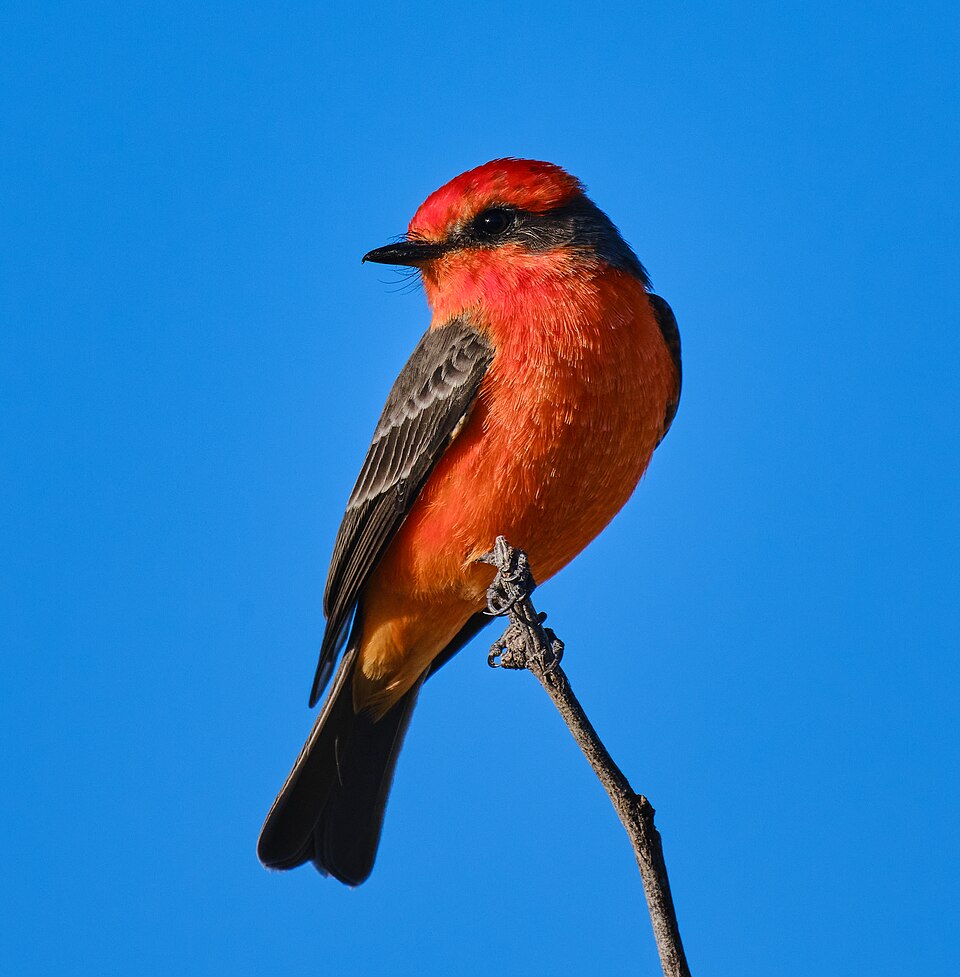
Few small birds stop a birder in their tracks the way an adult male Vermilion Flycatcher does. Perched on a low fence wire or a dead twig over a stream, he looks almost too vivid to be real, a burning scarlet head and underside set against a sooty brown-black mask, back, and tail. He is a flycatcher in the truest sense, sitting upright and alert, then darting out to snatch an insect from the air before returning to nearly the same perch. In the dry, sun-baked country he favors, that flash of red against pale desert and blue sky is unforgettable.
The Vermilion Flycatcher belongs to the tyrant flycatcher family, a huge group of mostly drab birds, which makes the male's color all the more startling. It is a bird of the American Southwest and Mexico, ranging south through Central America into much of South America. In the United States it is closely tied to water in arid land: cottonwood-lined washes, ranch ponds, irrigation ditches, golf course edges, and the green margins of desert rivers. Where it occurs, it is often a local favorite, and even non-birders learn to recognize "the little red bird" near the water.
This is a small, compact flycatcher with a relatively large, slightly peaked head, a short stout bill, and an upright, watchful posture. Size and shape are roughly between a sparrow and a phoebe. Identification is rarely difficult for the brilliant male, but females and young birds are subtler and worth a closer look.
| Adult male | Brilliant scarlet-red crown, throat, and underparts; contrasting dark brown to blackish mask, back, wings, and tail. |
| Crest | Often raises a small bushy red crest, giving the head a peaked, big-headed look. |
| Female | Grayish-brown above with a streaked whitish breast and a wash of pinkish, salmon, or peachy color on the lower belly and undertail. |
| Bill | Short, black, and broad-based, typical of an aerial insect-catcher. |
| Tail | Dark and fairly short; frequently pumped or wagged downward when perched. |
| Size | Small and chunky, about 5 to 6 inches long, noticeably smaller than a robin. |
Male vs. female
The sexes look strikingly different. The adult male is the famous one: fiery red below and on the head, with a dark mask through the eye and dark brown to black upperparts. The female is far more muted, gray-brown above with a finely streaked, whitish breast, and her best field mark is the warm pinkish, salmon, or peach wash low on the belly and under the tail. That blush of color, however faint, separates her from other small streaky flycatchers. Some older females and birds in certain populations can show a stronger reddish tone below, but they never approach the male's saturated scarlet.
Juveniles
Juveniles resemble females but look plainer and more spotted, with a whitish, often mottled or scaly-looking breast and little or no color below; their belly wash tends toward pale yellow rather than the female's salmon-pink. Young males begin acquiring patches of red as they mature, and immature males can look beautifully blotched, with uneven scarlet coming in among brown feathers, a transitional plumage that sometimes puzzles observers expecting an all-red bird.
The male's song is a soft, tinkling, slightly stuttering phrase, often written as pit-pit-pit-pidddreee or p-p-p-pit-zeee, ending in a thin, buzzy or trilled flourish. It is surprisingly delicate for such a flashy bird and easy to overlook against background noise.
What makes the song memorable is how it is delivered. The male performs a fluttering flight display, rising into the air with quivering wings and fanned tail while singing, hovering briefly above his territory before parachuting back down to a perch. The common call is a sharp, thin peet or pseet, given by both sexes as a contact or alarm note.
In the United States, the Vermilion Flycatcher is mainly a bird of the desert Southwest, breeding across Arizona, southern New Mexico, West Texas, and into the southern Rio Grande Valley, with smaller and more local numbers in southern California and southwest Nevada and Utah. From there its range extends through Mexico and Central America and well into South America, where many populations are resident year-round.
Movement in the U.S. is partial and somewhat complicated. Many northern breeders pull back south in winter, but the species also disperses, and individuals, especially in fall and winter, turn up well outside the expected range. It is a regular and exciting vagrant along the Gulf Coast and occasionally farther afield, so a wintering Vermilion Flycatcher at a Louisiana or Texas pond can draw a crowd of admirers.
The Vermilion Flycatcher eats insects, and it hunts them in classic flycatcher style. From a low, exposed perch, it watches for passing prey, then sallies out to grab flying insects in midair or drops to the ground to snap up something crawling, returning to a perch to eat. Bees, wasps, flies, beetles, grasshoppers, and other small insects all feature on the menu, and birds often work the air over water where insects are most plentiful.
It tends to forage low, frequently within a few feet of the ground, which makes it easier to watch than many treetop flycatchers. The downward tail-pumping it does between sallies is a useful behavioral clue even before you raise binoculars.
The female builds a small, neat, cup-shaped nest of twigs, grasses, and fine plant fibers, often bound together and camouflaged with spider silk, lichen, and bits of bark. Nests are typically placed in the horizontal fork of a tree branch, frequently in mesquite, cottonwood, willow, or other trees and shrubs near water, usually at low to moderate height.
She lays a small clutch, usually two to four eggs that are whitish or cream and blotched with brown and lavender, and she does most or all of the incubating. The male helps feed the young and defends the territory, sometimes bringing food to the incubating female. In the warm parts of their range, pairs often raise more than one brood in a season.
The Vermilion Flycatcher is not a feeder bird. It eats live insects caught in flight or on the ground, so it will never visit a seed or suet feeder. That said, if you live within its range, you can absolutely make a yard more attractive to it by creating the open, insect-rich, water-edge habitat it loves.
- Provide water. A pond, fountain, or even a reliable birdbath or water feature near open ground is the single biggest draw, since this species is tightly linked to water in dry country.
- Keep some open, low perches. Leave a few exposed branches, fence wires, or a dead snag where a flycatcher can sit and watch for insects.
- Skip the insecticides. A pesticide-free yard supports the flying insects that make up this bird's entire diet.
- Favor native trees and shrubs like mesquite, cottonwood, and willow that host insects and offer nesting forks.
- Maintain a mix of open ground and scattered vegetation rather than dense lawn or dense brush, mimicking its preferred desert riparian edges.
- If you are outside the arid Southwest or away from water, accept that this is a bird to seek out rather than expect in the yard.
- Say's Phoebe: Similar desert flycatcher and tail-pumper, but larger and plain gray-brown overall with a soft cinnamon belly and no scarlet or streaking.
- Black Phoebe: Also a water-loving flycatcher, but cleanly black above and on the breast with a sharply contrasting white belly, never red.
- Northern Cardinal: Often confused by beginners because of the red male, but cardinals are much larger, have a tall pointed crest and thick orange bill, and lack the dark mask-and-back pattern.
- Summer Tanager: Male is all rosy-red without the dark mask, back, and tail of a Vermilion Flycatcher, and is a larger, heavier bird with a pale stout bill.
Where can I see a Vermilion Flycatcher?
Look in the desert Southwest, especially Arizona, southern New Mexico, and West Texas, near water: cottonwood washes, ranch ponds, irrigation ditches, river edges, and even golf courses and park ponds. They perch low and out in the open, so scan fences and bare twigs near water. In fall and winter, wandering individuals also show up along the Gulf Coast.
Why is the male so red?
The brilliant scarlet plumage is driven by carotenoid pigments the bird gets from its insect diet, and it functions in courtship and territory defense. A vivid male advertises his fitness to females and warns off rival males, which is why he shows it off in a fluttering, singing display flight.
What does a female Vermilion Flycatcher look like?
Much plainer than the male: gray-brown above with a finely streaked whitish breast. The key field mark is a wash of pinkish, salmon, or peach color low on the belly and under the tail, which separates her from other small streaky flycatchers.
Will Vermilion Flycatchers come to a bird feeder?
No. They eat only live insects caught in the air or on the ground and will not touch seed or suet. To attract them within their range, provide water, open low perches, native trees, and a pesticide-free, insect-friendly yard instead of feeders.
Is the Vermilion Flycatcher endangered?
Globally it is listed as Least Concern and remains widespread, but in parts of the U.S. Southwest local populations have declined as desert rivers and riparian habitats have been lost or degraded. Protecting water sources and streamside vegetation is the best way to keep them common.