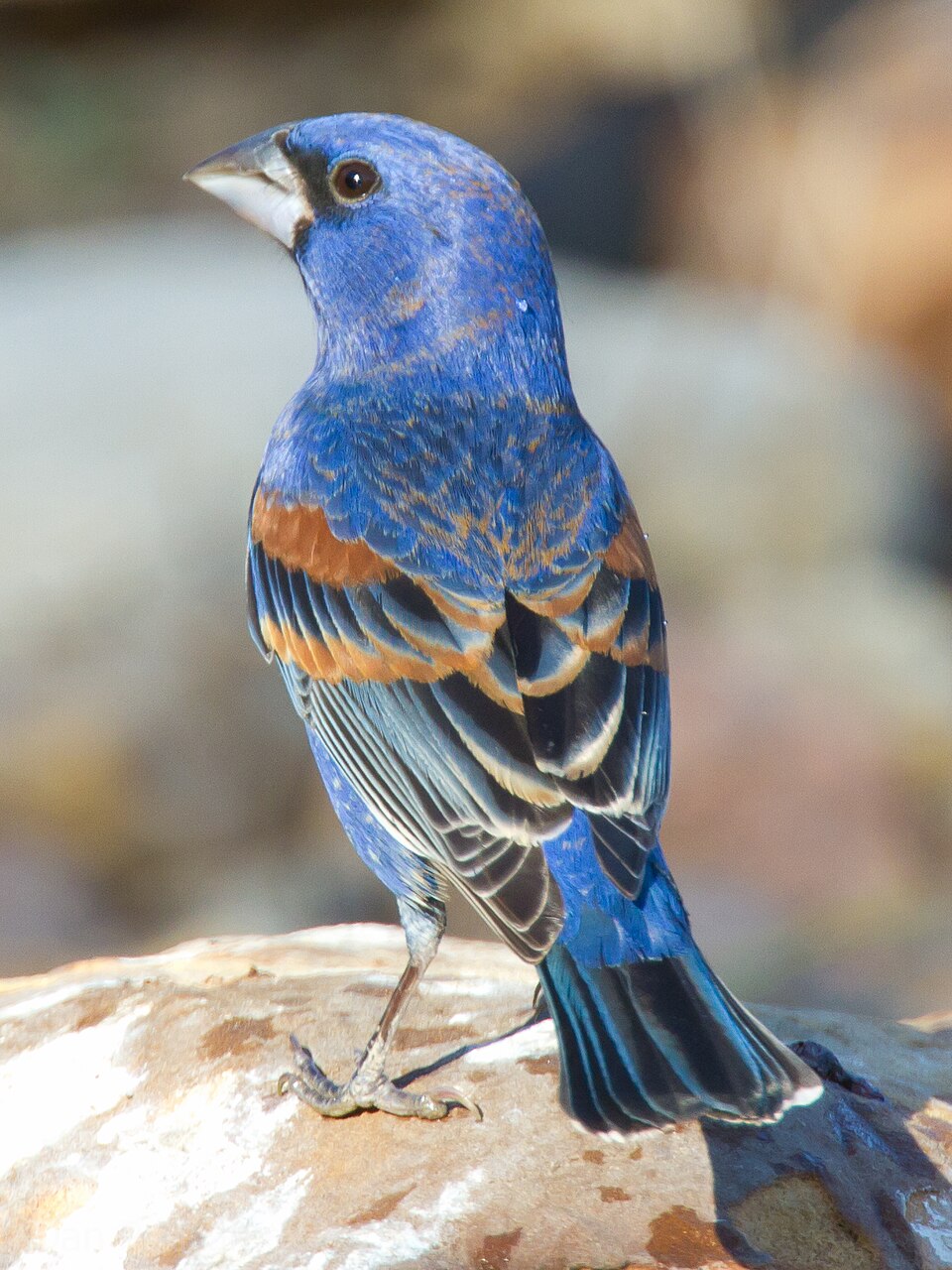
The Blue Grosbeak is a richly colored songbird of brushy fields, woodland edges, and overgrown roadsides across the southern half of the United States. Despite its name and bunting-blue plumage, it is noticeably larger and chunkier than its cousins the Indigo and Lazuli buntings, with an oversized, silvery bill built for crushing seeds and large insects. A breeding male in good light is a striking deep cobalt blue set off by two warm chestnut wingbars, but in poor light or at a distance he can look surprisingly dark, almost black.
Though widespread, Blue Grosbeaks are often overlooked because they favor scrubby, weedy habitat that birders tend to drive past, and because they spend a lot of time perched quietly or foraging low in dense cover. Patient observers learn to find them by listening for the male's rich warbling song delivered from an exposed perch on a wire, fence post, or tall weed. Once you know the habitat and the song, they turn out to be a regular summer presence across much of the South and the lower Midwest.
This is a stocky, big-headed songbird about the size of a House Sparrow but heavier-looking, with a thick conical bill that looks almost too large for the bird. The short tail is often flicked or spread, and the overall impression is a compact, deliberate bird rather than a slim, active warbler-type.
| Adult male | Deep cobalt-blue overall, often looking dark; two broad chestnut-rufous wingbars; black around the base of the bill |
| Bill | Very large and conical, silvery-gray, the single best mark separating it from buntings |
| Female | Warm cinnamon-brown overall, paler below, with buffy to tawny wingbars and often a faint blue wash on the rump and shoulders |
| Wingbars | Two rusty or buff wingbars present in all plumages, a key field mark at any season |
| Size & shape | Stocky, large-headed, short-tailed; clearly bigger and bulkier than an Indigo Bunting |
| Behavior | Frequently flicks and spreads its tail; perches in the open to sing |
Male vs. female
Breeding males are unmistakable when seen well: deep blue all over with two contrasting chestnut wingbars and a small patch of black feathering near the bill. Females and immatures are a rich cinnamon- or rusty-brown, paler on the belly, with buffy wingbars and frequently a hint of blue on the rump, shoulders, or tail that confirms the identification. In fall and winter, males molt into a browner, scaled-looking plumage with blue feathers showing through unevenly, so a patchy blue-and-brown bird in late summer is almost always a Blue Grosbeak.
Juveniles
Juvenile Blue Grosbeaks are warm brown and resemble adult females but look plain and unmarked at first, soon showing the characteristic two rusty wingbars. First-year males spend their first spring and summer in a mix of brown body feathers and scattered blue, which can make them look blotchy; they still sing and breed in this immature plumage. The heavy silver bill is obvious even on young birds and is the most reliable mark for separating them from the smaller buntings.
The male's song is a rich, rapid, sweet warble that rises and falls in pitch, often described as a jumbled, musical phrase lasting a couple of seconds. It is fuller and more burry than the bright, paired phrases of an Indigo Bunting, with a slightly husky, rolling quality. Males sing persistently through the heat of summer, frequently from a conspicuous perch atop a shrub, weed stalk, fence wire, or small tree.
The most distinctive call is a sharp, metallic chink or tink, loud and percussive, that often gives the bird away before it is seen. In flight or when agitated they may also give a buzzy, twittering note. Learning the explosive chink call is one of the quickest ways to detect this species in brushy habitat.
The Blue Grosbeak is a long-distance migrant that breeds across the southern United States, from California and the Southwest eastward through the southern Great Plains and the Southeast, and north along river valleys into the lower Midwest and Mid-Atlantic. Its breeding range has been expanding gradually northward in recent decades.
It is strictly a summer resident in the U.S., arriving from late April into May and departing by September and October. Birds winter in Mexico and Central America, with some reaching as far as Panama. During migration they can turn up at brushy edges and weedy fields well outside the breeding range, so an out-of-place grosbeak in spring or fall is worth a second look.
Blue Grosbeaks eat a mix of insects and seeds, with the balance shifting toward animal prey in the breeding season. They take grasshoppers, crickets, beetles, caterpillars, cicadas, mantises, and other large invertebrates, and that heavy bill lets them handle tough-bodied insects that smaller songbirds avoid. They also eat spiders and snails.
Outside of nesting, seeds and grain make up much of the diet, including the seeds of grasses, weeds, and waste grain in fields, plus some wild fruits. Birds typically forage low, on the ground, in weedy growth, or in shrubs, moving deliberately and often staying hidden in cover until they pop up to a perch.
The female builds a compact open cup nest low in a shrub, tangle, vine, or small tree, usually within a few feet of the ground in dense brushy cover near an open field. The nest is woven from grasses, weed stems, leaves, and rootlets, and is frequently lined with finer material; pairs sometimes incorporate snakeskin, paper, or other found items into the structure.
The female lays a clutch of pale blue, unmarked eggs and does most or all of the incubation, with the male helping to feed the young once they hatch. Pairs often raise two broods in a season across much of the range. Like many open-cup nesters in scrubby habitat, Blue Grosbeaks are regular hosts to Brown-headed Cowbird parasitism.
Blue Grosbeaks are not classic feeder birds, but they do visit yards in the right setting, especially rural properties bordering fields, hedgerows, or weedy edges within their summer range. They are far more likely to show up where habitat suits them than because of any single feeder.
- Offer white millet and sunflower seeds on or near the ground or on platform feeders, which suits their seed-eating, low-foraging habits better than tube feeders.
- Leave a weedy, brushy edge or unmowed field margin near your yard, this is the single biggest draw, since they nest and forage in scrubby cover.
- Provide a ground-level or low birdbath; like many seed-eaters they readily come to water in hot summer weather.
- Skip the pesticides so grasshoppers, crickets, and other large insects remain available, especially during the breeding season.
- Expect them only in summer and only within their southern U.S. breeding range, a yard far north or a winter sighting is highly unlikely.
- Listen for the loud metallic chink call and scan fence wires and weed tops, where males perch in the open to sing.
- Indigo Bunting: Smaller and slimmer with a much smaller bill and no chestnut wingbars; males are a brighter, more uniform blue.
- Lazuli Bunting: Smaller western bird; male has a turquoise head, orange breast, and white belly rather than all-over deep blue.
- Eastern Bluebird: Has a thin insect-eating bill, a rusty breast, and a slimmer build; lacks the heavy conical bill and chestnut wingbars.
- Brown-headed Cowbird: A dark male can recall a Blue Grosbeak at a glance, but it has a thinner bill, a brown head, and no wingbars.
Is a Blue Grosbeak the same as an Indigo Bunting?
No, though they are closely related and can look similar. The Blue Grosbeak is noticeably larger and stockier, has a much heavier silver bill, and shows two chestnut wingbars that the Indigo Bunting lacks. Indigo Bunting males are a brighter, more uniform blue with a small bill.
What does a female Blue Grosbeak look like?
Females are warm cinnamon- or rusty-brown overall, paler below, with two buffy wingbars and often a faint blue wash on the rump, shoulders, or tail. The large conical bill and rusty wingbars help separate them from female buntings and sparrows.
Where do Blue Grosbeaks live?
They breed in brushy fields, woodland edges, hedgerows, and overgrown roadsides across the southern United States in summer, then migrate to Mexico and Central America for the winter. Their range has been slowly expanding northward.
Will Blue Grosbeaks come to a backyard feeder?
Sometimes, mainly in rural yards near fields and brushy habitat within their summer range. They prefer millet and sunflower seed on or near the ground rather than tube feeders, and they are far more drawn to weedy edges and natural cover than to feeders alone.
What sound does a Blue Grosbeak make?
Males sing a rich, rapid, slightly burry warble that rises and falls, fuller than an Indigo Bunting's song. The most distinctive sound is a loud, sharp metallic chink call that often reveals the bird before you see it.