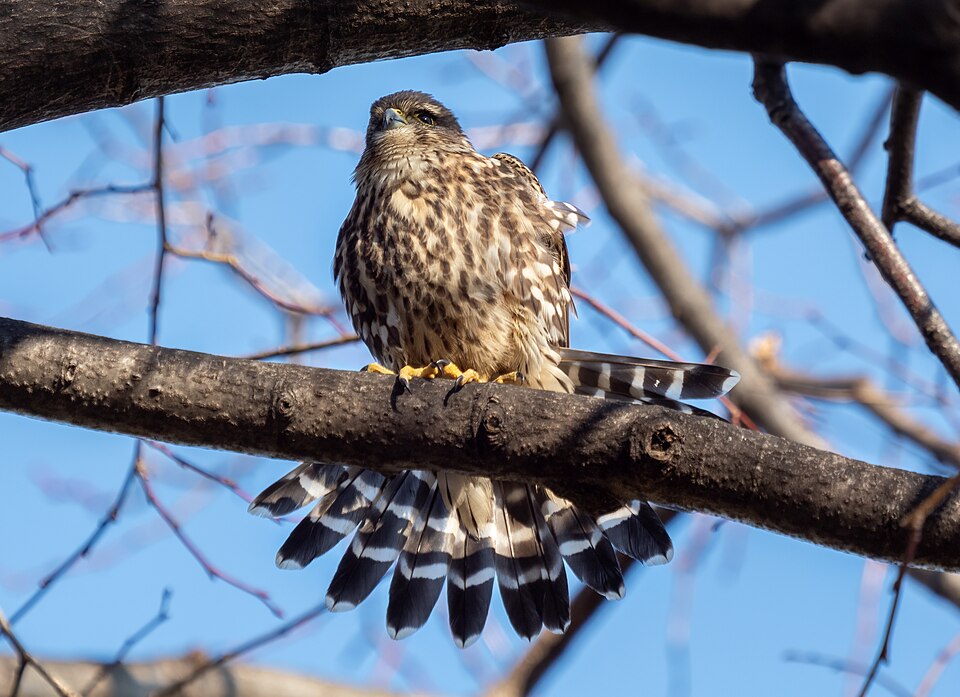
The Merlin is a small, compact falcon with an outsized reputation. Barely bigger than a jay, it is built like a feathered missile: broad-chested, short-tailed, and capable of running down songbirds in flat-out horizontal pursuit rather than the steep dives favored by its larger cousins. Where a kestrel hovers and a Peregrine stoops, the Merlin simply chases, twisting low over open ground until it overtakes its prey through sheer speed and persistence. Falconers have prized it for centuries, and once you have watched one slice across a winter field you understand why.
Merlins breed across the northern forests and prairies of North America, Europe, and Asia, and spend the colder months spread widely across temperate and subtropical regions. In recent decades they have made a notable move into towns and cities, nesting in conifers in parks and neighborhoods where flocks of House Sparrows and waxwings offer easy hunting. For many birders, a Merlin is a thrilling cold-season surprise: a dark, fast shape perched bolt-upright on a bare treetop, surveying everything that moves.
Look for a small but powerfully built falcon, noticeably stockier and darker than an American Kestrel. The Merlin has long, pointed, swept-back wings, a relatively short tail, and rapid, stiff, almost rowing wingbeats. Perched, it sits upright and alert, often on an exposed snag or pole. Unlike the kestrel, it shows no bold facial pattern and almost never hovers.
| Size & shape | Small, chunky falcon with a broad chest, pointed wings, and a medium-short, banded tail. |
| Face | Plain face with only a faint, weak mustache mark, not the bold double stripe of a kestrel or Peregrine. |
| Underparts | Heavily streaked breast and belly, the streaks coarse and dark on a buffy or whitish ground. |
| Tail | Dark tail with narrow pale bands and a white tip, often fanned briefly on landing. |
| Flight | Fast, direct, powerful wingbeats low to the ground; chases prey in level pursuit rather than hovering. |
| Upperparts | Color varies by subspecies from slate-blue (males) to dark gray-brown or sooty (females and some western birds). |
Male vs. female
Adult males and females differ mainly in the color of the upperparts. Males are slate blue-gray above, while females and immatures are browner, ranging from gray-brown to a dark chocolate, depending on the subspecies. Females are also distinctly larger, as is typical of falcons. Both sexes show streaked underparts and a banded tail, so on a brief look the blue back of an adult male is the clearest clue to sex. Regional populations add complication: prairie birds tend to be paler, while the "Black" Merlin of the Pacific Northwest is very dark and sooty in both sexes.
Juveniles
Juvenile Merlins closely resemble adult females: brown above rather than blue, with heavily streaked underparts and a brown, narrowly banded tail. Young birds may look slightly more uniformly dark and can have buffier edges to the back feathers in fresh plumage. Because first-year males are brown like females, you generally cannot age and sex a Merlin by the blue back until it has molted into adult plumage.
Merlins are usually silent away from the nest, which is part of what makes them feel so stealthy in winter. Around the breeding territory, though, they become vocal and noisy in defense. The signature sound is a rapid, strident, chattering series, a sharp ki-ki-ki-ki-ki or klee-klee-klee, higher and faster than a kestrel's call, delivered when an intruder approaches.
Females give a softer, more drawn-out wailing or whining note when begging food from the male, and both birds use various chips and chitters during courtship and food exchanges. If you hear an angry, machine-gun chatter erupt from a conifer in a city park in spring, look up: there may be a Merlin nest nearby.
Merlins breed across the boreal forest, northern prairies, and parklands of Canada, Alaska, the northern United States, and across northern Eurasia. The species is split into several subspecies that differ in color and habitat, from the pale prairie birds of the Great Plains to the dark Pacific coastal form and the gray taiga form.
In winter they spread south and become widespread across the United States, Mexico, the Caribbean, and into Central and northern South America, as well as throughout temperate Europe, North Africa, and southern Asia. Migration peaks in fall along coastlines and ridgelines, where hawkwatchers count good numbers shadowing the same shorebird and songbird flocks the Merlins feed on. A growing number now winter in towns and cities, drawn by abundant small-bird prey.
The Merlin is overwhelmingly a hunter of small birds, taken in the air after fast, low chases. Larks, pipits, sparrows, finches, waxwings, and small shorebirds are all regular prey, and a single Merlin will often key in on a flock and harry it relentlessly until it picks off a straggler. They are aggressive and confident well above their weight class, sometimes attacking birds nearly their own size.
Beyond birds, Merlins take dragonflies and other large insects (especially in late summer), small mammals such as voles, and occasionally bats. They hunt from a perch or on the wing, using surprise and speed; one favorite tactic is a fast low approach hugging the terrain so prey has little time to react. Excess prey is sometimes cached for later.
Merlins do not build their own nests. Instead they take over old stick nests built by crows, magpies, ravens, or hawks, usually in a conifer or, on the prairies, in trees in shelterbelts and farmyards. Some populations nest on cliff ledges or, in treeless tundra, on the ground. This reliance on corvid nests has helped them colonize towns, where magpie and crow nests are plentiful.
The female lays a clutch of typically 3 to 5 reddish-brown, heavily blotched eggs and does most of the incubating over roughly four weeks while the male hunts and delivers food. Chicks fledge at about a month old but stay dependent on their parents for several more weeks as they learn to hunt. Pairs raise a single brood per year.
The Merlin is not a feeder bird in any conventional sense, you will never lure one with seed or suet. What it wants is prey, and ironically a busy feeding station can attract one indirectly by concentrating the small birds it hunts. You are far more likely to see a Merlin perched nearby, watching your feeder flock, than visiting it. To increase your odds, focus on habitat and timing rather than food.
- Watch open habitats, fields, shorelines, marshes, and city parks with conifers, especially in fall and winter when Merlins move south.
- Scan exposed perches: Merlins love to sit bolt-upright on bare treetops, snags, poles, and antennas surveying for prey.
- Keep an eye on your own feeder flock; a sudden, total scatter of small birds can mean a Merlin (or other raptor) has arrived.
- In cities, check tall conifers in parks and older neighborhoods during the breeding season for nesting pairs.
- Join a fall hawkwatch on a coastline or ridge, where migrating Merlins are tallied as they shadow songbird and shorebird flocks.
- Look early and late in the day, when Merlins are most actively hunting.
- American Kestrel: Slimmer and more colorful, with two bold black face stripes, rusty back and tail, and a habit of hovering, the Merlin is darker, stockier, plainer-faced, and never hovers.
- Peregrine Falcon: Much larger and longer-winged with a bold black helmet and mustache; the Merlin is far smaller and plainer-faced.
- Sharp-shinned Hawk: A small accipiter with short rounded wings and a long tail, flying flap-flap-glide; the Merlin has pointed falcon wings and steady powerful wingbeats.
- Prairie Falcon: Larger and sandy-brown with dark 'armpits' visible in flight; the Merlin is smaller, darker, and more uniformly streaked below.
How can I tell a Merlin from an American Kestrel?
Kestrels are slimmer and brightly colored with two bold black stripes on the face and a rusty back and tail, and they frequently hover while hunting. Merlins are stockier and darker, have a plain face with at most a faint mustache, and chase prey in fast level flight rather than hovering.
Is the Merlin related to the Merlin bird app?
Yes, the popular Merlin Bird ID app from the Cornell Lab of Ornithology is named after this falcon. The app helps identify birds by photo, sound, and description, but it is a software tool, not the bird itself.
Do Merlins eat backyard birds?
They can. Merlins are specialist hunters of small birds and will sometimes patrol feeder areas where sparrows, finches, and waxwings gather. If your feeder flock suddenly scatters and goes silent, a Merlin or another small raptor may be nearby.
Where do Merlins live in winter?
In winter Merlins spread widely across the United States, Mexico, the Caribbean, and Central America, as well as temperate Europe, North Africa, and southern Asia. Many favor open country, coastlines, and increasingly towns and cities with abundant small-bird prey.
Are Merlins rare?
No, Merlins are fairly common and listed as Least Concern, though they are easy to miss because they are small, fast, and often silent. Their populations rebounded after the DDT era, and they have adapted well to nesting in towns.