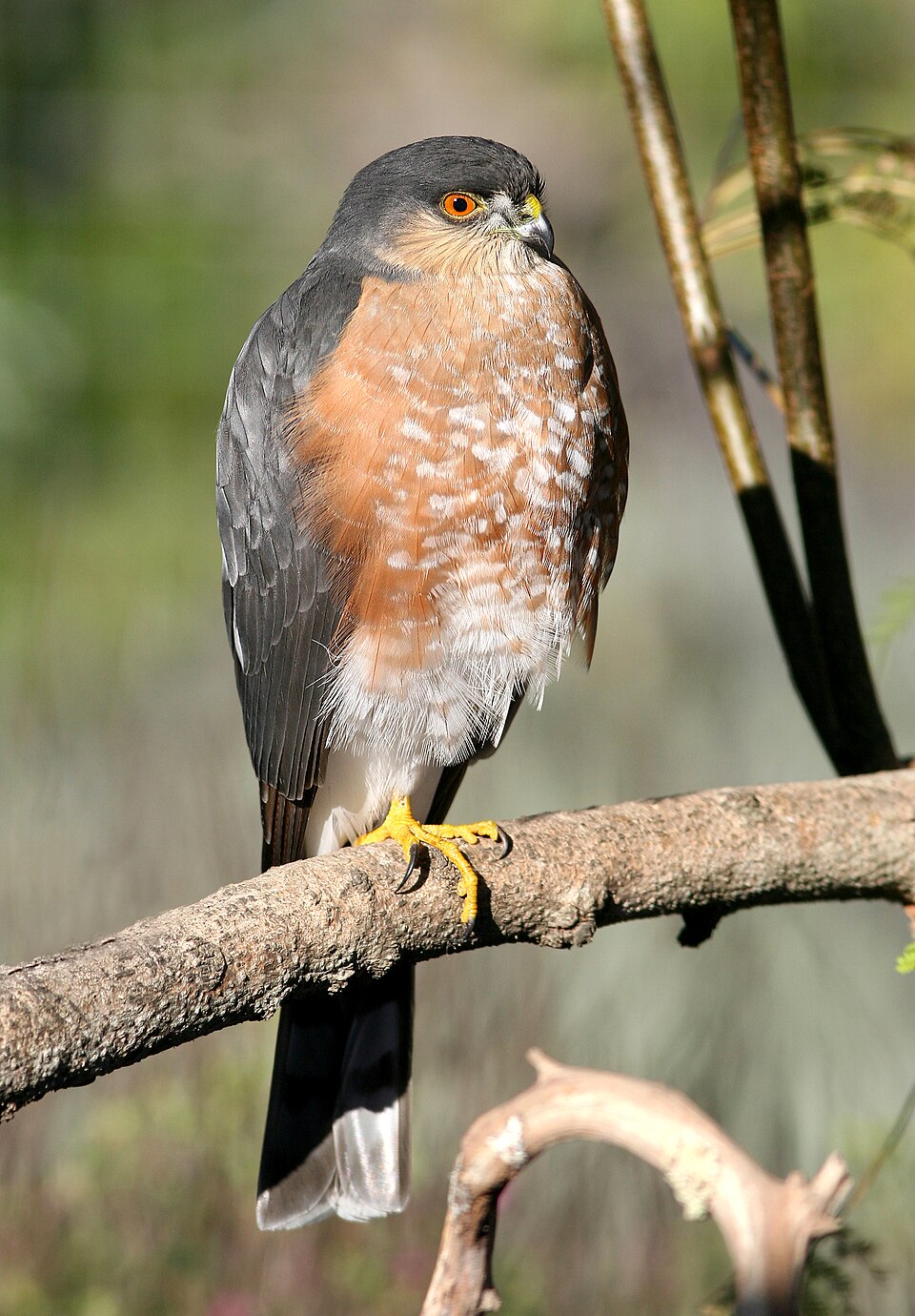
The Sharp-shinned Hawk is the smallest of North America's accipiters, a slim, long-tailed forest hawk built for chasing small birds through tangled cover. Many people meet their first "sharpie" not in the woods but in the backyard, when a compact, blue-gray raptor suddenly scatters the goldfinches and snatches one in mid-flight. It is a bird that lives by stealth and short bursts of blistering speed rather than the soaring patience of buteos like the Red-tailed Hawk.
Despite being widespread and fairly common, Sharp-shinned Hawks can be maddeningly hard to pin down. They are secretive nesters in dense conifers, they migrate by the thousands along ridgelines and coastlines every autumn, and they are routinely confused with their larger near-twin, the Cooper's Hawk. Learning to read their proportions, flight style, and behavior is one of the classic puzzles of North American birding, and a genuinely rewarding one to crack.
Think small, slim, and long-tailed. A Sharp-shinned Hawk has short, rounded wings and a comparatively long, narrow tail, the classic accipiter shape that lets it thread through branches at speed. The head looks small and is held close to the wings in flight, giving a slightly hunched, "no neck" silhouette. Females are noticeably larger than males, but even the biggest female is roughly jay-to-pigeon scale.
| Size & shape | Small, slim accipiter with short rounded wings and a long tail; smaller-headed and more delicate than Cooper's Hawk. |
| Adult upperparts | Slate blue-gray back, wings, and crown in adults. |
| Adult underparts | Fine rusty-orange barring across a pale breast and belly, looking warm and finely striped. |
| Tail | Squared or slightly notched tip with a thin, often inconspicuous pale terminal band; bold dark bands across the tail. |
| Eyes | Red to deep orange in adults, yellow to orange in younger birds; set forward on a small head. |
| Legs | Very thin, pencil-like yellow legs, the trait behind the name 'sharp-shinned.' |
Male vs. female
Males and females wear the same plumage, so the difference is size, and it is dramatic for a bird. Females are about a third larger than males and can weigh nearly twice as much, sometimes approaching the size of a small male Cooper's Hawk. A male Sharp-shinned can be barely bigger than an American Robin, while a female is closer to a small pigeon. In a nesting pair the size gap is obvious; on a lone migrating bird it is one reason size alone is a treacherous field mark.
Juveniles
Juveniles look completely different from adults and are what most people see in fall and winter. They are brown above rather than blue-gray, with pale yellow eyes, and their underparts are streaked with coarse brown rather than barred with rust. The streaking is typically thick, blurry, and reddish-brown, often heaviest on the breast, which can help separate them from young Cooper's Hawks that tend to show crisper, finer streaking. Birds keep this brown immature plumage through their first year before molting into the gray adult dress.
Sharp-shinned Hawks are quiet most of the year and rarely heard away from the nest. The main vocalization is a sharp, high, repeated alarm call, a thin kik-kik-kik-kik or kew-kew-kew delivered rapidly when a bird is agitated near its nest or defending territory. It is higher and squeakier than the deeper, more barking cak-cak-cak of a Cooper's Hawk, though the two can be tricky to tell apart by ear.
Around the nest you may also hear softer, squealing or whining notes between mates, and begging young can be loud and persistent. Outside the breeding season, expect mostly silence, this is a hawk you spot rather than hear.
The Sharp-shinned Hawk breeds across much of Canada, Alaska, the northern and montane United States, and down through forested highlands into Mexico and Central America, with resident populations farther south. It favors dense conifer and mixed forest for nesting and is easy to miss during the breeding season because it stays hidden in the canopy.
It is a famous migrant. Northern breeders move south in large numbers each autumn, streaming along ridgelines, lake shores, and coastlines where hawk watchers tally them in the thousands at sites like Hawk Mountain and Cape May. In winter, sharpies spread across the southern U.S., Mexico, and Central America, and many move into towns and suburbs, which is when feeder-watchers most often encounter them. Some southern and coastal populations stay put year-round.
Small birds are the heart of the diet, and the Sharp-shinned Hawk is built for catching them. It hunts by surprise, using cover to approach low and fast, then bursting out to grab a sparrow, finch, warbler, or junco in the air or off a perch. Songbirds up to the size of robins are fair game; females, being larger, take bigger prey than males. It also eats some small mammals, large insects, and occasionally bats or lizards.
This is why a sharpie is both thrilling and unwelcome at a bird feeder. A busy feeding station is essentially a buffet, and these hawks quickly learn to patrol them. They typically pluck prey before eating and may carry a catch to a regular feeding perch or "plucking post" littered with feathers.
Sharp-shinned Hawks nest secretively, usually in dense conifers within unbroken forest. The pair builds a fairly large, flattish stick platform placed against the trunk or on horizontal branches, often well up in the tree and screened by foliage. They tend to choose well-concealed sites and can be aggressive in defending the immediate nest area.
The female does most of the incubating while the male delivers food, a division of labor typical of accipiters. Clutches are usually 4 to 5 pale, blotched eggs, and the species typically raises a single brood per year. After hatching, the male keeps hunting for the family while the female broods and feeds the young; the chicks fledge in roughly a month but depend on the parents for several more weeks while they learn to hunt.
You don't attract a Sharp-shinned Hawk on purpose so much as inherit one. It isn't a feeder bird in the usual sense, it's a predator that comes for your feeder birds. A well-stocked feeding station naturally draws sharpies in fall and winter, and seeing one is a sign your yard supports a healthy songbird population. Whether you welcome that is up to you.
- A busy feeder full of finches, sparrows, and juncos is the single biggest draw, the hawk follows the prey, not the seed.
- Native shrubs and brushy cover give both songbirds and the hunting hawk the habitat they use; sharpies hunt from edges and tangles.
- If a hawk is hitting your feeders too hard, take the feeders down for a week or two, the songbirds disperse and the hawk moves on.
- Place feeders either within about 3 feet of a window or more than 10 feet away to reduce panicked window strikes during hawk attacks.
- Provide dense escape cover (evergreens, brush piles) so songbirds have somewhere to dive, this is healthier than an exposed feeding area.
- Remember that predation is natural and legal protection applies, never harm or harass a hawk; it's protected under the Migratory Bird Treaty Act.
- Cooper's Hawk: Larger and bulkier with a bigger head that projects well past the wings in flight, a rounded tail tip with a broad white band, and steadier wingbeats. The hardest and most important species to separate from a sharpie.
- Northern Goshawk: Much larger and heavier accipiter; adults are pale gray below with a bold white eyebrow stripe and dark cap. Far bigger and more powerful than a Sharp-shinned.
- American Kestrel: Similar small size but a falcon, with long pointed wings, a rufous back and tail, and bold facial markings; hovers over open ground rather than chasing birds through cover.
- Merlin: Compact falcon of similar size that also chases small birds, but has pointed wings, a streaked breast, and faster, more powerful direct flight without the accipiter's flap-flap-glide.
How do I tell a Sharp-shinned Hawk from a Cooper's Hawk?
Look at proportions rather than raw size. Sharp-shinned Hawks have a small head that barely projects past the wings, a squared or notched tail tip with a thin pale band, and a quick, flicking flap-flap-glide flight. Cooper's Hawks have a larger, more projecting head, a rounded tail with a broad white tip, and steadier wingbeats. Size overlaps because female sharpies and male Cooper's are similar in size, so don't rely on size alone.
Why is a hawk attacking the birds at my feeder?
That's almost certainly a Sharp-shinned or Cooper's Hawk, and it's doing exactly what it evolved to do, hunting the small birds your feeder concentrates. It's natural and a sign of a healthy bird community. If it bothers you, simply take your feeders down for a week or two and the hawk will move on to find food elsewhere.
Is the Sharp-shinned Hawk the smallest hawk in North America?
Yes, it's the smallest accipiter and the smallest true hawk on the continent. Males in particular are tiny, barely larger than an American Robin. The American Kestrel is a smaller raptor overall, but it's a falcon, not a hawk.
What sound does a Sharp-shinned Hawk make?
They're usually silent, but near the nest they give a sharp, high, rapid alarm call, a thin kik-kik-kik or kew-kew-kew. It's higher and squeakier than the deeper barking call of a Cooper's Hawk. Away from the breeding season you'll rarely hear them at all.
Should I stop feeding birds if a hawk shows up?
You don't have to, but you can. Predation is legal and natural, and hawks are protected, so harming them isn't an option. If you want to break the cycle, take feeders down for one to two weeks so the songbirds disperse; the hawk loses its easy meal and moves on. Adding dense escape cover nearby also gives songbirds a fighting chance.