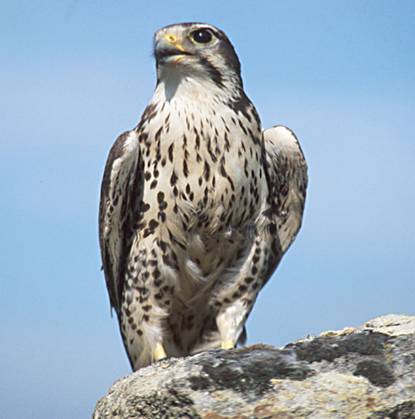
The Prairie Falcon is the bird of the wide-open, dry West: a powerful, sandy-brown falcon that hunts low and fast over sagebrush flats, shortgrass prairie, and the badlands of the Great Basin. Roughly the size of a Peregrine but built for hot, treeless country, it spends its days quartering the ground for ground squirrels and small birds, then retreats to a sheer cliff face to roost. Where the Peregrine is the celebrity of coastlines and cities, the Prairie Falcon is the quieter specialist of the interior West, and many birders go years before getting a good look at one.
It is a bird shaped by harsh, sun-baked landscapes. Its pale, dusty coloring blends into eroded canyon walls and dry grassland, and it tolerates extremes of heat and cold that few other raptors face by choice. Although the species is doing reasonably well overall, it depends on a few specific things: cliffs or steep banks for nesting, healthy populations of ground squirrels, and large blocks of open habitat that haven't been plowed or paved. Watching one streak across a desert basin is one of the great experiences of birding the American West.
A Prairie Falcon is a medium-large falcon with the classic falcon silhouette: a compact, deep-chested body, long pointed wings, and a fairly long tail. In flight it looks pale and "dirty" sandy-brown above rather than slaty, and the single best mark is a dark patch in each "wingpit" (the axillaries and inner underwing) that shows as a black smudge on otherwise pale underwings.
| Upperparts | Sandy or dusty brown above, not blue-gray; can look faded and washed-out, especially in worn plumage. |
| Underwing patch | Dark blackish-brown patches in the 'armpits' and along the inner underwing coverts - the key field mark, visible from below in flight. |
| Face pattern | Narrow, faint dark mustache mark and a pale line behind the eye; the face looks much paler and less hooded than a Peregrine's. |
| Underparts | Whitish to buff below with fine brown spotting or streaking, not heavily barred. |
| Size & shape | Peregrine-sized but slimmer-winged, with a relatively long tail; pointed wings and quick, shallow wingbeats. |
| Bare parts | Yellow legs, cere, and eye-ring in adults; dark eye. |
Male vs. female
Male and female Prairie Falcons look essentially identical in plumage, so you can't reliably tell them apart by color or markings in the field. As with most falcons, the difference is size: the female is noticeably larger and heavier than the male, sometimes appearing close to a third bulkier. When a pair is perched together or hunting near each other, the size gap can be obvious, but a lone bird usually can't be sexed visually.
Juveniles
Juveniles look much like adults but tend to be more heavily and coarsely streaked below, with the underparts often appearing darker and dingier than the cleaner-looking adult. Young birds typically show bluish or pale gray legs, cere, and eye-ring rather than the bright yellow of adults, and their upperpart feathers are crisply fresh and pale-edged early in the first year. As they mature, the bare parts turn yellow and the underpart streaking becomes finer.
Prairie Falcons are not songbirds and are usually silent away from the nest, but they get noisy and aggressive when defending their territory or cliff. The signature sound is a loud, repeated, scolding kik-kik-kik-kik or kree-kree-kree, harsher and more grating than the calls of smaller falcons. It's often delivered while the bird circles and dives at an intruder near the nest ledge.
Near the nest you may also hear a softer, chattering chup or whining notes between mates, and begging young can produce persistent rasping calls. Most of the year, though, a Prairie Falcon you encounter hunting over open ground will give you no vocal clues at all.
The Prairie Falcon is a bird of western North America, found across the arid and semi-arid interior from southern Canada through the Great Basin, the Rocky Mountain region, the Great Plains, and the deserts of the Southwest, down into northern Mexico. It favors open country: shortgrass and mixed prairie, sagebrush steppe, alpine tundra edges, deserts, and agricultural land, almost always within reach of cliffs, canyons, or steep banks for nesting.
It is largely a short-distance and altitudinal migrant rather than a long-haul traveler. Many birds shift after breeding, with some moving from high-elevation or northern breeding grounds to lower, more open wintering areas, and birds can wander east onto the plains in winter following prey. Overall, much of the population stays within the western interior year-round, simply relocating to wherever food is most available.
The Prairie Falcon is a versatile predator with a strong appetite for ground squirrels - in many areas, ground squirrels and other small mammals make up the bulk of the breeding-season diet. It also takes a wide variety of birds, from horned larks and meadowlarks up to the size of small ground-dwelling species, as well as the occasional reptile or large insect.
Its hunting style sets it apart from the high-stooping Peregrine. Prairie Falcons often hunt by flying fast and low over the ground, using the contours of the terrain to surprise prey, then making a sudden dash to seize a squirrel at its burrow or flush a bird and run it down. They will also still-hunt from a perch or a low circling flight, dropping in fast pursuit. This low, contour-hugging attack is well suited to open, broken country.
Prairie Falcons don't build a nest of their own. They lay their eggs in a scrape - a shallow depression scratched into the dirt or gravel of a sheltered cliff ledge, a pothole, or a small cave in a canyon wall. They will also use old stick nests built by other species such as ravens or hawks, and occasionally human-made structures or quarry walls. A protected, inaccessible ledge with an overhang is the classic site.
The female lays a typical clutch of three to five eggs, which are pale and heavily marked with reddish-brown spotting. She does most of the incubation over roughly a month while the male delivers food, and the pair shares feeding once the chicks hatch. Young birds fledge several weeks later and then depend on their parents while they learn to hunt. The species normally raises a single brood per year.
The Prairie Falcon is not a backyard or feeder bird, and there's no realistic way to draw one to a typical yard. It's a wide-ranging predator of open western landscapes that needs cliffs to nest and lots of room to hunt. Instead of attracting it, the goal is to find it where it lives.
- Look in open western country - sagebrush flats, shortgrass prairie, deserts, and badlands - rather than woodlands or suburbs.
- Scan cliffs, canyon rims, and steep dirt banks, which the species depends on for nesting and roosting.
- Watch for a falcon hunting low and fast over the ground rather than soaring high; that contour-hugging flight is a strong clue.
- In flight from below, check the dark 'armpit' patches on the pale underwings - the single most reliable way to clinch the ID.
- Try winter on the Great Plains and in agricultural valleys, where birds disperse to hunt and can be easier to find perched on poles or fenceposts.
- If you own rural land in the West, supporting native grassland and ground-squirrel habitat helps the prey base these falcons rely on.
- Peregrine Falcon: Slaty blue-gray above (not sandy-brown), with a bold dark hood/mustache and no pale underwing 'armpit' patches; hunts with high, dramatic stoops.
- Gyrfalcon: Much larger and bulkier with broader wings; an Arctic bird that rarely overlaps in range, and lacks the dark underwing patches.
- Merlin: Much smaller and stockier with quick, dashing flight; darker overall and without the pale sandy tone and dark wingpits of a Prairie Falcon.
- American Kestrel: Far smaller and more colorful, with rusty back and tail and two facial stripes; often hovers, which Prairie Falcons rarely do.
How do you tell a Prairie Falcon from a Peregrine Falcon?
Color and underwing pattern are the keys. A Prairie Falcon is pale sandy-brown above with a faint mustache and shows dark blackish patches in the 'armpits' on otherwise pale underwings. A Peregrine is slaty blue-gray above with a bold dark hood and heavy mustache, and lacks those dark wingpit patches. Prairie Falcons also tend to hunt low over the ground, while Peregrines are famous for high, plunging stoops.
Where do Prairie Falcons live?
They live in the arid and semi-arid interior of western North America, from southern Canada through the Great Basin, Rockies, and Great Plains down into the deserts of the Southwest and northern Mexico. They favor open country - sagebrush, shortgrass prairie, and desert - always near cliffs or steep banks for nesting.
What do Prairie Falcons eat?
Ground squirrels and other small mammals make up a large part of their diet, especially in the breeding season, along with many small to medium birds such as horned larks and meadowlarks. They will also take reptiles and large insects when available.
Are Prairie Falcons rare or endangered?
No. The Prairie Falcon is listed as Least Concern and is fairly common in suitable western habitat, though it's local and easy to miss because it ranges widely over open country. The main long-term concerns are loss of native grassland and disturbance at cliff nest sites.
Will Prairie Falcons come to a backyard or bird feeder?
No. They are open-country predators that need cliffs to nest and large areas to hunt mammals and birds, so they don't visit feeders or typical yards. The best way to see one is to go birding in open western landscapes with nearby cliffs or canyons.