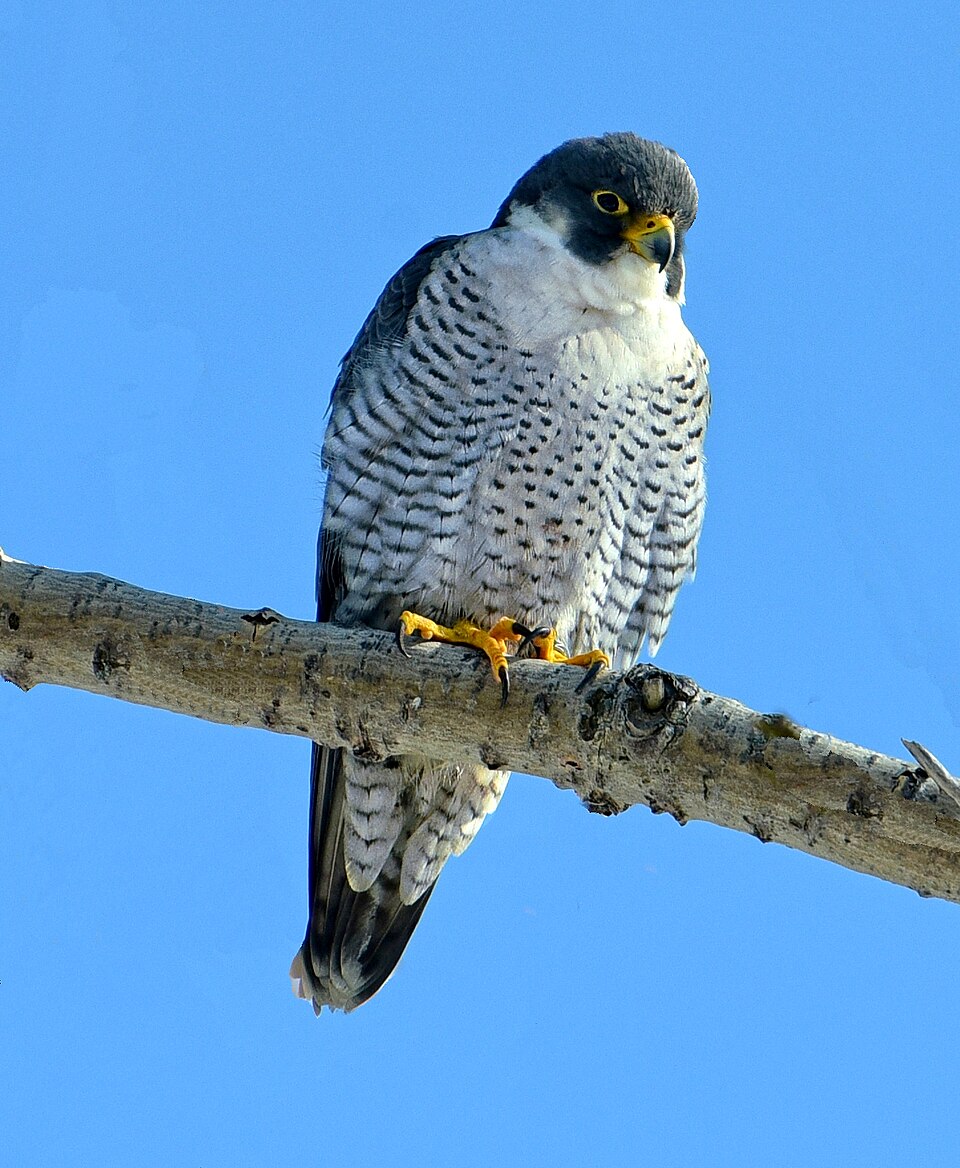
The Peregrine Falcon is one of the most celebrated raptors in the world, and for good reason: in a hunting stoop it can exceed 200 miles per hour, making it the fastest animal alive. It is a crow-sized falcon built like a fighter jet, with long, pointed wings, a barrel chest, and a no-nonsense expression framed by a heavy dark "helmet" and sideburns. Across open country, coastlines, river gorges, and increasingly the concrete canyons of big cities, Peregrines specialize in catching other birds in mid-air with breathtaking precision.
This bird also has one of conservation's great comeback stories. By the mid-20th century, the pesticide DDT had thinned eggshells so badly that Peregrines vanished from the entire eastern United States and crashed across much of their range. After DDT was banned and captive-bred birds were released, populations rebounded dramatically, and the species was removed from the U.S. Endangered Species List in 1999. Today many people get their best looks at one perched on a bridge girder or a skyscraper ledge, hunting the pigeons of downtown.
Shape is the first clue. A Peregrine is a stocky, powerful falcon with long, tapered wings that come to a sharp point and a relatively short, tapered tail. In flight it shows the classic falcon silhouette - anchor-shaped on the glide, with stiff, shallow, rowing wingbeats - and it flies with purpose, rarely soaring lazily the way a buteo hawk does.
| Head | Bold dark "helmet" with a thick black malar stripe (sideburn) framing a pale throat and cheek - the single most reliable mark |
| Upperparts | Slate blue-gray to blackish on the back and wings in adults |
| Underparts | Pale, whitish to buff chest fading to fine dark barring on the belly, flanks, and underwings |
| Wings | Long and pointed; in flight the whole bird looks sharply swept-back and powerful |
| Size | Crow-sized and heavy-bodied - clearly larger and bulkier than a Merlin or kestrel |
| Bare parts | Yellow legs, yellow cere and eye-ring, dark hooked bill with a falcon's "tooth" notch |
Male vs. female
Males and females look essentially identical in plumage - same slate-gray back, helmeted head, and barred underparts - so you cannot reliably sex them by color in the field. The clearest difference is size: like most birds of prey, the female is noticeably larger, often around a third bigger and heavier than the male. Falconers traditionally call the smaller male a "tiercel," a nod to that roughly one-third size gap. When a pair is seen together at a nest ledge, the size contrast can be obvious; a lone bird usually cannot be sexed with confidence.
Juveniles
Young Peregrines look distinctly browner than adults and are a common source of confusion. Instead of the clean blue-gray back, juveniles are dark chocolate-brown above, and their underparts are heavily streaked lengthwise (vertical streaking) rather than the crisp horizontal barring of adults. The helmet and malar stripe are still present but a bit less sharply defined, and the cere and eye-ring are pale bluish or greenish rather than bright yellow. They keep this browner, streakier plumage through their first year before molting into adult dress.
Peregrines are not songbirds, but they are loud and dramatic near the nest. The signature call is a harsh, repeated, scolding alarm given when an intruder approaches an eyrie - a rapid, grating "kak-kak-kak-kak-kak" or "rehk-rehk-rehk," ringing and insistent. Both members of a pair will hurl this call at passing eagles, ravens, humans, or rival falcons.
Around the nest you may also hear softer, intimate sounds: a wailing "eee-chip" or "ee-chup" used in courtship and food exchanges, and quiet chittering between mates. Away from breeding sites, Peregrines are usually silent, so most encounters with hunting or migrating birds come with no vocalizations at all.
The Peregrine Falcon is one of the most widespread birds on Earth, found on every continent except Antarctica - the species name peregrinus literally means "wanderer." In North America it breeds from the high Arctic tundra south through Canada and into the mountain West, along both coasts, and at scattered city and bridge sites across the continent. Several subspecies occur, from the pale, far-ranging tundra tundrius to the dark Pacific-coast pealei.
Movement varies enormously by population. Arctic-nesting tundra birds are champion long-distance migrants, some traveling to southern South America and back each year, and fall coastal hawk-watches can produce excellent Peregrine flights, especially along beaches and barrier islands. Birds nesting in milder climates, including many urban pairs, are largely year-round residents that defend their territory through the winter.
Peregrines are bird-hunting specialists. Their prey is overwhelmingly other birds taken in flight - pigeons and doves, shorebirds, ducks, jays, starlings, flickers, and a long list of others, ranging from small songbirds up to birds nearly their own size. In cities, the abundance of feral pigeons and European Starlings is exactly why Peregrines have moved in so successfully.
The hunting technique is the stuff of legend. A Peregrine climbs high, then folds its wings and drops into a steep, controlled dive called a stoop, reaching extraordinary speeds before striking its target with a clenched foot or seizing it outright. The blow alone can kill or stun the prey, which the falcon then carries to a perch to pluck and eat. They also take prey in fast level chases and occasionally hunt bats. They are not feeder birds and do not eat seed - but a Peregrine may briefly turn a backyard into a hunting ground.
Peregrines build no real nest. Traditionally they lay their eggs in a simple scrape on a high cliff ledge, where the female scratches out a shallow depression in gravel or soil. Famously adaptable, they have embraced human structures, nesting on skyscraper ledges, bridge towers, quarry walls, and purpose-built nest boxes - tall vertical sites that mimic a cliff and give a commanding view.
A typical clutch is three to four eggs, reddish-brown and heavily marked. Incubation lasts roughly a month and is shared, though the female does most of it while the male delivers food. The young fledge at around six weeks but depend on their parents for weeks afterward as they learn the demanding skill of catching birds on the wing. Pairs are strongly territorial and often reuse the same eyrie year after year, which is why some city nest sites have hosted falcons for decades.
The Peregrine Falcon is not a backyard or feeder bird in any normal sense - it eats birds, not seed or suet, and it needs tall, open hunting space rather than a shrubby yard. You attract Peregrines mostly by being in the right place and watching the sky, but there are real ways to improve your odds of seeing one.
- Scan high structures. Check tall bridges, skyscrapers, water towers, smokestacks, cliffs, and quarry walls, especially ledges with a wide open view - classic Peregrine perches.
- Watch active feeders from a distance. If your yard draws lots of pigeons, doves, or starlings, a Peregrine may occasionally cruise through hunting them; an explosion of panicked birds is a tip-off.
- Visit coastal hawk-watches in fall. Beaches, barrier islands, and migration lookouts can produce excellent Peregrine flights from late summer through autumn.
- Look up near water. Rivers, lakes, and shorelines concentrate the shorebirds and ducks Peregrines hunt, making these prime spots to scan.
- Support local nest-box and monitoring programs. Many cities host Peregrine nest boxes with live cams - a reliable way to watch a pair through the breeding season.
- Learn the flight style. Stiff, shallow, rowing wingbeats and a swept-back, anchor-shaped silhouette help you pick a distant Peregrine out of the sky.
- Merlin: Much smaller and more compact, with a weaker, less distinct mustache mark and no bold helmet; flies with faster, more frantic wingbeats.
- Prairie Falcon: Sandy brown rather than slate-gray above, with a thinner mustache and dark "armpit" patches visible under the wings in flight.
- American Kestrel: Tiny and colorful, with rusty back and tail and two facial stripes; often hovers, which Peregrines rarely do.
- Gyrfalcon: Larger and bulkier with broader wings and a fainter mustache; an Arctic bird, far rarer and heavier-bodied than a Peregrine.
How fast can a Peregrine Falcon actually fly?
In a hunting stoop - a steep, wings-folded dive - a Peregrine can exceed 200 miles per hour, making it the fastest animal on Earth. In ordinary level flight it is much slower, cruising at more typical bird-of-prey speeds; the record-breaking numbers only happen in the dive.
Why do Peregrine Falcons live in cities?
Cities offer two things a Peregrine needs: tall ledges that act like artificial cliffs (skyscrapers, bridges, towers) and an endless food supply of pigeons and starlings. Many urban pairs now nest on building ledges and nest boxes, and some city sites have been occupied for decades.
How can I tell a Peregrine Falcon from a hawk?
Look at the wing shape and flight. Falcons like the Peregrine have long, pointed, swept-back wings and fly with stiff, rowing wingbeats, while most hawks have broader, rounded wings and soar more. The bold dark helmet and heavy mustache mark on a slate-gray bird also point to Peregrine.
Are Peregrine Falcons endangered?
Not anymore. DDT poisoning nearly wiped them out in the mid-1900s, but after the pesticide was banned and captive-bred birds were released, populations recovered strongly. The species was removed from the U.S. Endangered Species List in 1999 and is now listed as Least Concern, though it remains protected by law.
What do Peregrine Falcons eat?
Almost entirely other birds, caught in flight - pigeons, doves, shorebirds, ducks, starlings, jays, and many more. They do not eat seed and are not feeder birds, though one may hunt the birds that visit your yard. They occasionally take bats as well.