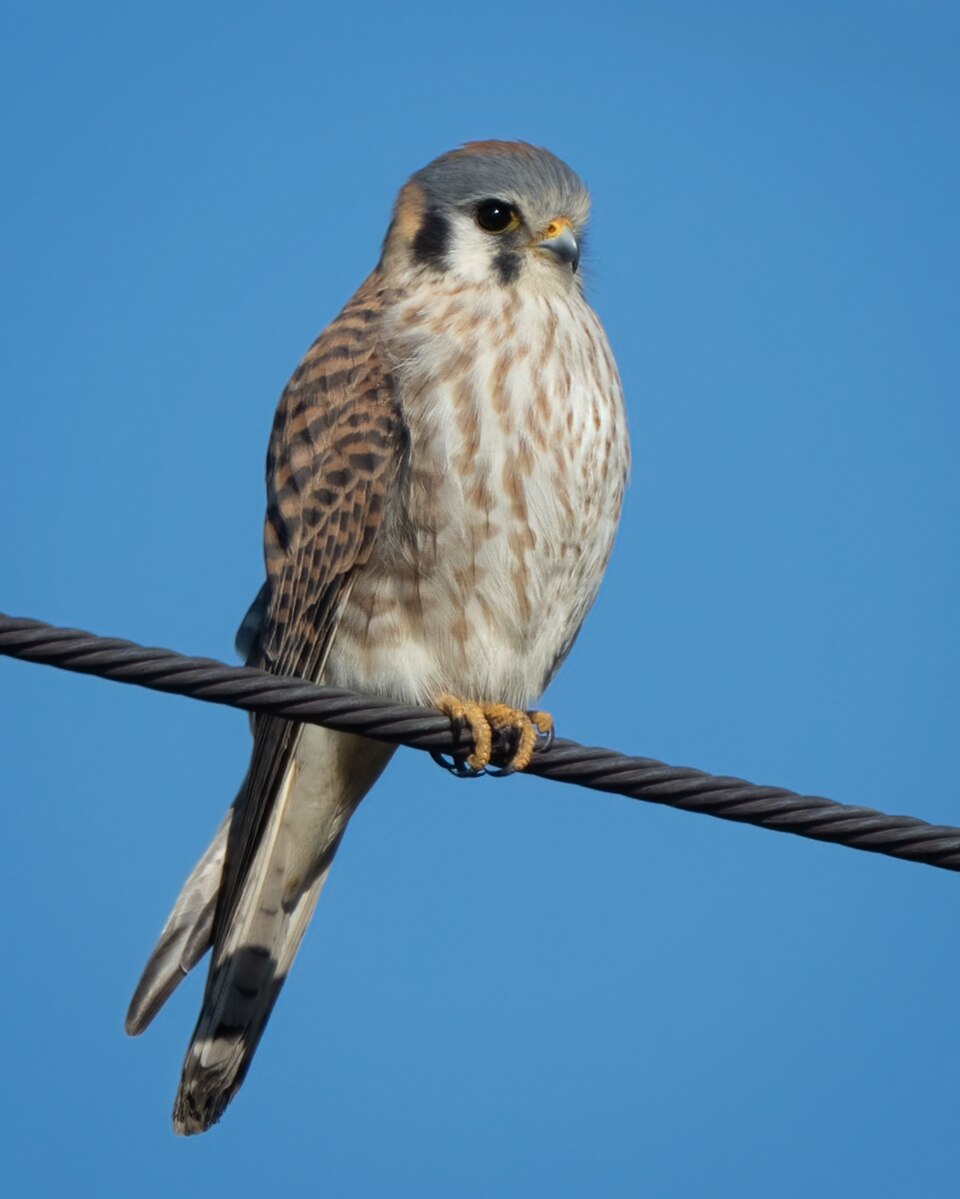
The American Kestrel is a falcon small enough to perch on a power line beside the sparrows it sometimes hunts. Roughly the size of a Mourning Dove but far more boldly marked, it is the most widespread and abundant falcon in the Americas, ranging from Alaska to the tip of South America. Birders often spot one before anything else gives it away: a slim, long-tailed shape hunched on a wire above a grassy roadside, or hovering on rapidly beating wings over a field, head locked perfectly still as it scans the ground below.
For all its diminutive size, this is a true raptor with a hooked beak, sharp talons, and the falcon's hallmark facial markings. It is also genuinely beautiful. The rusty back and tail, slate-blue wings of the male, and the pair of bold black "sideburns" on a white face make it one of the easiest birds of prey to identify and one of the most rewarding to watch. Despite remaining common, kestrel numbers have slipped steadily across much of North America in recent decades, which has made nest-box programs and open-country conservation increasingly important.
Look for a jay-sized falcon with a notably long, square-tipped tail, pointed wings, and an upright posture when perched. The combination of small size, two vertical black stripes on a pale face, and rufous tones on the back and tail is unique among North American raptors and rules out almost everything else at a glance.
| Size | Small, slim falcon about the size of a Mourning Dove; long tail and pointed wings give a graceful silhouette. |
| Face | White cheeks marked by two bold vertical black stripes (the 'mustache' and a second bar behind the eye) framing the face. |
| Crown | Often shows a rusty-red cap, sometimes with a slate-blue border, especially noticeable on males. |
| Back & tail | Warm rufous (rusty) back and tail; the male's tail is solid rufous with a bold black band near the tip. |
| Wings | Males have blue-gray wings; females have rufous wings barred with black, matching the back. |
| Behavior | Frequently hovers in place over open ground and bobs its tail up and down when perched. |
Male vs. female
This is one of the rare raptors where the sexes look clearly different, which makes them fun to sort out. The male has striking blue-gray wings that contrast with his rufous back and a clean rufous tail tipped with a single bold black band. His underparts are often warm buff or peach with sparse dark spots. The female is rufous all over the back, wings, and tail, with the wings and tail finely barred with black, and her underparts are streaked rather than spotted. In short: if the wings are blue, it's a male; if the wings are rusty and barred, it's a female.
Juveniles
Juveniles look much like adults of their respective sexes, so young males already show blue-gray wings within their first months. Fresh juveniles tend to be more heavily marked underneath, with bolder streaking on the breast, and the colors can appear slightly duller before the first molt. By their first fall, most are difficult to separate from adults in the field without a close, detailed look.
The kestrel's signature call is a loud, excited klee-klee-klee or killy-killy-killy, a rapid series of shrill, high notes often given in alarm or excitement, especially near the nest. It is one of the most recognizable raptor calls in open country and frequently the first clue that a kestrel is nearby.
Beyond that staccato rattle, kestrels also give a whining, drawn-out kree and various soft chittering notes during courtship and at the nest. Pairs are often quite vocal in spring, calling back and forth as the male delivers food to the female.
American Kestrels occur across an enormous range, breeding from Alaska and much of Canada south through the United States, Mexico, and Central America, and on down into South America. They favor open and semi-open country: grasslands, pastures, deserts, farmland, parks, road edges, and even urban areas with grassy medians and vacant lots.
Movement varies by region. Northern populations are migratory, withdrawing from Canada and the northern states in fall to winter farther south. Across the central and southern United States, many kestrels are year-round residents. During fall migration, they are a familiar sight along ridgelines and coastlines at hawk-watch sites, drifting south in loose, steady numbers.
The American Kestrel is a versatile hunter that eats a lot of large insects in the warm months, including grasshoppers, crickets, beetles, dragonflies, and cicadas. In colder seasons and when feeding young, it shifts toward small vertebrates: voles, mice, shrews, small birds, lizards, and frogs. Because so much of its prey is insect-based, it is often considered a beneficial bird around farms.
Two hunting styles stand out. The first is perch-hunting, where the bird sits on a wire, pole, or dead snag and drops onto prey spotted below. The second is the kestrel's famous hovering: it beats its wings rapidly and faces into the wind to hang in one spot, head held perfectly motionless, before plunging onto a target. Kestrels can even see ultraviolet light, which helps them detect the urine trails rodents leave across the grass.
Unlike most falcons, the American Kestrel is a cavity nester. It does not build a stick nest; instead it uses natural tree hollows, old woodpecker holes, crevices in cliffs and buildings, and readily accepts nest boxes. The female does most of the incubating while the male brings her food, and both parents feed the nestlings.
A typical clutch is four to five eggs, whitish to pinkish and speckled with brown. Incubation lasts about a month, and the young fledge roughly four to five weeks after hatching. Most pairs raise a single brood per year, though a second is possible in the southern part of the range. Lacking the ability to excavate their own cavities, kestrels depend heavily on existing holes, which is exactly why well-placed nest boxes have become such an important conservation tool.
You won't draw a kestrel to a seed feeder, since it's a meat-eating raptor, but you can absolutely make property attractive to one, especially if you live near open fields, pastures, or large grassy areas. The single most effective thing you can do is put up a properly built nest box, as kestrels reliably take to them where natural cavities are scarce.
- Install a kestrel nest box roughly 10-30 feet up on a pole, isolated tree, or building edge, ideally facing an open field; mount it before late winter so it is available by the breeding season.
- Add a layer of wood shavings (not sawdust) in the bottom of the box, since kestrels add no nest material of their own.
- Provide open hunting ground nearby, like unmowed grassy areas or pasture, and leave hunting perches such as wires, posts, or dead snags in place.
- Reduce or eliminate rodenticides and broad insecticides, which poison the voles and large insects kestrels rely on and can poison the birds themselves.
- Add a predator guard to the mounting pole to keep raccoons, snakes, and squirrels from raiding the box.
- Be patient: it can take a season or two for a box to be discovered, and competition from starlings and squirrels may need managing.
- Merlin: Stockier and darker with no rufous and no bold facial stripes; flies fast and direct rather than hovering, and lacks the kestrel's slim, long-tailed look.
- Sharp-shinned Hawk: A small accipiter with short rounded wings and a flap-flap-glide flight; lacks pointed falcon wings, the facial stripes, and the rufous back and tail.
- Peregrine Falcon: Much larger and heavier, slate-backed with a single broad mustache mark; powerful and fast rather than small and hovering.
- Mourning Dove: Similar size and shape on a wire at a distance, but a dove has a small head, no hooked beak, no facial stripes, and a plain buffy-brown body.
What does an American Kestrel look like?
It's a small, slim falcon about the size of a Mourning Dove, with a long tail, pointed wings, two bold black vertical stripes on a white face, and rusty (rufous) coloring on the back and tail. Males have distinctive blue-gray wings, while females have rusty, black-barred wings.
How do you tell a male from a female American Kestrel?
Look at the wings. Males have blue-gray wings and a rufous tail with one black band near the tip. Females have rufous wings barred with black, matching their back and tail. Males are also more spotted below, females more streaked.
Why do American Kestrels hover?
Hovering lets a kestrel hunt over open ground where there's no perch. By beating its wings into the wind and holding its head perfectly still, it can scan the grass for insects and small rodents, then drop straight down once it spots prey.
Will an American Kestrel use a nest box?
Yes. Kestrels are cavity nesters that don't build stick nests, and they readily accept properly built boxes mounted about 10-30 feet up near open fields. Add a few inches of wood shavings inside and a predator guard on the pole, and put the box up before late winter.
Are American Kestrels endangered?
They are still listed as Least Concern and remain fairly common, but their numbers have declined steadily across much of North America in recent decades. Habitat loss, pesticide use that reduces their prey, and a shortage of nesting cavities are thought to be contributing factors, which is why nest-box programs matter.