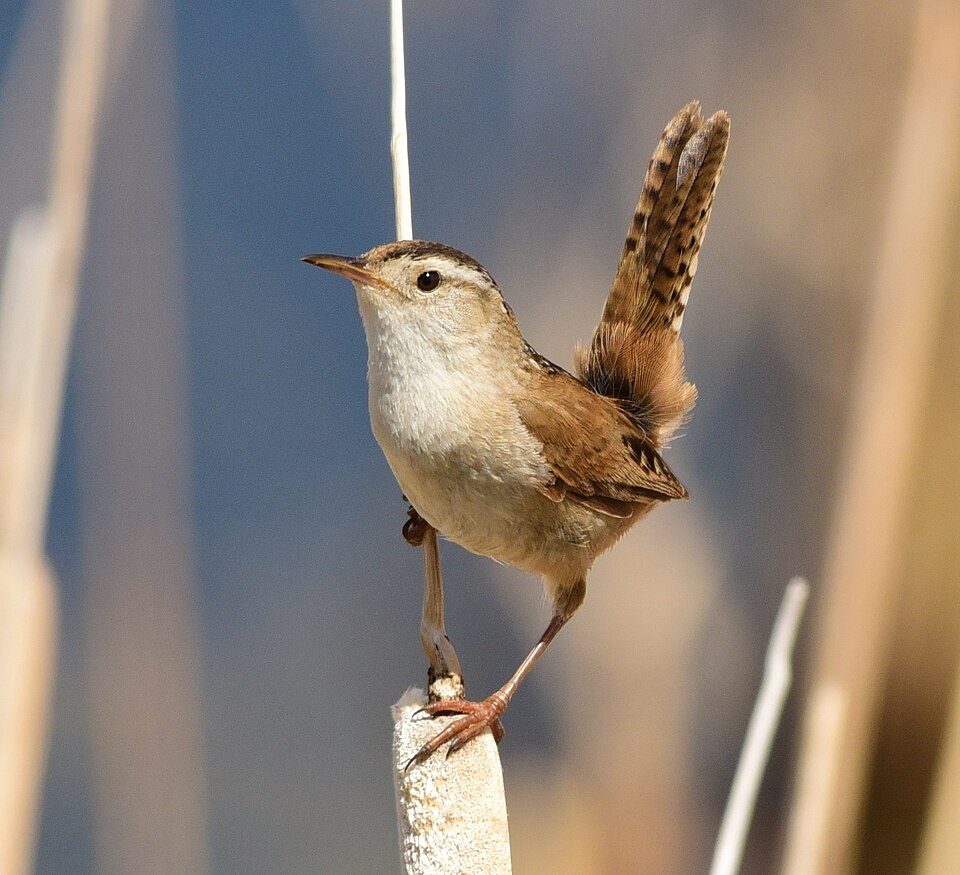
The Marsh Wren is one of those birds you almost always hear before you see. Spend a morning beside a stand of cattails or bulrushes and you'll catch a burst of gurgling, rattling song rising from deep in the reeds, often from several directions at once. The singer himself stays hidden, a tiny brown ball of energy clambering up and down the stems just out of view. When he finally pops into the open, he's a compact, warm-brown wren with a cocked tail, a bold white eyebrow, and an air of perpetual indignation.
What makes this bird worth knowing is its sheer intensity. A male Marsh Wren on his breeding territory is a relentless singer and a busy builder, throwing together a cluster of football-shaped nests woven into the marsh grass. He is also famously aggressive, known to puncture the eggs of his neighbors and other marsh-nesting birds. For all that drama, the Marsh Wren is tied tightly to wetlands, so finding one means visiting the right habitat at the right time of year rather than waiting for it at a feeder.
Marsh Wrens are small, round-bodied wrens with the classic short, frequently cocked tail of the family and a thin, slightly downcurved bill. They are roughly the size of a House Wren but a touch slimmer, and they almost always appear low in dense marsh vegetation rather than perched in the open for long.
| Eyebrow | Bold, clean white supercilium (eyebrow stripe) that stands out against a darker crown and eyeline |
| Back | Dark brown back with crisp black-and-white streaking forming a distinct triangular patch between the shoulders |
| Underparts | Whitish throat and breast fading to warm buff or cinnamon on the flanks and belly |
| Tail | Short, barred, rusty-brown tail held cocked upward, often flicked while foraging |
| Crown | Plain dark brown to blackish crown, unstreaked, contrasting with the pale eyebrow |
| Bill | Thin and fairly long for a wren, slightly decurved, ideal for probing among reeds |
Male vs. female
Males and females look essentially identical in the field, with the same streaked back, white eyebrow, and cocked tail. Males average slightly larger and do nearly all of the loud, persistent singing, so behavior is your best clue: the bird belting out a long rattling song from atop a cattail in spring is almost certainly a male, while the quieter bird slipping through the reeds nearby may be his mate. You cannot reliably separate the sexes by plumage alone.
Juveniles
Juvenile Marsh Wrens look much like adults but are duller and less crisply marked. The streaking on the back is muddier and less contrasting, the white eyebrow is fainter, and the overall plumage tends toward a plainer, washed-out brown. Young birds also show buffier underparts and often appear a bit fluffier and shorter-tailed before they finish growing. By their first fall they are difficult to tell from adults in the field.
The song is the signature of the species: a fast, mechanical jumble that often starts with a few sharp introductory notes and breaks into a dry, gurgling rattle or trill, frequently written as chit-chit-chit-trrrrrrr or a reedy cut-cut-cut-tle-tle-tle-tle. To many ears it sounds like a sewing machine or an old typewriter buried in the cattails. Eastern birds tend to sound more musical and liquid, while western Marsh Wrens deliver a harsher, buzzier, more grating version, and individual males may have dozens of song variations.
Males sing tirelessly through the day and well into the night during breeding season, often answering one another across the marsh. The common call is a sharp, scolding tsuk or chuck, sometimes run together into an agitated chatter when a bird is alarmed or defending territory.
Marsh Wrens breed widely across the United States and southern Canada wherever there are freshwater or brackish marshes with tall emergent vegetation, from the Great Plains potholes and Great Lakes marshes to the coastal wetlands of both seaboards and the reedy edges of western lakes and rivers. Populations split roughly into an eastern and a western group, which differ in song and subtle plumage and may eventually be recognized as separate species.
In winter, northern and interior breeders move south, retreating to milder marshes across the southern United States and into Mexico, while birds along the Pacific and southern coasts and in the desert Southwest are often year-round residents. During migration they can turn up briefly in damp weedy spots away from large marshes, but they rarely linger outside good wetland habitat.
Marsh Wrens are almost entirely insectivorous. They glean and probe through the reeds for a wide menu of small invertebrates: beetles, flies, mosquitoes and their larvae, caterpillars, moths, ants, aquatic insects, spiders, and tiny snails. Because they hunt low in the marsh, much of their food comes from the wet bases of stems and the surface of the water and mud.
Watch one forage and you'll see classic wren behavior. It works methodically up and down the vertical stems, often clinging sideways with feet splayed across two reeds, peering into crevices, flicking its tail, and snatching prey with quick jabs of that slender bill. They are agile enough to hover briefly or drop to the water's edge to grab an insect before darting back into cover.
Nesting is where the Marsh Wren really shows off. The male builds a remarkable structure: an oval or football-shaped dome of woven wet reeds, grasses, and cattail strips lashed to several upright stems a few feet above the water, with a small side entrance. What's unusual is that he doesn't build just one. A single male may construct several to a couple dozen of these "dummy" or courting nests across his territory, and a female who pairs with him chooses one (or builds her own breeding nest) and lines the interior with fine grass, feathers, and plant down.
The female typically lays around 4 to 6 eggs, usually pale to dark brown and finely speckled, and she does the incubating for roughly two weeks. Many males are polygynous, attracting more than one female to their cluster of nests. Marsh Wrens are also notoriously destructive neighbors, frequently puncturing the eggs of nearby Marsh Wrens, Yellow-headed and Red-winged Blackbirds, and other marsh nesters, behavior that helps reduce competition for food and nest sites.
The Marsh Wren is not a backyard or feeder bird in any practical sense, so don't expect to lure one in with seed. It is tied to standing marsh vegetation and eats only insects. That said, there are real ways to encounter and even host them if your situation is right.
- Habitat is everything: if you own or border wetland, preserving cattails, bulrushes, and reedy edges is the single best way to attract breeding Marsh Wrens.
- Avoid mowing, draining, or spraying marsh margins; these birds need dense standing vegetation over shallow water for both food and nesting.
- To find them, visit a freshwater or brackish marsh at dawn in late spring and early summer and listen for the rattling song before scanning the reeds.
- Use spishing or a soft pish near the edge of the cattails; curious males will often pop up briefly to investigate the intruder.
- Don't expect feeders or nest boxes to work; they are insect-eaters that build their own woven nests in living marsh plants.
- Bring patience and waterproof boots, and watch the tops of reeds where a singing male will periodically climb into view.
- Sedge Wren: Smaller and buffier with a streaked (not solid dark) crown, a fainter eyebrow, and a preference for wet sedge meadows and grassy fields rather than tall cattail marshes; song is a dry, staccato chatter.
- House Wren: Plainer grayish-brown overall with no bold white eyebrow and no streaked back patch; found in yards, woodland edges, and brushy uplands rather than marshes.
- Carolina Wren: Larger and richly rusty with a long bold white eyebrow and a loud teakettle-teakettle song; lives in woodlands and gardens, not in standing marsh vegetation.
- Winter Wren: Very tiny and dark with a stubby cocked tail and finely barred belly; haunts shaded forest floors and brushy stream banks, not open cattail marsh.
What does a Marsh Wren sound like?
It sings a fast, gurgling, rattling jumble often described as a sewing machine or typewriter buried in the reeds, frequently starting with a few sharp chit notes before breaking into a dry trill. Eastern birds sound more musical and liquid; western birds are harsher and buzzier. Its alarm call is a sharp, scolding tsuk.
Where do Marsh Wrens live?
They live in freshwater and brackish marshes with tall emergent plants like cattails and bulrushes. They breed across much of the U.S. and southern Canada and winter in southern marshes and Mexico, with year-round populations along the Pacific coast, the Gulf, and parts of the Southwest.
How do I tell a Marsh Wren from a Sedge Wren?
Look at the crown and habitat. A Marsh Wren has a solid dark unstreaked crown, a bold clean white eyebrow, and lives in tall cattail marshes. A Sedge Wren is smaller and buffier with a streaked crown and a fainter eyebrow, and it prefers wet grassy or sedge meadows rather than standing cattails.
Why does a male Marsh Wren build so many nests?
Males build multiple football-shaped dummy or courting nests across their territory as part of attracting mates and defending space. A female chooses or builds the actual breeding nest among them. Building many nests helps males court several females and may confuse predators.
Will Marsh Wrens come to a backyard feeder?
No. Marsh Wrens are insect-eaters tied to marsh vegetation, so they won't visit seed or suet feeders. The only way to host them is to have or protect nearby wetland with dense cattails or reeds; otherwise, the way to enjoy them is to visit a marsh and listen for their song.