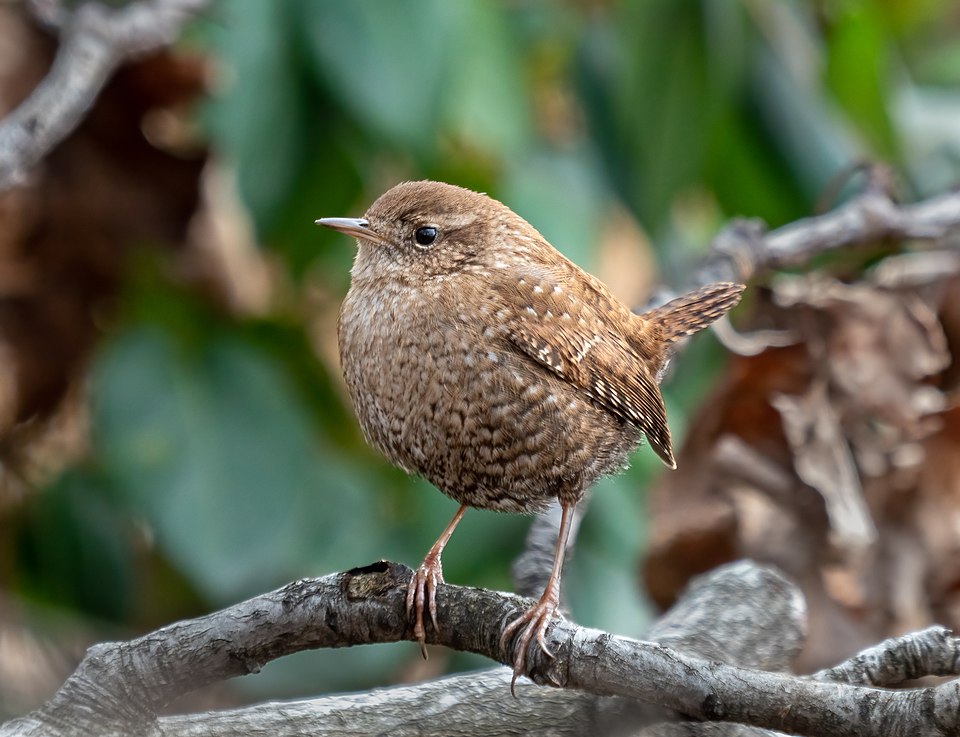
The Winter Wren is one of the smallest songbirds in North America, a dark, round little bird that seems to be made mostly of attitude. It weighs about as much as two nickels, yet it produces a song so long and intricate that, ounce for ounce, it delivers more sound output than almost any bird on the continent. You will rarely see one out in the open. Instead, it works the shadows of damp coniferous forests, creeping like a mouse through fallen logs, root tangles, and the litter of the forest floor, its stubby tail flicked up over its back.
For a long time this bird was lumped together with the wrens of Europe and the Pacific Northwest under a single name. Genetic and song studies eventually split the group into three species: the Eurasian Wren, the Pacific Wren of the western mountains and coast, and the Winter Wren (Troglodytes hiemalis) of eastern and boreal North America. The Winter Wren is the eastern bird, breeding across the boreal forest and the Appalachians and retreating to milder lowlands in winter, where its sharp double call note often gives it away long before you spot it.
Think of a feathered ping-pong ball with a needle bill and a tail that points at the sky. The Winter Wren is compact and almost neckless, with a rounded body, very short wings, and an extremely short tail that it habitually cocks straight up. At a glance in dim woods it can look like a dark, hyperactive mouse darting between roots.
| Size | Tiny, even by wren standards - smaller and rounder than a House Wren, roughly the bulk of a Golden-crowned Kinglet |
| Color | Rich dark brown overall, warmest on the rump and tail, with heavy dark barring on the belly, flanks, and wings |
| Tail | Very short and stubby, frequently held cocked vertically over the back |
| Eyebrow | A pale buffy supercilium (eyebrow stripe) is present but often faint and indistinct |
| Bill | Thin, fine, and slightly downcurved - a probing tool for crevices and leaf litter |
| Underparts | Buffy-brown rather than whitish, with bold dark bars across the lower belly and undertail |
Male vs. female
Male and female Winter Wrens look essentially identical in the field. Both sexes share the same dark, barred, short-tailed plumage, and there is no reliable way for a birder to separate them by sight. Behavior offers the only practical clue: during the breeding season, the bird perched up and pouring out a long, machine-gun song is almost always the male, since females generally stay quiet and low. Outside the breeding season, sex is not something you can determine visually.
Juveniles
Juvenile Winter Wrens look much like adults but are a little softer and less crisply marked. Fresh fledglings can appear duskier and more uniformly dark, with the barring on the underparts somewhat less defined and a slightly fluffier, looser texture to the feathers. They quickly molt into adult-like plumage, so by the time you encounter most birds in fall and winter they are difficult to age in the field.
The song is the showstopper. A breeding male Winter Wren sings an extraordinarily long, rapid cascade of high, tinkling trills and warbles that can run for five to ten seconds or more without an obvious pause - a silvery, bubbling stream of notes that seems impossible to come from such a small body. Birders often describe it as a tireless, music-box jumble that rises and falls and tumbles over itself. Once you have heard it ringing through a spruce bog or a hemlock ravine, it is unmistakable.
The call note is just as useful for finding the bird. Listen for a hard, sharp chimp-chimp or jip-jip, often delivered as a quick doubled note - it is drier and harder than the call of most warblers and is frequently the first sign that a Winter Wren is skulking nearby in the undergrowth.
Winter Wrens breed across the boreal forest of Canada and the northern United States, and southward down the Appalachian Mountains as far as northern Georgia, favoring cool, moist, mature conifer and mixed forests with plenty of fallen wood and dense ground cover. Mountains and shaded stream ravines are classic breeding habitat.
True to the name, the species shifts south and to lower elevations for the winter, spreading across much of the eastern and central United States. In the colder months you can find them in wooded swamps, brushy creek bottoms, ravines, and overgrown thickets - anywhere with tangled cover near the ground. Birds breeding in the high Appalachians may simply drop downslope, while northern breeders make a longer migration into the Southeast and lower Midwest.
The Winter Wren is almost entirely insectivorous, gleaning small invertebrates from the dark, damp corners of the forest. Its diet centers on insects and spiders - beetles, flies, caterpillars, ants, springtails, and the like - along with other tiny arthropods it pries from bark crevices, mossy logs, root masses, and leaf litter.
Watching one feed is half the fun. The bird behaves more like a wind-up toy than a typical songbird, scurrying mouse-like over and under fallen timber, poking into every crack and cranny, and disappearing into a brush pile only to pop out somewhere unexpected. In winter, when insects are scarce, it continues to probe sheltered, frost-free microhabitats such as the undersides of streambanks and the interiors of woodpiles.
The male is the architect of the operation. He builds several bulky, domed nests of moss, twigs, grass, and rootlets, tucking them into hidden nooks - upturned tree roots, crevices in banks, cavities in rotting stumps, or the root wads of fallen trees, usually low and well concealed. The female then inspects his work, chooses the nest she likes best, and lines it with feathers and fine material before laying.
The female does the incubating, while the male may continue to defend the territory and, in some cases, tend additional mates. The pale, finely speckled eggs hatch after about two weeks, and both parents feed the nestlings until they fledge. In the southern part of the range a pair may raise two broods in a season.
The Winter Wren is not a feeder bird in the usual sense - it eats insects, not seeds, so you will not lure it with sunflower or suet displays the way you would a chickadee. But you can absolutely make a wooded or wild-edged yard more appealing to one, especially in fall and winter when they wander into lowland thickets.
- Leave a brush pile or a tangle of fallen branches in a shady corner - this is the single best way to attract a Winter Wren, which loves to creep through dense low cover.
- Resist the urge to tidy. Leave logs, stumps, and leaf litter in place; the insects and hiding spots they provide are exactly what the bird hunts.
- Maintain a damp, shaded native thicket or a wild streambank edge rather than open lawn - moist, sheltered ground is prime habitat.
- If you have wooded property in the breeding range, retain dead wood and upturned root wads, which provide natural nest sites.
- Provide a low, clean water source near cover; like many small birds, wrens will use shallow water at ground level if it feels safe.
- Listen and watch in winter rather than expecting a feeder visit - learn the sharp doubled jip-jip call and you will start noticing them in brushy spots.
- Pacific Wren: Nearly identical in shape and behavior but found in the West; its song is even faster and buzzier, and ranges barely overlap. Best separated by location and voice.
- House Wren: Larger, longer-tailed, paler and grayer-brown, with a longer tail held less vertically. Prefers open yards and nest boxes rather than deep, damp woods.
- Carolina Wren: Much larger and warmer rusty-brown with a bold white eyebrow stripe and a loud, ringing teakettle-teakettle song. Common in suburban yards, unlike the skulking Winter Wren.
- Marsh Wren: Similar size but a marsh specialist with a strong white eyebrow and white streaks on the back; found in cattails and reeds rather than forest floor.
How do I tell a Winter Wren from a House Wren?
Look at size, color, and tail. The Winter Wren is noticeably smaller and rounder, darker reddish-brown, with bold barring on the belly and an extremely short tail that it cocks straight up. The House Wren is larger, plainer grayish-brown, and longer-tailed. Habitat helps too: House Wrens like open yards and nest boxes, while Winter Wrens skulk in damp, shady woods and brush piles.
Why is it called a Winter Wren if it lives in the north?
The name comes from where many people first encounter it - in winter. Across much of the eastern and central United States the bird shows up only in the colder months, having moved south from its boreal and mountain breeding grounds. For those southern observers, it truly is a wren of winter.
What does a Winter Wren's song sound like?
It is an exceptionally long, rapid, silvery cascade of high trills and warbles, often lasting five to ten seconds and tumbling on without an obvious break. People compare it to a runaway music box. The common call is a hard, sharp doubled note, something like jip-jip or chimp-chimp.
Will a Winter Wren come to my bird feeder?
Not in the typical sense. Winter Wrens eat insects and spiders rather than seeds, so they ignore most feeders. The best way to attract one is to provide habitat: a brush pile, leaf litter, fallen logs, and dense shady cover where it can hunt for bugs.
Where do Winter Wrens nest?
In hidden, low spots in damp forest - upturned tree roots, bank crevices, rotting stumps, and root wads of fallen trees. The male builds several domed moss nests and the female picks her favorite, lines it, and does the incubating.