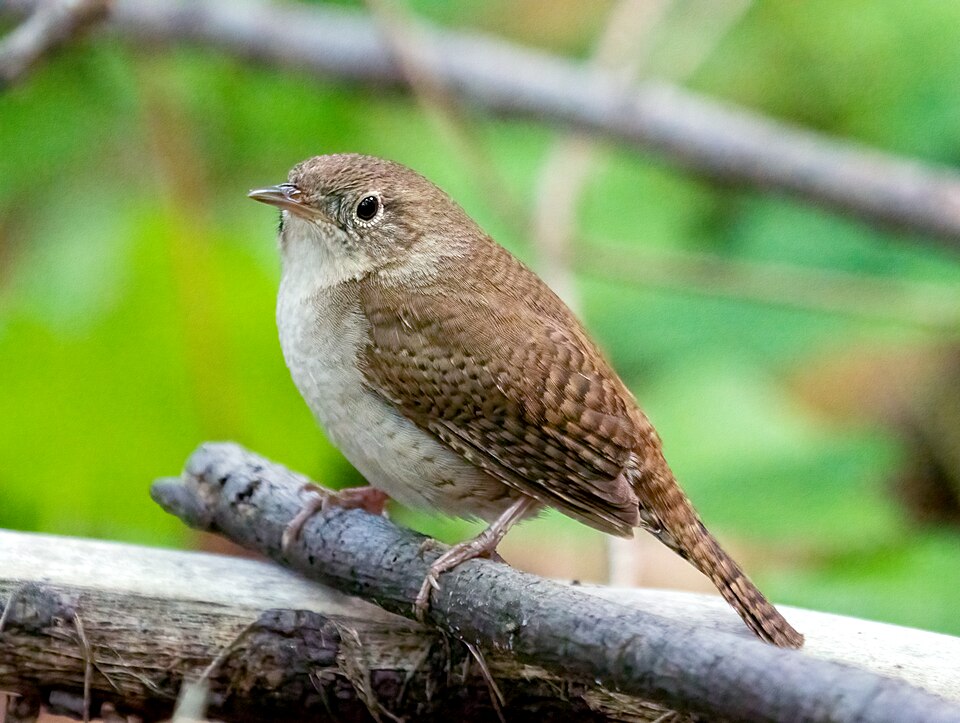
Few birds pack as much personality into such a small body as the House Wren. Barely longer than your thumb and dressed in plain warm brown, it would be easy to overlook if it ever stopped moving or singing. It rarely does. From late spring through summer, males pour out a long, tumbling, bubbly song from brush piles, fence posts, and the tops of nest boxes across nearly all of the United States and southern Canada. The Latin name Troglodytes means "cave dweller," a nod to the wren's habit of poking into every dark crevice, woodpile, and cavity it can find.
This is a bird of edges and tangles: hedgerows, shrubby yards, old orchards, brushy woodland borders, and suburban gardens. It thrives alongside people and readily takes to nest boxes, which makes it one of the most accessible "wild" birds for backyard watchers to host and observe. Energetic, curious, and famously feisty for its size, the House Wren will fearlessly scold a cat, a squirrel, or a much larger bird that wanders too close to its nest.
The House Wren is a small, compact, energetic bird with a short neck, a slightly flattened head, and a thin, slightly downcurved bill made for probing crevices. Its silhouette is unmistakable once learned: a rounded little body, often with the tail cocked sharply upward, and a constant, twitchy, restless manner as it works through low cover.
| Overall color | Warm grayish-brown above, paler and grayer below, with no bold markings, a fairly plain bird overall |
| Barring | Fine dark barring on the wings, tail, and flanks, easiest to see in good light at close range |
| Tail | Short and often held cocked up at a jaunty angle, especially when alert or scolding |
| Bill | Thin, fairly long for a wren, and slightly downcurved, built for probing nooks and crannies |
| Face | Plain, with only a faint, indistinct pale eyebrow (much less obvious than on other wrens) |
| Size | Tiny, noticeably smaller than a House Sparrow, with a rounded, almost tailless look when the tail is down |
Male vs. female
Males and females look essentially identical in the field. Both sexes share the same plain warm-brown plumage, fine barring, and cocked tail, and there is no reliable visual difference in color or size that a backyard birder can use. Behavior is the best clue: the bird singing the long, energetic, bubbling song is almost always the male, and during nesting it is the male who builds several "dummy" nests of sticks while the female makes the final choice and lines the chosen one.
Juveniles
Recently fledged young House Wrens look much like adults but a bit fluffier and softer-edged, often with slightly duller, warmer plumage and a paler, less defined face. Juveniles may show a faint mottling on the chest and a gape (the fleshy corner of the mouth) that still looks pale and swollen for the first days out of the nest. Within a few weeks they are essentially indistinguishable from adults, and like the parents they quickly adopt the species' restless, tail-cocking, crevice-probing habits.
The song is the easiest way to find a House Wren, and once you know it you will hear it everywhere in summer. It is a long, exuberant, bubbling cascade, a rush of churry, gurgling, chattering notes that rises and then tumbles downward in a burst, often described as a sputtering, energetic "chee-chee-chee, tsee-tsee-tsee, churrchurrchurr". The whole performance lasts a couple of seconds and is delivered over and over from a perch, far louder and more energetic than you would expect from so small a bird.
Calls are sharper and more abrupt. Agitated birds give a hard, dry, scolding chatter, a rapid "chrrrr" rattle, along with harsh churt and jit notes when a predator or rival is near. This scolding is a reliable giveaway that a wren has a nest nearby and is annoyed at your presence.
The House Wren is one of the most widespread songbirds in the Western Hemisphere. In North America it breeds across most of the United States and into southern Canada, favoring shrubby, semi-open country and human-altered landscapes. It is highly migratory in the north: birds withdraw in fall to the southern United States, Mexico, and Central America, returning to northern breeding grounds in April and May.
Beyond the familiar northern form, the broader House Wren complex ranges all the way south through Mexico, Central America, and much of South America, where many populations are year-round residents. In the northern part of its range, listen for the first bubbling songs as a classic sign that spring migration is underway.
House Wrens are almost entirely insectivorous. They feed on a wide variety of small invertebrates, beetles, caterpillars, true bugs, grasshoppers and crickets, flies, spiders, and the eggs and larvae of many insects. They forage low and methodically, hopping through brush piles, tangled vegetation, woodpiles, and the bases of shrubs, probing into crevices and flicking through leaf litter with that thin, slightly curved bill.
Because their diet is built around live prey, House Wrens rarely visit seed feeders. They are far more interested in a brushy, insect-rich yard than in anything in a feeder tray, which is why a tidy, sprayed lawn holds little appeal while a weedy hedge or garden border is wren heaven.
House Wrens are cavity nesters, and they are wonderfully unfussy about the cavity. Natural tree holes, old woodpecker holes, and crevices all work, but so do nest boxes, mailboxes, flowerpots, old boots, and the cup of a hanging plant. The male starts the process by stuffing one or more potential cavities with a foundation of small twigs and sticks, sometimes building several "dummy" nests, and the female chooses one, then lines the cup with softer material such as grass, feathers, hair, and plant down.
A typical clutch is about 5 to 8 small, heavily speckled eggs. The female does the incubating for roughly two weeks, and both parents feed the nestlings, which fledge after another two weeks or so. Pairs frequently raise two broods in a season. House Wrens have a notably aggressive streak around nest sites: they are known to puncture the eggs of competing cavity nesters nearby and will fill rival cavities with sticks, a behavior that can put them at odds with bluebirds, chickadees, and other box-nesting neighbors.
Yes, the House Wren is a true backyard bird and one of the easiest native species to host, as long as you think habitat rather than feeders. It will not come for seed, but it readily accepts nest boxes and thrives in yards with cover and insects.
- Put up a nest box with a small entrance hole (about 1 to 1.25 inches), mounted 5 to 10 feet up on a post or tree at the edge of shrubby cover.
- Leave a brush pile or untidy hedge, dense tangles give wrens the low cover and crevices they love for foraging and hiding.
- Skip the pesticides. A chemical-free yard supports the caterpillars, beetles, and spiders that make up nearly the wren's entire diet.
- Provide a shallow birdbath or moving water feature for drinking and bathing, kept clean and at ground or low level.
- Plant native shrubs and let a corner of the garden grow a little wild, structure and insects matter far more than any feeder.
- Expect feisty tenants: if you also host bluebirds or chickadees, space boxes well apart, since wrens can be aggressive toward neighboring cavity nesters.
- Carolina Wren: Larger and richer rusty-brown, with a bold white eyebrow stripe and a loud, ringing 'teakettle-teakettle' song, far more boldly marked than the plain House Wren.
- Winter Wren: Smaller and darker, with a stubbier tail and heavier barring on the belly; favors damp, dense forest understory and gives a very long, high, tinkling song.
- Bewick's Wren: Has a long tail that it flicks side to side, edged with white spots, and a crisp white eyebrow, the House Wren's tail is shorter and lacks the white-cornered look.
- Marsh Wren: Lives in cattail marshes, shows a bold white eyebrow and white streaks on a dark back, and gives a mechanical, rattling song, habitat and back pattern separate it easily.
What does a House Wren sound like?
A long, bubbling, energetic cascade of churry, gurgling notes that rises and then tumbles downward, surprisingly loud for such a tiny bird. When agitated, it gives a dry, scolding chatter and harsh chirp notes, usually a sign there's a nest nearby.
Will House Wrens use a nest box?
Absolutely. They readily take to nest boxes with a small entrance hole (about 1 to 1.25 inches), and they'll also nest in flowerpots, mailboxes, old boots, and almost any cavity. The male often fills several boxes with sticks, and the female picks her favorite.
Do House Wrens come to bird feeders?
Rarely. House Wrens eat almost entirely insects and spiders, so they ignore most seed feeders. To attract them, focus on brushy cover, a pesticide-free yard full of insects, a water source, and a nest box rather than food.
Are House Wrens aggressive to other birds?
For their size, yes. They are known to puncture the eggs of nearby cavity nesters and stuff competing cavities with sticks. If you host bluebirds or chickadees too, space your nest boxes well apart to reduce conflict.
How can I tell a House Wren from a Carolina Wren?
The Carolina Wren is larger, a richer rusty-brown, and has a bold white eyebrow stripe with a loud 'teakettle-teakettle' song. The House Wren is smaller, plainer grayish-brown, lacks a strong eyebrow, and sings a bubbling, tumbling cascade.