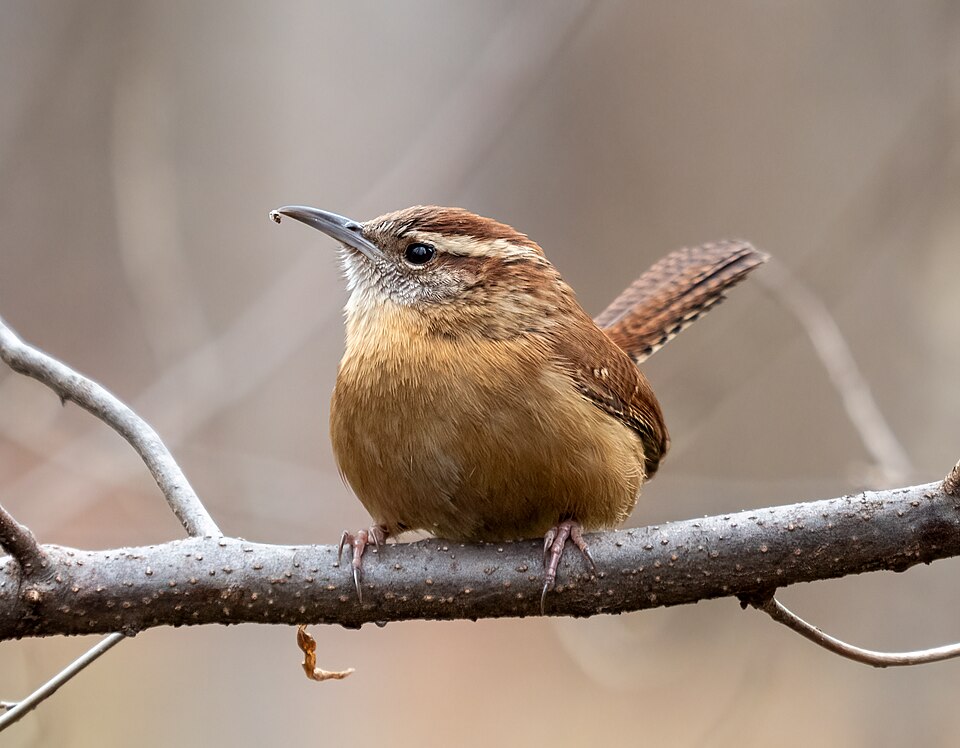
Few backyard birds pack as much volume into so small a frame as the Carolina Wren. This rich rusty-brown bird is more often heard than seen, belting out a ringing, repetitive song from deep within a brush pile, a tangle of vines, or the shrubs along a wooded edge. Despite its energy and noise, it is a master of staying hidden, slipping mouse-like through low cover with its tail flicked jauntily upward. When it does pop into view, the bold white eyebrow stripe and warm cinnamon tones make it one of the easiest wrens to recognize across the eastern United States.
The Carolina Wren is a year-round resident, holding its territory through every season rather than migrating south. That tenacity is part of its charm and its vulnerability: in mild years the population climbs steadily and the birds push farther north, but a single severe winter can knock back numbers at the northern edge of the range. Backyard birders in the Southeast know it as a familiar and welcome presence, nesting in flowerpots, garage shelves, and hanging baskets with a boldness that belies its secretive habits.
The Carolina Wren is a small, plump, round-bodied songbird with a slightly downcurved bill and a tail it habitually cocks upward. Among eastern wrens it is on the larger, chunkier side, and its warm reddish-brown upperparts paired with a long, conspicuous white eyebrow give it a distinctive look.
| Eyebrow stripe | Bold, clean white supercilium running from the bill back over the eye to the nape - the single best field mark |
| Upperparts | Warm rusty or cinnamon-brown on the back, wings, and tail |
| Underparts | Rich buffy-orange to warm cinnamon below, brightest on the flanks and undertail |
| Tail | Reddish-brown with fine dark barring, often held cocked up over the back |
| Bill | Long, slender, and slightly decurved - typical wren shape, dark above and paler below |
| Size & shape | Plump and compact, larger than a House Wren, with a short neck and rounded body |
Male vs. female
Male and female Carolina Wrens look essentially identical in the field - both show the same rusty back, white eyebrow, and warm buffy underparts, and there is no reliable plumage difference for backyard observers to use. The clearest behavioral clue is song: only the male delivers the loud, ringing "teakettle" territorial song. Females do not sing this song, though they produce a distinctive chattering or rattling call, sometimes given as a duet with the singing male. Males average very slightly larger, but the difference is too small to judge by eye.
Juveniles
Juvenile Carolina Wrens look much like adults but appear a touch softer and duller. Their underparts are paler and less richly colored, the plumage has a looser, fluffier texture, and the white eyebrow stripe may be slightly less crisp. The bill is often paler and the gape (the fleshy corners of the mouth) can still show a yellowish tinge in very young birds. Juveniles reach essentially adult-like appearance within their first few months, so by late summer and fall most birds in a yard are difficult to age.
The Carolina Wren's song is astonishingly loud for such a small bird - a rolling, energetic series often written as teakettle-teakettle-teakettle or cheery-cheery-cheery, with three or four repeated phrases delivered in a clear, ringing tone. A single male may know dozens of song variations and will repeat one type many times before switching. Because the song carries so far and is given year-round, it is one of the defining sounds of southeastern woodlands and gardens.
Calls are equally distinctive. Listen for a harsh, scolding cheh-cheh-cheh rattle or buzz when the bird is agitated, and a sharp pink or jeet note used in contact and alarm. Pairs frequently call back and forth, and the female's chatter overlapping the male's song creates a lively, conversational racket that often gives the birds away long before you spot them.
The Carolina Wren is a bird of the eastern United States, common throughout the Southeast and across the eastern third of the country, from the Gulf Coast and Florida north into the lower Midwest and the Mid-Atlantic, and west to the eastern edge of the Great Plains. It also ranges into extreme southern Ontario and reaches south into northeastern Mexico. Over recent decades its range has expanded northward, helped by warming winters and the abundance of backyard feeders.
Unlike many songbirds, it does not migrate. Pairs defend the same territory all year and are highly sedentary, rarely moving far from where they hatched. This makes them reliable yard birds in much of their range, but it also means harsh winters at the northern limits can cause sharp local declines, followed by gradual recolonization during milder years.
Carolina Wrens are primarily insectivores, foraging low and methodically through leaf litter, brush piles, bark crevices, and dense vegetation. They eat a wide variety of insects and other invertebrates - caterpillars, beetles, true bugs, ants, grasshoppers, crickets, spiders, and even small snails - probing into curled leaves, peeling bark, and poking into nooks the way a tiny hands-on inspector might. They are active, restless foragers, constantly hopping and flicking their tails.
In colder months, when insects are scarce, they broaden their diet to include seeds, berries, and small fruits, and they readily visit feeders. This dietary flexibility is a key reason they can tough out winters that would force a strict insect-eater to move on.
Carolina Wrens are famously opportunistic nesters. The pair builds a bulky, somewhat domed nest with a side entrance, woven from leaves, grass, bark strips, moss, and twigs, and lined with finer material like feathers, hair, or fine grasses. While they will use natural sites such as tree cavities, stumps, and tangles, they are notorious for choosing odd human-provided spots - flowerpots, hanging baskets, mailboxes, garage shelves, coat pockets, and open-fronted nest boxes among them.
The female typically lays 4 to 6 eggs, which are whitish or pinkish with brown speckling concentrated toward the larger end. She does most of the incubating over roughly two weeks while the male brings food and stands guard, and both parents feed the nestlings. Pairs commonly raise two or even three broods in a single season across the warmer parts of their range, and they often roost in sheltered cavities and nooks year-round.
Yes - the Carolina Wren is very much a backyard bird, and a yard with the right cover and food can host a resident pair year after year. They favor dense, low vegetation and edges rather than open lawns, so the goal is to provide tangled cover, natural insect-rich foraging, and a few targeted feeder offerings.
- Offer suet, peanuts, peanut butter, and shelled sunflower or mealworms - wrens favor protein-rich, soft foods over hard seed, especially in winter
- Leave brush piles, leaf litter, and a few tangled shrubs or vine thickets where they can forage for insects under cover
- Provide a shallow water source or birdbath, which they will use for drinking and bathing year-round
- Put up a nest box or nesting shelf with an open or large-entrance design, and don't be surprised if they pick a flowerpot or porch shelf instead
- Plant native berry-producing shrubs to supply natural winter food and dense cover at once
- Go easy on pesticides so the insects, spiders, and caterpillars they depend on stay abundant in your yard
- House Wren: Smaller, plainer grayish-brown, with a much fainter eyebrow and no warm cinnamon underparts; House Wrens migrate, while Carolina Wrens stay all year.
- Bewick's Wren: Also has a white eyebrow but is grayer-brown above and whitish (not buffy-orange) below, with a longer tail edged in white spots; mainly a western and south-central bird.
- Marsh Wren: Smaller and confined to cattail marshes and wetlands; shows black-and-white streaking on the back, unlike the plain rusty back of the Carolina Wren.
- Winter Wren: Tiny, dark, and round with a very stubby tail and only a faint eyebrow; skulks in dense forest understory and lacks the bold markings and loud ringing song.
Why is the Carolina Wren so loud?
Males sing a ringing 'teakettle-teakettle' song to defend their year-round territory and stay in contact with their mate. The song is remarkably powerful for a bird that weighs about as much as two quarters, and a single male may have dozens of song variations he repeats throughout the day in every season.
Do Carolina Wrens migrate or stay all winter?
They do not migrate. Pairs hold the same territory year-round and remain on it through winter, which is why you can hear and see them in cold months. Severe winters can hurt populations at the northern edge of their range, but in most areas they are permanent residents.
What do Carolina Wrens eat at feeders?
They prefer protein-rich, soft foods - suet, peanuts, peanut butter blends, shelled sunflower, and mealworms are favorites. They are less interested in hard seed than finches or sparrows. In winter they also take berries and seeds when insects are hard to find.
Why did a wren build a nest in my flowerpot or garage?
Carolina Wrens are famous for nesting in odd human-made spots like flowerpots, hanging baskets, mailboxes, shelves, and even coat pockets. They look for sheltered, enclosed nooks with a side entrance. If you find an active nest, it's best to leave it undisturbed until the young fledge, usually within a few weeks.
How can I tell a Carolina Wren from a House Wren?
The Carolina Wren is larger and warmer-colored, with a bold clean white eyebrow stripe, rusty-brown back, and rich buffy-orange underparts. The House Wren is smaller, plainer grayish-brown, has only a faint eyebrow, and lacks the warm cinnamon tones. The Carolina Wren also stays year-round, while House Wrens migrate.