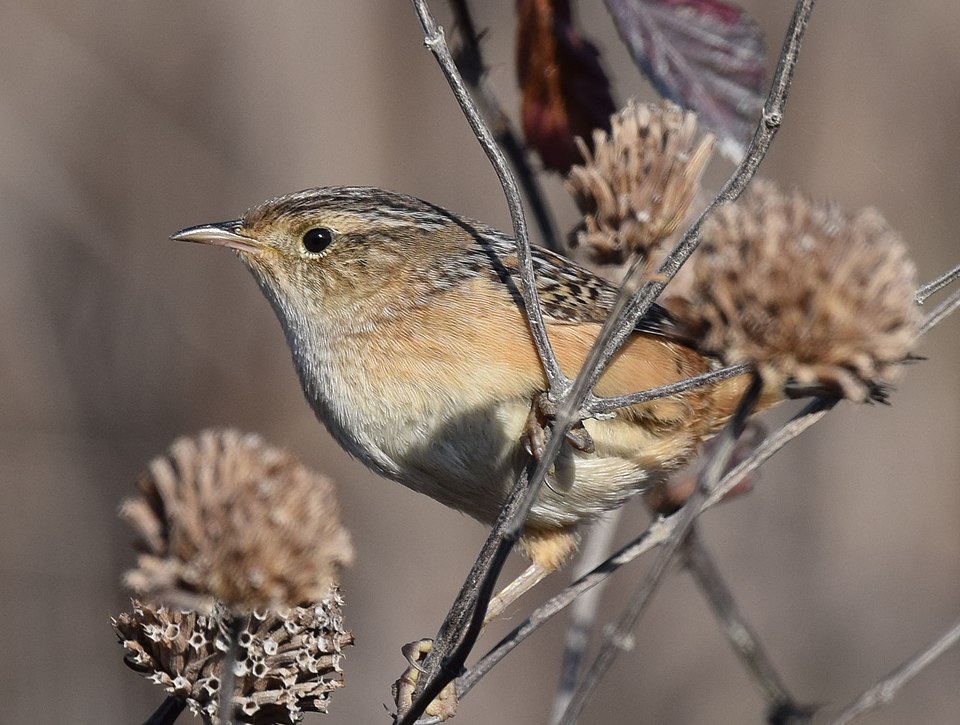
The Sedge Wren is one of North America's most overlooked songbirds, a tiny, warm-buff wren that lives a hidden life among damp sedge meadows, wet grasslands, and the grassy margins of marshes. It is rarely seen well. More often you'll hear its dry, mechanical chatter rising from a tangle of grass, catch a half-second glimpse of a small brown bird flicking up to a stem tip, and then watch it drop back into cover and vanish. Patience and a good ear are far more useful than sharp eyes when looking for this species.
What makes the Sedge Wren especially fascinating is how unpredictable it is. Unlike most songbirds that return faithfully to the same breeding grounds, Sedge Wrens are famously nomadic and irregular. A field that holds singing males one summer may be empty the next, and they often nest late in the season, sometimes shifting to new locations to raise a second brood. This wandering habit means birders treasure every encounter, and a singing Sedge Wren in a quiet wet meadow at dusk is one of the small, satisfying rewards of grassland birding.
This is a very small, round, short-tailed wren with a compact, almost mouse-like shape. When it does perch in the open, it often cocks its tail upward in classic wren fashion. The overall impression is of a warm brown bird, paler and buffier below, that seems to melt back into the grass the moment you raise your binoculars.
| Crown & back | Brown crown and upper back streaked with black and white, giving a finely 'striped' look unlike the plainer Marsh Wren |
| Eyebrow (supercilium) | Pale, indistinct buffy eyebrow line - much fainter than the bold white brow of the Marsh Wren |
| Underparts | Warm buff to cinnamon on the flanks and breast, paler whitish on the throat and belly |
| Tail | Short, narrow, barred with black, frequently cocked upright |
| Bill | Short, slender, and slightly downcurved - finer than many wrens |
| Size | Tiny, noticeably smaller and rounder than a House Wren |
Male vs. female
Male and female Sedge Wrens look essentially identical in the field. Both sexes share the streaked back, faint eyebrow, and warm buffy underparts, and there are no reliable plumage differences a birder can use to separate them. In practice, the singing bird is almost always the male, since males do the persistent territorial singing, while the quieter bird slipping through the grass nearby may be the female. Behavior, not appearance, is your only real clue.
Juveniles
Juvenile Sedge Wrens look much like adults but tend to be plainer and a bit duller, often showing less distinct streaking on the crown and back and a slightly more washed-out, uniform buff below. Freshly fledged young can appear softer and fluffier overall. Because the species nests late and young birds quickly take on adult-like plumage, distinctive juveniles are seen only briefly and are easy to overlook in dense grass.
The song is the best way to find this bird and one of the most distinctive sounds of a wet meadow. It begins with a few sharp, separate chap chap chap notes that then run together into a dry, mechanical trill or rattle, often written as chap-chap-chap-chap-churrrrr. The quality is staccato and almost insect-like, lacking the rich, gurgling, bubbly musicality of the Marsh Wren's song. Once you learn it, that dry chattering rattle is unmistakable.
Sedge Wrens sing persistently through the day and frequently into the evening and even on warm nights during the breeding season. The common call note is a sharp, dry chip or chap, sometimes repeated. Males improvise their songs rather than copying neighbors note-for-note, which adds to the slightly random, rattling character of a singing colony.
Sedge Wrens breed across the north-central United States and south-central Canada, with a stronghold in the upper Midwest and the northern Great Plains, extending east through the Great Lakes region and into parts of the Northeast. Their distribution is patchy and shifting from year to year because they track suitable wet-meadow habitat rather than fixed territories.
In winter they move south to the southeastern United States, the Gulf Coast, and into eastern Mexico, where they occupy wet grassy fields, coastal marsh edges, and damp ditches. Migration is somewhat protracted and the species is notably erratic, so birders in the breeding range may find them late in summer and birders along the Gulf may turn them up in winter grasslands where they skulk quietly and rarely sing.
The Sedge Wren is almost entirely insectivorous, feeding on a wide variety of small invertebrates. Its diet includes beetles, true bugs, grasshoppers and their relatives, caterpillars, flies, ants, and small spiders, all gleaned from grass stems, sedge leaves, and the moist ground at the base of vegetation.
It forages by working low and methodically through dense grass and sedge, hopping along stems and probing into the tangle rather than chasing prey in flight. Because it stays buried in cover while feeding, you rarely watch a Sedge Wren eat - you simply see the grass twitch and hear an occasional call as it moves through its damp, leafy world.
Nesting is a quintessentially wren-like affair. The male builds several globe-shaped 'dummy' nests woven from grasses and sedges, tucked low in dense vegetation, often just above damp ground or shallow water. The female selects one (or builds her own) for actual use and lines it softly with finer grasses, plant down, and feathers, creating a domed structure with a small side entrance that is extremely well hidden.
The female lays a clutch of typically 4 to 7 white eggs - unmarked, unlike the speckled eggs of the closely related Marsh Wren - and does most of the incubation, which lasts roughly two weeks. Sedge Wrens frequently raise two broods and are well known for nesting late in the season, sometimes shifting to entirely new areas for a second nesting attempt, part of the nomadic lifestyle that makes them so unpredictable.
The Sedge Wren is not a backyard or feeder bird, and there is no realistic way to draw one to a typical yard with seed, suet, or nest boxes. It is a specialist of wet, grassy, undisturbed habitat, so attracting it is really about habitat rather than feeding. If you have access to land, the best approach is to encourage the kind of damp, weedy, sedge-filled ground these wrens depend on.
- If you own wet, low-lying land, leave sedge meadows and damp grassy areas unmowed through the late-summer breeding season rather than cutting them early.
- Avoid draining or 'tidying' wet spots - the moist ground and dense grass that look messy to us are exactly what Sedge Wrens require.
- Protect natural marsh and grassland edges, since these transition zones between wet and dry are prime habitat.
- To actually find one, visit wet meadows and marsh margins at dawn or dusk in the breeding season and listen for the dry chattering song rather than scanning for the bird.
- Stand quietly at the edge of cover and use patience over pishing - these wrens often pop up briefly on their own when undisturbed.
- Support local grassland and wetland conservation, which does more for this habitat-sensitive species than anything you can do in a yard.
- Marsh Wren: Very similar but has a bolder white eyebrow, a plain (unstreaked) brown crown, and a richer, more gurgling, bubbly song; favors cattail marshes over grassy sedge meadows.
- House Wren: Plainer grayish-brown overall without the streaked black-and-white back, larger and longer-tailed, and far more likely to use yards and nest boxes.
- Winter Wren: Dark, rich reddish-brown and even tinier with a stubby tail; lives in forest and brushy tangles, not open grass, and has a long musical tinkling song.
What is the difference between a Sedge Wren and a Marsh Wren?
The two are easily confused but separable. The Sedge Wren has a streaked black-and-white crown and back, a faint buffy eyebrow, and a dry, staccato chattering song, and it prefers grassy sedge meadows. The Marsh Wren has a plain brown crown, a bold white eyebrow, and a rich, gurgling, bubbly song, and it favors cattail and bulrush marshes.
Where do Sedge Wrens live?
They breed in wet meadows, damp grasslands, and the grassy edges of marshes across the north-central U.S. and south-central Canada, and they winter in wet grassy fields and coastal marsh edges in the southeastern U.S., along the Gulf Coast, and into eastern Mexico.
Why are Sedge Wrens so hard to see?
They spend almost all their time low in dense grass and sedge, only briefly climbing a stem to sing before dropping back into cover. They are also small, well camouflaged, and naturally secretive, so birders usually locate them by their distinctive song rather than by sight.
What does a Sedge Wren sound like?
The song starts with a few sharp, separate chap notes that run into a dry mechanical trill or rattle - something like chap-chap-chap-churrrr. It sounds staccato and almost insect-like, very different from the musical, bubbling song of the Marsh Wren.
Will Sedge Wrens come to a backyard or bird feeder?
No. They are insect-eating habitat specialists of wet grasslands and do not visit feeders or typical yards. The only way to host them is to maintain or protect undisturbed wet, grassy, sedge-filled habitat; otherwise, the way to enjoy them is to seek them out in the field.