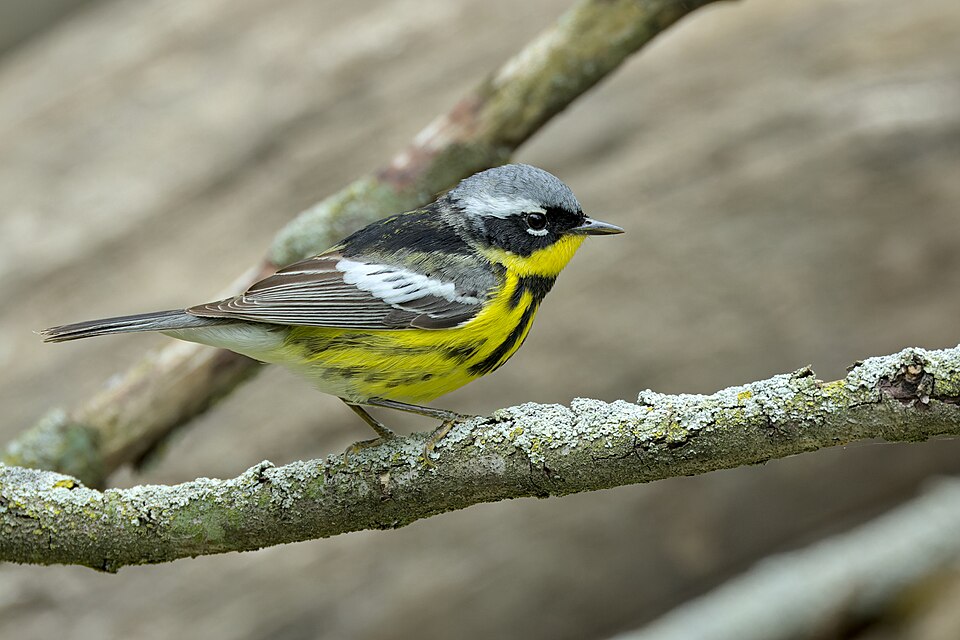
The Magnolia Warbler is one of the showiest of the wood-warblers, and one of the easiest to fall in love with. A breeding male in spring is a study in clean contrast: a gray crown, black mask, bright lemon-yellow underparts hung with bold black streaks, and a flashing white wing patch. Despite the name, the bird has nothing to do with magnolia trees. It was named by Alexander Wilson in 1810 after he collected the first specimen from a magnolia in Mississippi during migration. The bird breeds in young conifers far to the north, but the misleading name stuck.
This is a bird of the great northern forests, nesting across Canada and the northeastern United States in dense stands of young spruce, fir, and hemlock. For most birders south of that range, the Magnolia Warbler is a migration treat, a flash of yellow moving through the trees in May and again in fall. It tends to forage at eye level or just above, often lower than many warblers, which makes it a favorite among people learning to sort out the spring warbler waves.
A small, slender, long-tailed warbler. The single most reliable field mark in any plumage or season is the tail pattern: from below, the tail looks white at the base with a broad black band across the tip, like a white tail that has been dipped in ink. No other warbler shows quite this look, and it is visible even on dull fall birds.
| Tail pattern | White tail base with a broad black terminal band, obvious from below in every plumage and season. The best single field mark. |
| Underparts | Bright yellow chest and belly heavily marked with black streaks, often coalescing into a 'necklace' across the breast in adult males. |
| Rump | Yellow rump, visible as the bird flies or feeds overhead. |
| Wings | White wing patch (broad on males) or two thin white wingbars (females and immatures). |
| Face | Adult males show a black mask through the eye and a thin white eyebrow; duller birds show a gray face with a pale eye-ring or arc. |
| Upperparts | Gray crown and black or gray-streaked back; throat is unmarked yellow. |
Male vs. female
Breeding males are unmistakable: gray crown, solid black mask, black back, a large white wing patch, and a heavy black necklace and streaks across bright yellow underparts. Females are a softer, washed-out version of the same pattern. They show a grayer face without the bold black mask, usually a pale eye-ring or eye-arcs, two thin white wingbars instead of a solid patch, and finer, sparser streaking on the yellow underparts. Both sexes always share the diagnostic black-and-white tail pattern.
Juveniles
Fall immatures are noticeably plain compared to spring males. They show a smooth gray head, a clean grayish breast band or faint streaking, a distinct whitish eye-ring on an unmarked gray face, and yellow underparts. The key is that the diagnostic tail pattern and the yellow rump remain, so even a confusing fall bird can be nailed by checking the underside of the tail and watching for the black tail band.
The primary song is a short, sweet, slightly rising phrase often written as weeta weeta weet-see or weety weety witchy, ending with an emphatic up-note. It is musical and a bit lazy compared to the buzzy songs of many warblers, and shorter than the similar-sounding Yellow Warbler. Males sing two main song types, one used more for attracting mates and one more in territorial disputes.
The most useful identification clue is the call note: a distinctive, husky, nasal tlep or chip that sounds slightly metallic and somewhat unmusical. Once learned, this rough chip note is a reliable way to pick the species out during migration. In flight, listen for a thin, high zeep.
Magnolia Warblers breed across the boreal forest belt of Canada from the Northwest Territories and British Columbia east to Newfoundland, dipping south into the northern Great Lakes states, New England, and the Appalachian highlands as far as West Virginia. They favor young, dense conifer regrowth rather than mature forest.
They are long-distance migrants, wintering mainly in Mexico, Central America, and the Caribbean. Across the eastern and central United States, most people see them only on passage: northbound in late April and May, and southbound from August into October. They are far less common in the West, where they turn up as scattered vagrants. During migration they readily use a wide range of habitats, including parks, woodlots, and suburban trees.
Magnolia Warblers are insectivores, and during the breeding season they feed heavily on caterpillars, including spruce budworm, along with beetles, aphids, flies, and other small arthropods. They are active, deliberate foragers that tend to work the lower and middle levels of trees and shrubs, often gleaning prey from the undersides of leaves while flitting from branch to branch.
They frequently fan and flick the tail open as they forage, flashing those white tail patches, which may help startle hidden insects into moving. On the wintering grounds they continue to eat insects but will also take some fruit when it is available.
Magnolia Warblers nest low, which is unusual for a warbler. The female builds a flimsy, loosely constructed cup of grasses, fine twigs, and plant fibers, lined with dark, hairlike fungal threads (often called horsehair fungus). The nest is typically placed only a few feet off the ground in the dense branches of a young spruce, fir, or hemlock.
The female lays a clutch of usually 3 to 5 eggs, which she incubates for around 11 to 13 days. Both parents feed the nestlings, which leave the nest in roughly 8 to 10 days. Most pairs raise a single brood per year given the short northern summer. The species is a regular host to Brown-headed Cowbird parasitism along forest edges.
The Magnolia Warbler is not a feeder bird and will not visit seed or suet, since it eats insects gleaned from foliage. That said, you can absolutely draw migrants into your yard during spring and fall passage by making the habitat appealing.
- Plant native trees and dense shrubs that host caterpillars and other insects. Native oaks, willows, and birches support far more insect life than ornamentals.
- Provide a clean, moving water source. A shallow bath with a dripper or mister is a powerful magnet for migrating warblers.
- Avoid pesticides. The insects you spray away are exactly the food these birds are passing through to find.
- Keep some understory and low conifer cover, since Magnolia Warblers naturally forage and rest at lower levels than many warblers.
- Watch during migration windows. In the East, focus on May mornings and the August-to-October stretch.
- Reduce nighttime light and make windows bird-safe, since collisions are a major hazard for nocturnal migrants like this one.
- Yellow-rumped Warbler: Also has a yellow rump but shows yellow side patches rather than streaked yellow underparts, lacks the white-and-black tail band, and has a streakier, browner overall look.
- Canada Warbler: Shares a 'necklace' of dark streaks on yellow underparts but has a plain gray back, bold yellow spectacles, no white in the wings or tail, and white undertail coverts.
- Prairie Warbler: Yellow below with black streaking confined to the sides, plus black face marks; lacks the gray crown, white wing patch, and banded tail of the Magnolia.
- Cape May Warbler: Yellow and streaked below like a Magnolia but shows chestnut cheeks (males), a yellow neck patch, and lacks the distinctive black-banded white tail.
Why is it called a Magnolia Warbler if it doesn't live in magnolias?
The name is a historical accident. Ornithologist Alexander Wilson collected the first specimen from a magnolia tree in Mississippi during migration in 1810 and used 'magnolia' as the species name. The bird actually breeds in northern spruce and fir forests, not magnolias, but the name was never changed.
What is the easiest way to identify a Magnolia Warbler?
Look at the underside of the tail. The Magnolia shows a white tail with a broad black band across the tip, as if the white tail were dipped in ink. This pattern is visible in every plumage and season, including dull fall birds, and no other warbler shows it quite the same way.
When can I see Magnolia Warblers where I live?
If you live across most of the eastern or central U.S., you'll see them during migration. Northbound birds pass through in late April and May, and southbound birds move from August into October. Farther north in Canada, the northern Great Lakes, New England, and the Appalachians, they stay to breed through the summer.
Will Magnolia Warblers come to my bird feeder?
No. They eat insects and caterpillars gleaned from leaves, not seeds or suet. The best way to attract them is to offer a moving water source, plant native insect-hosting trees and shrubs, and avoid pesticides during migration.
How do I tell a fall Magnolia Warbler from other confusing fall warblers?
Fall immatures look plain and gray-headed with a whitish eye-ring and a gray breast band, which can be confusing. Always check two things: the black-banded white tail underneath and the yellow rump. Together they confirm a Magnolia even when the bird looks washed out.