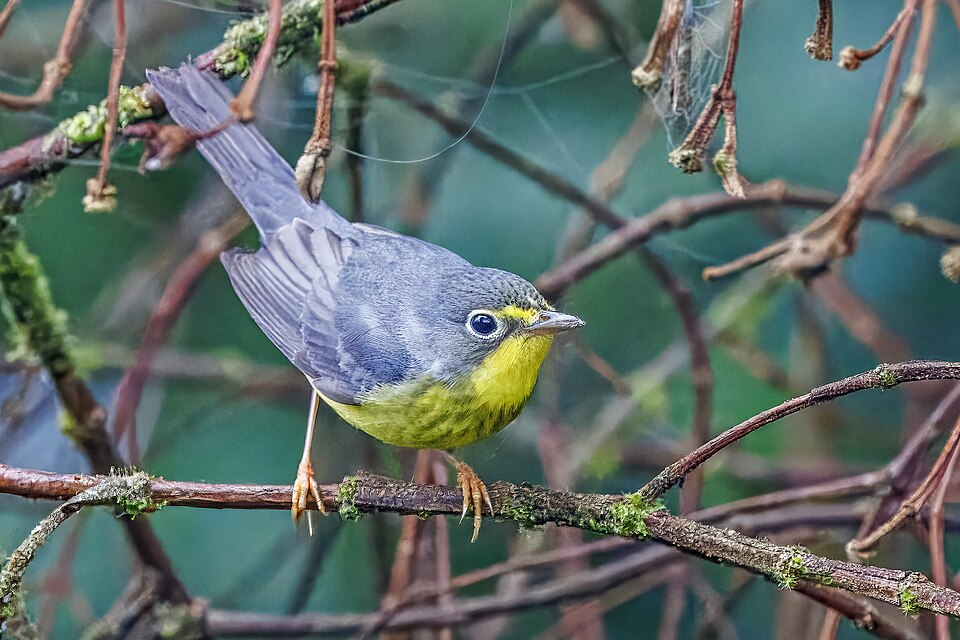
The Canada Warbler is one of the small jewels of the northern woods, a slate-gray and lemon-yellow bird best known for the smudge of black streaks across its chest that birders call its "necklace." It breeds across a broad swath of Canada and the northeastern United States, favoring cool, damp forests with a dense, tangled understory, alder swamps, rhododendron thickets, mossy ravines, and the brushy edges of streams. Despite the name, it spends only a few short months in Canada; for most of the year it lives in the cloud forests and foothills of the northern Andes in South America.
This is a warbler that rewards patience. It rarely sits still and tends to skulk in shadowy thickets, but it is also unusually curious and active, often flying out to snap insects from the air with an audible snap of the bill. It is one of the last warblers to arrive on its breeding grounds in spring and one of the first to leave in late summer, giving birders a narrow window to enjoy it. Unfortunately, the Canada Warbler has been declining steadily for decades, likely due to the loss of wet understory habitat on both its breeding and wintering grounds, which makes every sighting feel a little more precious.
The Canada Warbler is a small, slim, long-tailed warbler that often holds its tail slightly cocked and looks alert and busy. The combination of a plain blue-gray back, bright unmarked yellow underparts, bold yellow "spectacles," and a necklace of dark streaks across the breast is unlike any other North American warbler, once you learn it, it is hard to mistake.
| Necklace | Band of short black streaks across the upper breast, bold and inky on adult males, fainter and grayer on females and young birds. |
| Upperparts | Plain, unstreaked blue-gray to slate-gray from crown to tail, with no wing bars. |
| Underparts | Bright, clean lemon-yellow throat, breast, and belly; white undertail coverts. |
| Spectacles | Bold yellow eyering joined to a yellow loral line, creating a 'spectacled' look around a dark eye. |
| Face & forehead | Some black flecking on the forehead and lores in adult males, giving a slightly masked appearance. |
| Legs | Pinkish to pale flesh-colored legs, often noticeable as the bird forages low. |
Male vs. female
The sexes look broadly similar but differ in intensity. The adult male is the sharpest: clean blue-gray above, vivid yellow below, with a heavy, solidly black necklace and noticeable black on the forehead and around the eye. The adult female is softer overall, her necklace is thinner and more diffuse, often appearing dark gray rather than jet black, and she shows little or no black on the face. In good light the yellow spectacles and bright underparts are obvious on both sexes, so the necklace's boldness is the best clue to telling them apart.
Juveniles
Immature Canada Warblers in fall (first-year birds) are the dullest plumage you are likely to see. They retain the diagnostic yellow spectacles and yellow underparts, but the upperparts can look slightly grayer-brown, and the necklace may be reduced to a faint wash of pale gray streaking that is easy to overlook. Even so, the bold yellow eyering against an otherwise plain gray-faced bird with clean yellow underparts and no wing bars points reliably to this species. Juveniles just out of the nest are browner and more washed-out before molting into this first-winter look.
The song is a bright, energetic, somewhat jumbled burst that often begins with a sharp introductory chip note. Many birders render it as a quick, irregular chip-chupety-swee-ditchety, a tumbling, slightly explosive phrase with no fixed pattern, which is part of what makes it distinctive. It sounds hurried and a touch musical, rising and falling without the buzzy or trilled quality of many other warblers.
The most common call is a sharp, low, slightly husky chip or chup, given frequently as the bird forages and when agitated. In flight or during migration it also gives a thin, high tsip. Learning the explosive, irregular song is one of the best ways to find this skulking bird in dense cover.
Canada Warblers breed across the boreal and northern hardwood forests of Canada, from the eastern provinces west through Ontario and into the prairie provinces and parts of British Columbia, and southward into the northeastern United States, including New England, New York, the Great Lakes region, and down the Appalachian Mountains as far as northern Georgia at higher elevations. Throughout this range they seek out cool, wet woodlands with thick understory.
They are long-distance migrants and among the latest warblers to move north in spring, with most passing through the eastern and central U.S. in May. Fall departure is early, many are already heading south by late July and August. They winter primarily in the foothills and montane cloud forests of northern South America, especially in the Andes of Colombia, Venezuela, Ecuador, and Peru, where suitable mid-elevation forest is increasingly fragmented.
The Canada Warbler is almost entirely insectivorous, feeding on a wide variety of small invertebrates including caterpillars, beetles, flies, mosquitoes, moths, spiders, and other soft-bodied insects. It is an exceptionally active forager, working the lower and middle levels of dense, shady vegetation and frequently dropping to the ground or near the forest floor to glean prey from leaves, twigs, and mossy logs.
One of its most enjoyable habits is flycatching: it will dart out from a perch to snatch flying insects in mid-air, often with a quick, agile sally and a snap of the bill. This nimble, restless feeding style, combined with its habit of flicking its tail and constantly changing position, is a good behavioral clue when you catch only a brief glimpse in thick cover.
Canada Warblers are ground or near-ground nesters, which ties them tightly to forests with a rich, mossy, shrubby understory. The female builds a bulky cup nest of leaves, grasses, bark strips, and rootlets, usually tucked into a mossy hummock, the upturned roots of a fallen tree, a streambank, a rotting stump, or low in dense vegetation, almost always well hidden and close to the ground.
She typically lays around 3 to 5 eggs, creamy or whitish with brown speckling, and incubates them herself for roughly two weeks. Both parents feed the nestlings, which leave the nest after about ten days, often before they can fly strongly, and continue to be cared for in the surrounding cover. The species usually raises a single brood per season, a reflection of its short stay on the breeding grounds.
The Canada Warbler is not a feeder bird and will not visit seed, suet, or nectar, it eats live insects and prefers dense, shady forest interiors, so it is rarely a true backyard visitor. That said, you can improve your chances of seeing one during migration or attracting one to a wooded property, especially if you live near its breeding range and have damp, brushy woods nearby.
- Provide dense, low understory, leave shrub thickets, brush piles, and tangled vegetation rather than clearing the forest floor, since this bird forages and nests close to the ground.
- Protect or create moist, shady conditions: wet woodland edges, seeps, streamside vegetation, and ferny, mossy ground are exactly what this species seeks.
- Offer clean water, a ground-level or low birdbath or a natural dripping water feature can draw migrants moving through wooded yards.
- Plant native shrubs and trees that host abundant caterpillars and insects, the warbler's main food, and avoid spraying insecticides.
- Watch during the narrow migration windows, peak in May heading north and late July through August heading south, when birds may pause in wooded yards far from breeding habitat.
- Keep cats indoors, since a ground-foraging warbler is especially vulnerable to predation.
- Magnolia Warbler: Also yellow below with chest streaking, but its streaks run down the flanks (not a tidy necklace), and it shows white wing bars, a white tail band, and yellow on the rump, all absent in the plain-backed Canada.
- Kentucky Warbler: Shares yellow spectacles and bright yellow underparts, but it has a greenish-olive back, black sideburns down the face, and no breast necklace; it skulks on the forest floor of southern woods.
- Nashville Warbler: Has a gray head with a complete white eyering and yellow underparts, but its back is olive-green, it lacks the dark necklace, and it is generally a more open, treetop forager.
- Wilson's Warbler: Another plain-backed, yellow warbler in the same genus, but it is olive-green above, lacks any necklace, and the male wears a neat black cap instead.
How do I identify a Canada Warbler?
Look for a slim, gray-backed warbler with bright yellow underparts, bold yellow 'spectacles' around the eye, no wing bars, and a distinctive band of dark streaks, the 'necklace', across the upper breast. That necklace plus the plain blue-gray back is the key combination no other North American warbler shows.
Why is it called a Canada Warbler if it winters in South America?
It is named for the country where much of its breeding population was first described and where a large share of it nests across the boreal and northern forests. Despite the name, it is a long-distance migrant that spends most of the year in the Andean foothills of northern South America and only a few short months in Canada.
What's the difference between a male and female Canada Warbler?
Both have yellow spectacles and bright yellow underparts, but the male's necklace is bold and jet-black with some black flecking on the face, while the female's necklace is thinner, grayer, and more diffuse, and she shows little black on the head. The female is generally a softer, plainer version of the male.
Will Canada Warblers come to my bird feeder?
No. Canada Warblers eat live insects and spiders, not seed, suet, or nectar, and they prefer dense, shady forest with thick understory. You are most likely to see one during spring or fall migration in wooded areas; a low birdbath, native insect-friendly plantings, and brushy cover give you the best odds.
When is the best time to see a Canada Warbler?
It has a short window. In spring it is one of the last warblers to arrive, peaking in May, and in fall it departs early, with many moving south by late July and August. Listen for its sharp 'chip' note and explosive, jumbled song in damp, brushy woods to locate it.