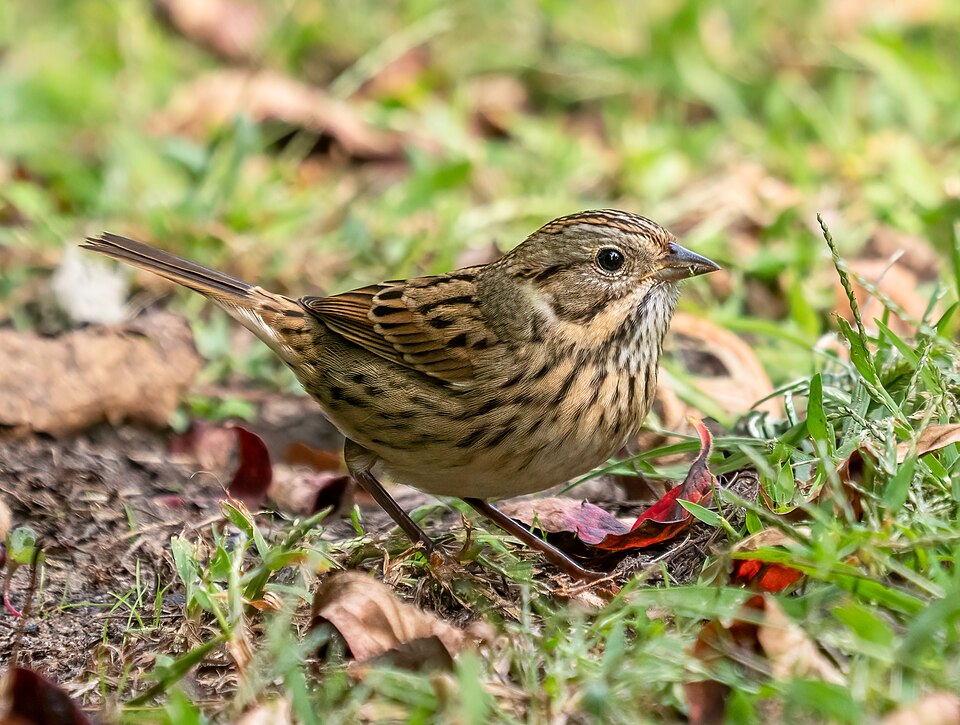
Lincoln's Sparrow is one of those birds that rewards a patient, careful eye. At a glance it looks like "just another little brown streaky sparrow," but slow down and the details snap into focus: crisp, hair-thin black streaks on a wash of warm buff across the chest, a neat gray face, and a buffy mustache stripe. It is a trim, elegant bird, and many birders consider it the most refined-looking of the Melospiza sparrows once they learn to pick it out.
The bird carries the name of Thomas Lincoln, a young companion of John James Audubon who collected the first specimen on a trip through Labrador in 1833. Despite being widespread and genuinely common across much of North America, it has a reputation for being hard to see. It is a skulker that prefers to stay low in dense, brushy cover, slipping through tangles rather than perching boldly in the open. Learn its habits and its song, though, and you will start finding it far more often than you expected.
Lincoln's Sparrow is a small, slim sparrow with a fairly short tail, a rounded peak to the crown that it can raise into a slight crest, and an overall neat, "clean" appearance compared with its scruffier relatives. The key to identifying it is the fine, sharp streaking set against warm buff.
| Breast | A band of warm buff across the upper chest crossed by very fine, crisp black streaks; lower belly is clean white |
| Face | Grayish face with a buffy eye-ring and a buffy submoustachial (mustache) stripe bordered by thin dark malar lines |
| Crown | Reddish-brown with fine dark streaks and a gray central stripe; often raised into a slight peak or crest |
| Back | Brown with bold black streaks, giving a finely patterned, almost herringbone look |
| Size & shape | Small and slim with a short, slightly notched tail; smaller and trimmer than a Song Sparrow |
| Bill | Small, conical, dark gray above and paler at the base of the lower mandible |
Male vs. female
Male and female Lincoln's Sparrows look alike. There is no visible plumage difference between the sexes, so you cannot reliably tell them apart in the field. In the breeding season, the singing bird is almost always the male, but otherwise behavior and appearance offer no shortcut. Plumage stays fairly consistent year-round, though fresh fall feathers can look especially rich and buffy.
Juveniles
Juvenile Lincoln's Sparrows, seen on or near the breeding grounds in summer, are paler and buffier overall with blurrier, less sharply defined streaking than adults. They can be tricky, because young Song Sparrows and Swamp Sparrows at the same stage are also streaky and indistinct. By the time these birds reach their wintering range, they have molted into the crisp, fine-streaked adult-type plumage, so the confusing juvenile look is mostly a summer-and-early-fall phenomenon close to nesting habitat.
The song is a real treat and one of the best ways to find this skulker. It is a rich, bubbling, gurgling jumble that rises and falls, often described as wren-like or even House Wren-like in its energy and sweetness. It typically starts with a few low notes, builds into a sputtering trill, and tumbles off at the end, with a musical, liquid quality that stands out among sparrows. Many listeners find it surprisingly complex and pretty for such a plain little bird.
The most useful call is a sharp, flat tsip or chip, often given when the bird is agitated or moving through cover. In flight or when flushed it may give a thin, buzzy zee. These short calls, along with rustling low in a thicket, are often your first clue that a Lincoln's Sparrow is present before you ever see it.
Lincoln's Sparrow breeds across the boreal forest of Canada and Alaska and southward in the mountains of the western United States, favoring cool, wet habitats: bogs, willow and alder thickets, beaver ponds, and damp montane meadows with dense low cover. It is a long-distance migrant.
In winter it withdraws to the southern United States, Mexico, and Central America, where it occupies brushy fields, weedy edges, thickets, and overgrown ditches. During spring and fall migration it can turn up almost anywhere across the continent in suitable brushy or weedy cover, including parks, hedgerows, and yard edges, so many birders far from its breeding range encounter it as a migrant.
Lincoln's Sparrows are omnivores whose diet shifts with the seasons. In the breeding months they feed heavily on insects and other small invertebrates such as beetles, caterpillars, true bugs, and spiders, which provide the protein needed for raising young. In fall and winter they switch largely to small seeds from grasses and weedy plants.
They forage mostly on or near the ground, hopping through leaf litter and low vegetation and staying close to cover. They tend to be unobtrusive feeders, working the shadowy base of thickets rather than out in the open, and they will scratch and pick through litter much like other sparrows. When disturbed they typically dive back into dense brush rather than flying far.
Lincoln's Sparrows nest on or very near the ground, well hidden in dense, low vegetation such as sedges, grasses, or the base of a shrub, often in damp or boggy settings. The female builds a cup nest of grasses and sedges, frequently tucked into a slight depression and screened by overhanging plants, which makes the nest notoriously difficult to find.
The female lays a clutch of pale eggs marked with brown spotting and does the incubating, which lasts about 12 to 14 days. Young leave the nest after roughly 10 to 12 days, often before they can fly well, and remain dependent on the parents for a time afterward. Pairs typically raise one brood per season in the short northern summer, though a second brood is possible in some areas.
Lincoln's Sparrow is not a classic feeder bird, but it is far from impossible to host, especially during migration and winter if you live within or along its range. The trick is habitat more than handouts: it wants dense, low cover and quiet ground to forage in.
- Scatter small seeds such as white millet on the ground or on a low platform near cover, rather than in hanging tube feeders, since this is a ground-forager.
- Maintain a brushy edge or thicket in the yard, like a brush pile, hedgerow, or unmowed weedy corner, where it can stay hidden while it feeds.
- Provide a low, clean water source such as a ground-level birdbath or a dish near sheltering shrubs.
- Keep feeding areas close to escape cover; a shy skulker will not venture into open, exposed space.
- Watch for it especially during spring and fall migration, when birds well outside the breeding range pass through brushy yards.
- Look low and listen for a sharp chip note; these birds reveal themselves by sound and movement long before they step into view.
- Song Sparrow: Larger and bulkier with coarser, blurrier streaking and a heavier central breast spot; lacks the fine streaks on a clean buff band and the crisp, gray-faced look.
- Swamp Sparrow: Plainer, grayer breast (usually unstreaked or faintly streaked), richer rufous wings, and a more uniform look without Lincoln's sharp fine streaks on buff.
- Savannah Sparrow: Often shows yellow in front of the eye, has pinkish legs, a shorter notched tail, and prefers open grassy areas rather than dense brush.
- Vesper Sparrow: Has a bold white eye-ring and white outer tail feathers flashed in flight; chunkier and an open-country bird, lacking the buffy breast band.
How do I tell a Lincoln's Sparrow from a Song Sparrow?
Look at the breast. Lincoln's has very fine, hair-thin black streaks over a band of warm buff and a neat, clean gray face. A Song Sparrow is larger and scruffier with coarse, blurry streaks and usually a bold dark spot in the center of the chest. Lincoln's also looks trimmer and more elegant overall.
Is Lincoln's Sparrow rare?
No, it is genuinely common and widespread across North America. It just has a reputation for being hard to see because it is shy and skulks low in dense brush. Once you learn its habits and its sharp chip call, you will likely find it more often, especially during migration.
What does a Lincoln's Sparrow sound like?
The song is a rich, bubbling, gurgling jumble that rises and falls, often compared to a House Wren for its sweetness and energy. The most useful call is a flat, sharp tsip or chip, frequently given as the bird moves through cover.
Will Lincoln's Sparrows come to a bird feeder?
They are not typical feeder birds, but they will visit yards that offer the right setup. Scatter small seeds like white millet on the ground near a brush pile or thicket rather than using hanging feeders, since they prefer to forage low and close to cover, especially in winter and during migration.
Where does Lincoln's Sparrow live?
It breeds in cool, wet habitats across the boreal forest of Canada and Alaska and in western U.S. mountains, favoring bogs, willow thickets, and damp meadows. In winter it moves to the southern U.S., Mexico, and Central America, using brushy fields and weedy edges, and it can appear nearly anywhere on migration.