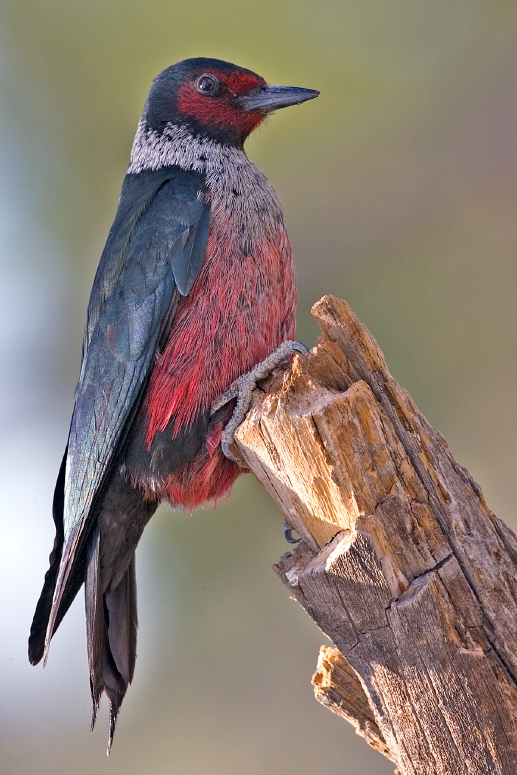
Lewis's Woodpecker is one of the most peculiar woodpeckers in North America, and birders who finally catch up with one rarely forget the experience. Instead of clinging to a trunk and hammering away, it perches upright on a snag or fence post and launches into the air to snatch insects like a flycatcher, or flaps across open country with slow, steady, crow-like wingbeats. From a distance it can genuinely be mistaken for a small crow, which is exactly why so many people overlook it. Its name honors Meriwether Lewis of the Lewis and Clark Expedition, who first described it for science in the early 1800s.
Up close, the bird is unexpectedly beautiful. Its back and wings gleam an oily greenish-black, its belly is a soft rose-pink, and a gray collar wraps around the neck and upper breast against a dark red face. It is a bird of open ponderosa pine forests, burned woodlands, oak savanna, and cottonwood groves across the American West. Sadly, it has declined across much of its range as fire-killed forests are salvage-logged and big old snags disappear, so seeing one is a treat worth slowing down for.
Think of a woodpecker built like a small crow. Lewis's is large and broad-winged with a long, slightly rounded tail and a heavy direct flight that looks nothing like the bounding, undulating flight of most woodpeckers. Its colors are subtle in poor light but striking in good sun, and the combination of dark glossy back, pink belly, and gray collar is unmistakable once you see it well.
| Size & shape | Crow-like proportions: large body, broad rounded wings, long tail. Roughly the size of an American Robin but bulkier. |
| Back & wings | Dark glossy greenish-black, looking almost solid black at a distance. |
| Belly | Rosy pink to salmon, often hard to see except in good light or on a perched bird. |
| Face & collar | Dark red (crimson) face with a pale silver-gray collar wrapping the neck and upper breast. |
| Flight | Slow, steady, crow-like flapping with little or no undulation - a key field mark. |
| Behavior | Perches conspicuously on snags and posts; sallies out to catch flying insects. |
Male vs. female
Males and females look essentially alike, and you cannot reliably tell them apart in the field. Both sexes share the dark green-black back, gray collar, red face, and pink belly. Males average very slightly larger with a marginally longer bill, but this is not something you can judge by eye on a lone bird. For practical purposes, treat the sexes as identical when birding.
Juveniles
Juveniles look noticeably duller and browner than adults and lack the crisp field marks. Young birds show a dark sooty-brown head without the red face, little or no gray collar, and only a faint wash of pink on the belly - sometimes none at all. They gradually acquire the adult colors through their first fall and winter. A drab, collarless Lewis's in late summer is almost always a youngster of the year.
Lewis's Woodpecker is a quiet bird for much of the year, which adds to how easy it is to miss. It does not have a true song. Around the nest and in territorial disputes it gives a harsh, churring series often written as chee-ur, chee-ur, chee-ur, repeated in a rolling, scolding rhythm. It also produces a high, squeaky chatter and various soft yick notes during interactions.
Unlike many woodpeckers, it drums only weakly and infrequently. When it does drum, it is a soft, slow, somewhat tapping roll rather than the loud, machine-gun bursts of a sapsucker or flicker. Most of the time you will find this bird by sight - perched bolt upright on a snag - rather than by sound.
Lewis's Woodpecker is a western species, breeding from southern British Columbia and the inland Pacific Northwest south through the Rocky Mountain states and the Great Basin into the Southwest. It favors open ponderosa pine forest, recently burned coniferous forest with standing snags, oak woodland, and riverside cottonwood groves - generally open country with plenty of perches and flying insects.
It is notably nomadic and irregular in its movements, which can frustrate birders. Northern and high-elevation breeders shift south and to lower elevations for winter, when the birds often concentrate in oak woodlands and orchards to feed on acorns and stored nuts. In some years they appear in good numbers in a given area; in others they are nearly absent. Wintering range centers on the interior Southwest, California, and parts of the southern Great Basin, with numbers varying year to year depending on the acorn crop.
This is where Lewis's Woodpecker really breaks the woodpecker mold. In the warmer months it is primarily an aerial insect hunter, sallying out from an exposed perch to catch beetles, ants, grasshoppers, bees, and other flying insects in mid-air, much like a flycatcher or a large swallow. It also gleans insects from bark and the ground, but it almost never excavates deeply into wood the way most woodpeckers do.
In fall and winter it switches to a heavily plant-based diet, especially acorns and other nuts, plus fruit and corn. Like its acorn-storing relatives, it shells and breaks nuts into pieces and wedges them into bark crevices and cracks, caching food it will defend and return to through the cold months. This dependence on flying insects in summer and stored mast in winter shapes where and when you find it.
Lewis's Woodpeckers nest in cavities, but they are reluctant excavators. They strongly prefer to reuse an existing hole - an old woodpecker cavity, a natural cavity, or a previously used nest - in a large dead or dying tree, often a ponderosa pine, cottonwood, or oak snag. When they do excavate, they choose soft, well-rotted wood. Big standing snags are essential to them, which is why salvage logging of burned forests hits this species so hard.
The female typically lays around 5 to 9 white eggs, with clutches often in the 6 to 8 range, and usually raises a single brood per year. Both parents share incubation, which lasts roughly two weeks, and both feed the nestlings. The young leave the nest after about four to five weeks. Pairs frequently return to the same nest snag in successive years when it remains standing.
Lewis's Woodpecker is not a typical backyard or feeder bird, and most people will never host one at a suet cage. It needs open western habitat, flying insects, and big snags, so attracting it is mostly about habitat rather than feeders. That said, in the right setting there are real ways to make your property more appealing.
- Leave dead trees standing. Large snags are the single most important thing this bird needs for perching, feeding, and nesting - keep them whenever they are not a safety hazard.
- Plant or protect oaks; acorns are a critical winter food, and oak woodlands draw wintering birds.
- Avoid spraying insecticides - flying insects are the bird's summer staple, and a healthy insect population matters more than any feeder.
- If you live near open ponderosa pine or burned forest, put up a large nest box on a tall pole; Lewis's will occasionally use boxes sized for flickers.
- Maintain open, perch-rich edges - fence posts, snags, and isolated trees give the bird the exposed launch points it uses to hawk insects.
- In fall and winter, leave fallen acorns and unharvested orchard fruit; wintering birds will cache and feed on them.
- Acorn Woodpecker: Shares the acorn-storing habit and overlaps in oak country, but has a bold black-and-white clown face, white wing patches, and a white rump - no pink belly or gray collar.
- Red-headed Woodpecker: An eastern relative with a fully red head, but it shows large white wing patches and a clean white belly, and its ranges barely overlap.
- Red-bellied Woodpecker: Has a barred black-and-white back and red nape, lacks the dark glossy back and pink belly, and is an eastern bird with little range overlap.
- Pileated Woodpecker: Also crow-like in size and flight, but it is black with a flaming red crest and bold white neck stripes - never pink-bellied or gray-collared.
Why does Lewis's Woodpecker fly like a crow?
Its slow, steady, flapping flight reflects its lifestyle. Rather than bounding tree to tree, it spends a lot of time in the air chasing flying insects and crossing open country, so it has broad wings and a direct, crow-like wingbeat instead of the typical undulating woodpecker flight.
Is Lewis's Woodpecker rare?
It is uncommon and has declined across much of its range, largely due to the loss of the big standing snags it depends on. It is not endangered, but it is patchily distributed and nomadic, so even within its range you may have to look in the right habitat at the right time of year to find one.
Where is the best place to see a Lewis's Woodpecker?
Look in open ponderosa pine forest, recently burned forest with standing dead trees, oak woodlands, and cottonwood groves across the interior West. Scan exposed snags, treetops, and fence posts where the bird perches upright. In winter, oak woodlands and orchards are good bets.
How do you tell a Lewis's Woodpecker from an Acorn Woodpecker?
Both store acorns and share oak country, but they look very different. Lewis's has a dark glossy green-black back, a pink belly, a gray collar, and a dark red face. Acorn Woodpecker has a striking black-and-white face, white wing patches, and no pink at all.
Will Lewis's Woodpecker come to a feeder?
Rarely. It is not a typical feeder bird and feeds mostly on flying insects in summer and stored acorns and nuts in winter. You are far more likely to attract it by protecting large snags and oaks than by putting out suet or seed.