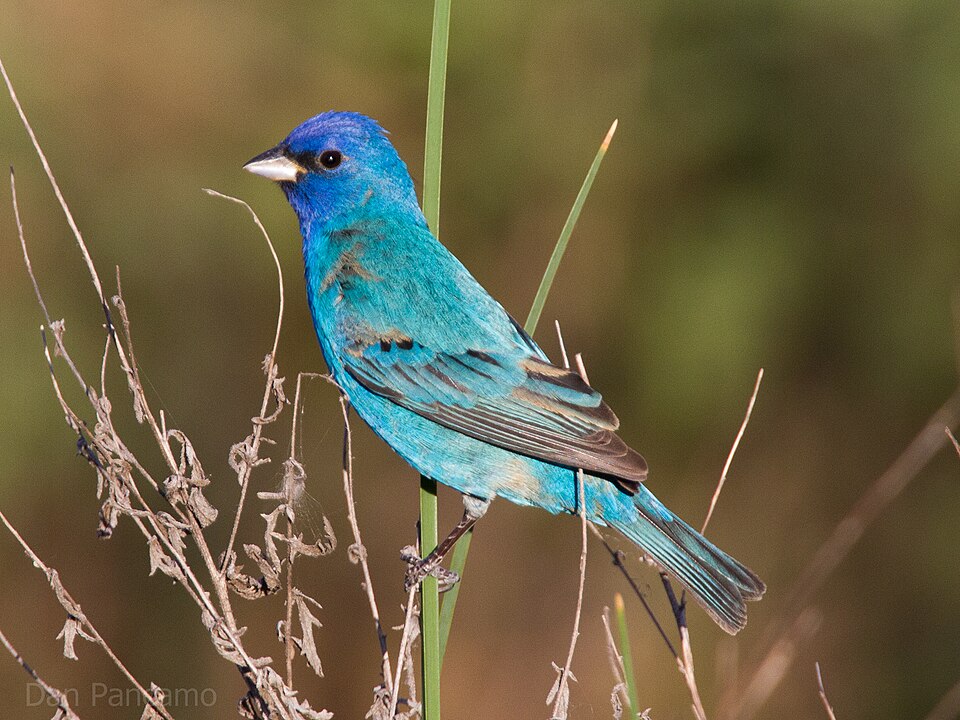
The Indigo Bunting is one of the great surprises of an eastern summer. A breeding male perched on a wire or treetop looks like a chip of sky come to life, singing his cheerful, paired phrases through the hottest part of the day when most other birds have gone quiet. Despite the electric color, he is a small, stocky bird only about the size of a sparrow, with a stubby conical bill built for cracking seeds. These buntings favor the messy in-between places that many people overlook: brushy field edges, old pastures growing back to scrub, roadside thickets, power-line cuts, and woodland clearings.
What makes the Indigo Bunting especially fun to know is the secret behind that blue. There is no blue pigment in the feathers at all. The color comes from the microscopic structure of the feathers scattering light, which is why a male can look brilliant turquoise in good sun and nearly black in shade or silhouette. The plain brown female, by contrast, is so unassuming that many backyard birders never connect her to the flashy male singing overhead. Together they are a familiar voice of summer across much of the eastern and central United States, and a long-distance traveler that navigates by the stars on its journeys to and from the tropics.
This is a small, compact songbird with a short tail and a thick, triangular seed-cracking bill, roughly sparrow-sized and finch-shaped. Shape and bill help confirm an identification when lighting plays tricks with the color, which it often does.
| Breeding male | Entirely deep blue, often appearing more vivid turquoise on the head and richer indigo on the body; can look black in poor light |
| Female | Warm, plain brown overall, slightly paler below with faint, blurry streaking on the breast and a hint of blue in the wings or tail |
| Bill | Short, thick, and conical with a silvery-gray lower mandible, built for cracking small seeds |
| Size & shape | Small and stocky, about 5 inches long, with a short tail and rounded head |
| Wing tones | Females and young birds show subtle bluish or grayish edging in the wings and tail, a key clue to separate them from sparrows |
| Winter/molting male | Patchy, mottled brown-and-blue, like a male half-painted, during fall and on the wintering grounds |
Male vs. female
The sexes look completely different in breeding season, which is the main source of confusion. The male is unmistakable when seen well: solid, glowing blue from bill to tail with no other markings. The female is a plain warm brown bird with a softly streaked breast and only the faintest wash of blue in the wings and tail. Outside the breeding season the male loses most of his blue and becomes a blotchy mix of brown and blue, a transitional look that can puzzle even experienced birders in fall.
Juveniles
Juveniles and first-year birds closely resemble the adult female: warm brown, faintly streaked below, and easy to mistake for a sparrow. The best clues are the thick conical bill, the slightly bluish tint often visible in the wing feathers and tail, and the overall unmarked face lacking the bold patterns of most sparrows. Young males molting into their first breeding plumage in spring may show a scattering of blue feathers mixed with brown, giving them a piebald appearance.
The song is a bright, energetic warble delivered in distinctly paired phrases, often written as sweet-sweet, where-where, here-here, see-it see-it. The doubling of notes is the giveaway and helps separate it from other warbling songbirds. Males sing persistently from exposed high perches throughout the breeding season, frequently continuing through midday heat when many birds fall silent.
Interestingly, the song is learned and varies regionally, so neighboring males often share a nearly identical local dialect that differs from buntings a few miles away. The common call note is a sharp, dry spik or chip, and in flight you may hear a thin, buzzy bzzt.
Indigo Buntings breed across the eastern and central United States and into southern Canada, from the Great Plains east to the Atlantic, and have been gradually expanding westward along cleared corridors and river systems. They are a classic neotropical migrant, with the entire population leaving North America for the winter.
In fall they head to southern Mexico, Central America, the Caribbean, and northern South America, returning north in spring. Migration is largely nocturnal, and the species is famous in research for navigating by the patterns of stars in the night sky. Across most of the U.S. they are a summer bird only, arriving roughly in late April and May and departing by September and October.
Indigo Buntings have a seasonally shifting diet. In summer, when feeding young, they eat large numbers of insects and other small invertebrates, including caterpillars, grasshoppers, beetles, and aphids, along with spiders. They also take small seeds, buds, and berries throughout the year.
Outside the breeding season their diet leans heavily on the small seeds of grasses, weeds, and herbaceous plants, which they harvest from low vegetation. They forage actively in brush, weedy fields, and the edges of woods, often clinging to seed heads and working through tangles of vegetation at low to moderate heights rather than high in the canopy.
Nesting is mostly the female's job. She builds a tidy, open cup of grasses, leaves, and bark strips bound with spider silk and lined with finer material, placing it low in a shrub, sapling, or tangle of weeds, typically within a few feet of the ground in dense cover at a field edge.
She lays a clutch of usually three to four pale, unmarked whitish eggs and does the incubating alone, with the young hatching after roughly two weeks. Pairs often raise two broods in a season, sometimes more in the south. Like many open-cup nesters in brushy habitat, Indigo Buntings are frequent hosts to Brown-headed Cowbird parasitism.
Indigo Buntings are not strictly backyard birds, but they can absolutely be drawn to yards near the brushy, weedy habitat they prefer, especially during spring and fall migration. If you live near field edges, scrub, or open woodland, your odds are good.
- Offer small seeds such as nyjer (thistle) and finely cracked or fine sunflower chips, which match their natural seed diet better than large seeds.
- Use a tube or finch feeder, the same kind that attracts goldfinches; buntings will readily use them, particularly in migration.
- Let part of your yard go a little wild: native grasses, weedy patches, and seed-bearing plants provide natural food and the brushy cover they love.
- Plant or preserve dense, low shrubs and thicket edges to provide nesting and foraging habitat near your property.
- Provide a clean, shallow water source such as a birdbath, which can draw in migrants and breeding birds alike.
- Be patient in spring migration (late April to May), when males in full blue are most likely to drop into feeders on their way north.
- Blue Grosbeak: Larger and chunkier with a much heavier bill and two rusty-brown wingbars; males are a darker, more navy blue than the brighter Indigo Bunting.
- Eastern Bluebird: Larger and thrush-shaped with a thin bill and a rusty-orange breast; perches upright and behaves very differently from the small, seed-eating bunting.
- Lazuli Bunting: Western counterpart; males show a sky-blue head, orange breast band, and white belly, unlike the all-blue Indigo Bunting. The two hybridize where ranges overlap on the Plains.
- Painted Bunting: Same genus and shape, but breeding males are multicolored (blue head, green back, red underparts) and females are bright greenish rather than brown.
Why does the male Indigo Bunting sometimes look black instead of blue?
There is no blue pigment in the feathers. The color is produced by light scattering off the feather's microscopic structure, so when a male is backlit or in shade, the structural blue disappears and he can look dark gray or black. Move so the sun is behind you and the brilliant blue returns.
What does a female Indigo Bunting look like?
She is a plain, warm-brown bird with faint blurry streaking on the breast and only a subtle hint of blue in the wings and tail. She is easily mistaken for a sparrow, but the thick conical bill and unmarked face help identify her.
What do Indigo Buntings eat, and will they come to feeders?
They eat insects in summer, especially when feeding nestlings, and small seeds from grasses and weeds the rest of the year. They will visit feeders, particularly tube or finch feeders stocked with nyjer (thistle) or fine sunflower chips, most often during migration.
Where do Indigo Buntings go in winter?
They are long-distance migrants that leave North America entirely, wintering in southern Mexico, Central America, the Caribbean, and northern South America. They migrate at night and famously orient by the stars.
What is the difference between an Indigo Bunting and a Bluebird?
An Indigo Bunting is a small finch-like bird with a thick seed-cracking bill and solid blue plumage in males. An Eastern Bluebird is larger and thrush-shaped, with a thin bill and a rusty-orange breast. Their shape, bill, and behavior are quite different.