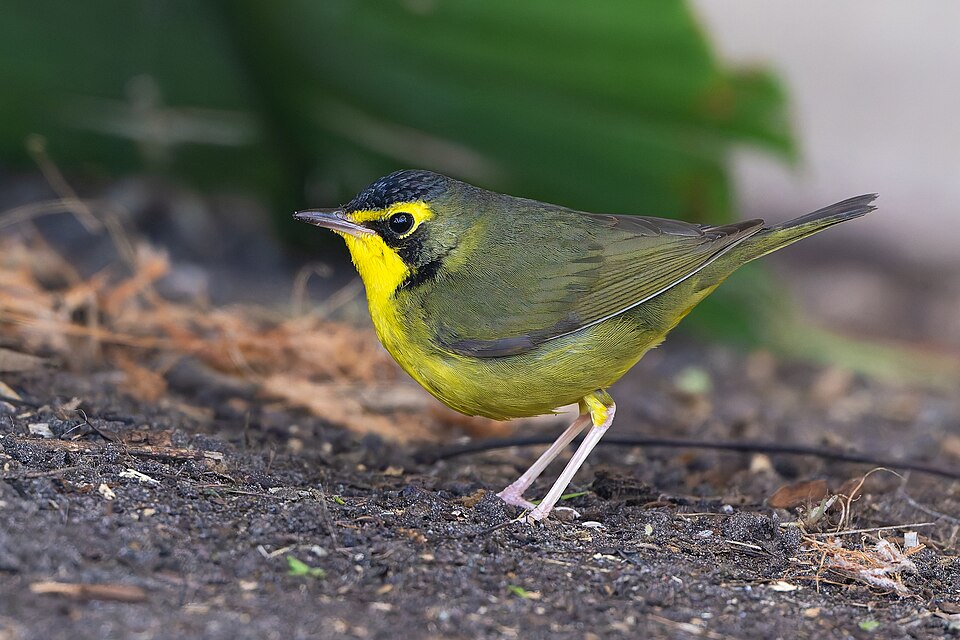
The Kentucky Warbler is one of the great voices of the eastern deciduous forest floor, a bird far more often heard than seen. Dressed in clean olive-green above and bright lemon-yellow below, it skulks through the dense, damp understory of mature woodlands, flicking through leaf litter and low tangles in search of insects. Its most memorable feature is the bold black mark that sweeps down from the eye and across the cheek like a pair of sideburns, set off by a striking yellow "spectacle" that loops over and around the eye.
Despite the name, the Kentucky Warbler is not a Kentucky specialty. It breeds across much of the eastern and central United States, favoring rich, moist forests with a thick herbaceous layer. It is a true Neotropical migrant, wintering in the forests of Central America and spending only the warmer months in North America. For many birders, finding one means tracking down a loud, rolling song coming from somewhere in the green shadows, then waiting patiently for its singer to hop into view.
This is a chunky, short-tailed warbler that spends most of its time on or near the ground, walking and hopping rather than flitting high in the canopy. Its rounded body, relatively long pinkish legs, and habit of cocking its tail give it a slightly thrush-like, sturdy look compared with daintier treetop warblers.
| Sideburns | Bold black mark running from below the eye down across the cheek, the bird's signature field mark |
| Spectacles | Bright yellow loop over and around the eye, broken at the rear, contrasting sharply with the black |
| Underparts | Uniform rich lemon-yellow from throat to undertail, with no streaking |
| Upperparts | Plain, unmarked olive-green back, wings, and tail; no wingbars |
| Crown | Black feathering on the forecrown and sides of the crown, heaviest in adult males |
| Legs | Long and pinkish, suited to a ground-foraging lifestyle |
Male vs. female
Males and females look broadly similar, and both show the diagnostic yellow spectacles and dark sideburns. The difference is one of intensity: adult males have more extensive and solidly black sideburns and crown markings, giving the face a crisper, bolder contrast. Females and younger males tend to show duller, browner, or more diffuse black on the face and crown, so the mask looks softer and less clean. In the field, a bird with jet-black, sharply defined sideburns is almost always an adult male.
Juveniles
Fresh juveniles just out of the nest are duller and more washed-out, with browner upperparts and paler, less saturated yellow underparts. The black facial markings are muted or nearly absent at first, so the diagnostic spectacles-and-sideburns pattern is faint. By their first fall, immatures closely resemble adult females, and they are generally separable from adults only with a good look at the limited, soft facial markings.
The song is a rich, rolling, churry-churry-churry-churry, a series of low, full-throated two-syllable phrases repeated rapidly and evenly. It carries well through the forest and has a ringing, almost rolling quality that some birders compare to a more musical, lower-pitched Carolina Wren. Once learned, it is hard to mistake, and a singing male will repeat it tirelessly from a low perch through late spring and early summer.
The most common call is a sharp, low chuck or chup, often given when the bird is agitated or moving through cover. This dry note is a useful clue that a skulking Kentucky Warbler is nearby even when it stays out of sight. In flight or at dawn, birds may also give a high, thin seep.
Kentucky Warblers breed across the eastern and south-central United States, from the lower Great Lakes and the Mid-Atlantic south to the Gulf Coast and west into the eastern Great Plains. They are most numerous in the Ohio and Mississippi River valleys and across the Southeast, thinning out toward the northern and western edges of the range. They favor large blocks of mature, moist deciduous forest with a dense understory.
This is a long-distance migrant. Birds depart North America in late summer and early fall to winter in the lowland forests of southern Mexico, Central America, and occasionally northern South America. They return north relatively early in spring, with males often arriving on the breeding grounds in April to claim territory. Because they are sensitive to forest fragmentation, populations have been declining over recent decades, and they are largely absent from small or disturbed woodlots.
The Kentucky Warbler is almost entirely insectivorous, feeding on a wide variety of invertebrates gleaned from the forest floor and low vegetation. Its menu includes caterpillars, beetles, ants, grasshoppers, true bugs, spiders, and other small arthropods. During the winter in the tropics, it may also take some small fruits, but insects remain the core of its diet year-round.
It forages low and methodically, hopping along the ground and through leaf litter, flicking leaves aside and probing into damp tangles. It often inspects the undersides of low leaves and may make short upward sallies to snatch prey, but it rarely ventures high into the canopy. This patient, near-ground feeding style is a big part of why the bird can be so hard to spot even when it is singing close by.
The nest is a bulky, somewhat loose cup built on or very near the ground, typically tucked into the base of a shrub, a clump of weeds, or a tangle of vines, and often supported by low vegetation. The female does most of the building, weaving an outer shell of leaves and stems and lining the inner cup with fine rootlets and hair. Its low placement makes it well hidden but also vulnerable to ground predators and to nest parasitism by Brown-headed Cowbirds.
A typical clutch is 4 to 5 eggs, whitish and speckled with brown. The female incubates for roughly 12 days, and both parents feed the nestlings, which leave the nest after about 8 to 10 days, before they can fly strongly. Pairs usually raise a single brood per season, though they may renest if an early attempt fails.
The Kentucky Warbler is not a backyard or feeder bird in any practical sense. It is an interior-forest specialist that eats insects gleaned from the ground, so it will not visit seed feeders, suet, or nectar, and it avoids open lawns and suburban yards. Attracting one is really about habitat and location rather than feeders.
- If you own or steward woodland, protect large, unbroken blocks of mature forest with a thick understory; this species needs forest interior and avoids fragmented woodlots.
- Preserve the shrubby, herbaceous layer on the forest floor rather than clearing it; the dense low cover is exactly where these birds forage and nest.
- To actually see one, visit moist deciduous forests in late spring (April to June) and listen for the rolling churry song, then wait quietly for the singer to show.
- Use the chuck call as a clue; a sharp, dry note low in the understory often marks a Kentucky Warbler skulking just out of view.
- Support forest conservation and connectivity, since this bird is sensitive to fragmentation on both its breeding and tropical wintering grounds.
- Common Yellowthroat: Male has a broad black mask across the face rather than dropping sideburns, lacks the full yellow spectacle, and favors marshes and brushy fields rather than forest interior.
- Hooded Warbler: Male wears a full black hood framing a yellow face and flashes white tail spots; it forages higher in the understory and is more active and flitting than the ground-hugging Kentucky.
- Canada Warbler: Shows yellow spectacles too, but has a gray back and a necklace of dark streaks across the chest, unlike the unmarked olive back and clean yellow breast of the Kentucky.
- Mourning Warbler: Has a gray hood and (in males) a dark chest patch instead of sideburns, and skulks in dense early-successional thickets rather than mature forest floor.
Why is it called a Kentucky Warbler if it lives all over the East?
The name comes from where it was first formally described, in Kentucky, by ornithologist Alexander Wilson in the early 1800s. The bird is not unusually common in Kentucky compared with the rest of its broad range across the eastern and south-central United States; the name is simply a historical accident of where the type specimen was collected.
Where should I look to find a Kentucky Warbler?
Search large blocks of mature, moist deciduous forest with a dense, leafy understory, especially in ravines, bottomlands, and along shaded streams. They stay low, on or near the ground, so scan the understory rather than the canopy. The best strategy is to learn the rolling churry-churry song, then patiently track down a singing male.
What does the Kentucky Warbler's song sound like?
It is a rich, rolling series of low two-syllable notes, often written churry-churry-churry-churry, repeated rapidly and evenly. It is loud and carries well, and many birders compare it to a more musical, lower Carolina Wren. The common call is a sharp, dry chuck or chup.
How do I tell a Kentucky Warbler from a Common Yellowthroat?
Look at the face. A Common Yellowthroat male has a wide black bandit mask across the eyes and forehead, while the Kentucky Warbler has black sideburns dropping below the eye plus a bold yellow loop, or spectacle, over and around the eye. Habitat helps too: yellowthroats love marshes and brushy edges, while Kentucky Warblers stick to forest interior.
Will Kentucky Warblers come to my feeder or yard?
No. They are insect-eaters of the deep-forest floor and do not visit seed, suet, or nectar feeders or typical suburban yards. The only way to enjoy them is to seek them out in suitable mature woodland during the breeding season, or to protect forest habitat if you have it on your land.