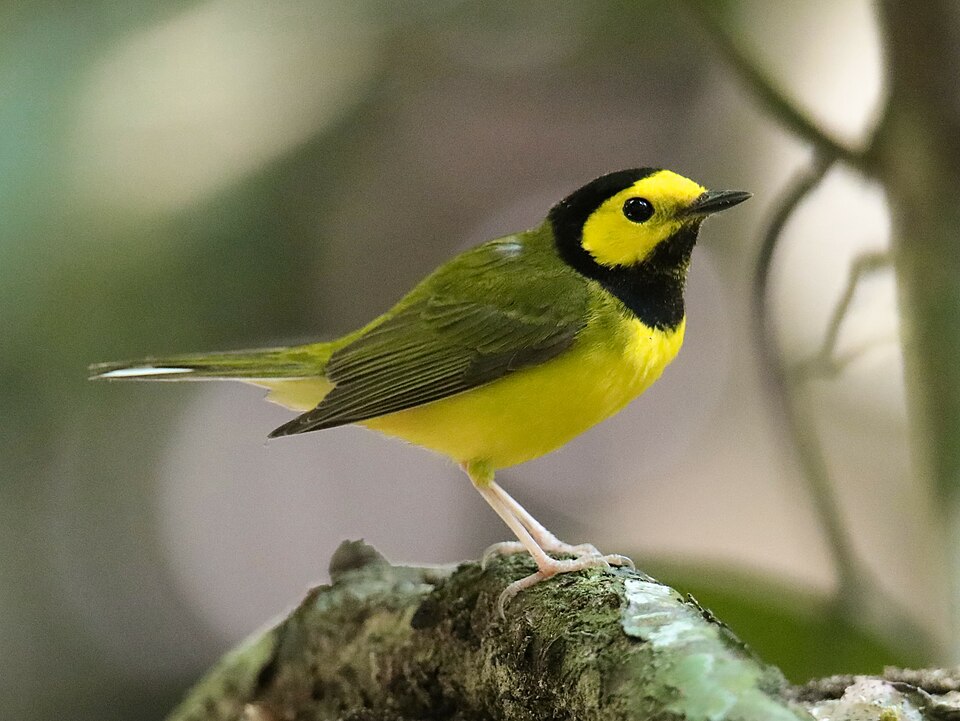
The Hooded Warbler is one of the most striking small songbirds of eastern North American woodlands. A male in full plumage looks almost painted: a coal-black hood and throat frame a bright golden-yellow face, as if the bird is peering out from a dark cowl. For all that flashy color, this is a bird of shadows. It spends most of its time low in the shrubby understory of mature, moist forests, flicking through tangles of vines and saplings rather than perching out in the open. Many birders hear a Hooded Warbler long before they ever lay eyes on one.
What gives this warbler away, besides its ringing song, is a constant habit of fanning its tail to flash white outer feathers. That nervous tail-spreading, combined with its preference for dense cover near the forest floor, makes it a satisfying bird to track down. It breeds across much of the eastern and southeastern United States and winters in Central America and the Caribbean, making it a true long-distance migrant whose arrival each spring is a welcome marker of the season in southern and Appalachian forests.
This is a small, fairly chunky warbler with a rounded head, a relatively heavy bill for a warbler, and a habit of holding its tail slightly cocked and frequently spread. At rest it can look plain yellow-and-olive from behind, but its movements and the white flashes in the tail are diagnostic.
| Male hood | Solid black hood and throat completely encircling a bright yellow face and forehead - unmistakable |
| Underparts | Rich, clean lemon-yellow below in both sexes |
| Upperparts | Plain olive-green back, wings, and tail with no wing bars |
| Tail flash | Large white spots on the outer tail feathers, constantly revealed by tail-fanning |
| Face (female) | Yellow face with little or no black; often a faint dark shadow on the crown and sides of the throat |
| Eye | Large dark eye that stands out against the yellow face, giving a gentle expression |
Male vs. female
Males and females are easy to separate at close range. The adult male wears the full black hood that gives the species its name: a black cap, nape, and bib that wrap completely around the golden face. Females and immatures show the same bright yellow face and underparts but usually lack the bold hood, instead showing anything from a clean yellow head to a partial dusky veil over the crown and along the sides of the throat. Older females can develop more black and approach the male's pattern, but they rarely match it fully. Both sexes share the unmarked olive upperparts and the white-flashing tail, so when the hood is faint, watch for the tail behavior to confirm the species.
Juveniles
Freshly fledged juveniles are duller and washed with brownish-olive above, with a paler, less saturated yellow below and no hint of the black hood. By their first fall, young birds resemble adult females: bright yellow-faced and yellow-bellied with plain olive upperparts. First-year males often show a scattering of black feathers coming in around the throat and crown, hinting at the hood they will wear the following spring. The white tail spots are present even in young birds, so the tail-flashing habit is a reliable clue at any age.
The male's song is a clear, ringing, musical whistle often written as wheeta-wheeta-whee-TEE-oh or ta-wit ta-wit ta-wit tee-yo, with an emphatic, slurred ending that drops or rises sharply on the final note. It is loud and carries well through the forest, and the bird sings persistently through the breeding season, even in the heat of midday when many other birds fall silent.
The most useful field mark of all may be the call note: a distinctive, metallic, hard chink or chip, loud and almost spitting in quality. Once learned, this sharp chink instantly betrays a Hooded Warbler skulking in the understory and is often the first sign that one is nearby.
Hooded Warblers breed across the eastern United States, from the Gulf states and the Southeast north through the Appalachians and the Ohio and Mississippi valleys, reaching into the lower Great Lakes region, the mid-Atlantic, and southern New England. The species has been gradually expanding its range northward in recent decades. Breeding density is highest in the Southeast, where mature moist forests with dense shrub layers are widespread.
This is a Neotropical migrant. In fall, birds head south across the Gulf of Mexico to winter in eastern Mexico, Belize, and the rest of Central America, with some reaching the Caribbean islands. Interestingly, the sexes tend to separate on the wintering grounds, with males favoring mature forest and females more often in scrubbier second-growth habitat. Spring migrants return to the southern United States as early as late March, with northern breeders arriving through April and into May.
The Hooded Warbler is almost entirely insectivorous, feeding on caterpillars, small moths, flies, beetles, spiders, and other small invertebrates. It forages low, typically within a few feet of the ground in the shrub layer and lower canopy, gleaning prey from leaves and twigs.
It is a notably active and acrobatic feeder, often making short fluttering sallies to snatch flying insects from the air or hovering briefly to pick prey from the undersides of leaves. The constant tail-fanning that reveals its white tail spots is thought to startle hidden insects into moving, flushing them out where the warbler can grab them. On the wintering grounds it continues this low, energetic foraging in the forest understory.
Hooded Warblers nest low to the ground, usually building in a shrub, sapling, or dense tangle within a few feet of the forest floor in the shaded understory. The female does most of the building, weaving a compact open cup of dead leaves, bark strips, plant fibers, and grasses, often bound with spider silk and lined with finer material. The outer leaves of the nest are frequently woven in a way that gives it a distinctive bulky base.
A typical clutch is three to four eggs, creamy white with brown speckling. The female incubates for roughly twelve days, and both parents feed the nestlings, which leave the nest after eight or nine days. Pairs often raise two broods in a season across much of the range. Because the nest sits so low and open, Hooded Warblers are frequent hosts to Brown-headed Cowbird parasitism, though they will sometimes abandon or bury parasitized nests.
The Hooded Warbler is not a feeder bird and will not visit seed, suet, or nectar feeders, since it eats almost exclusively insects gleaned from forest vegetation. The way to attract it is to provide the kind of habitat it needs, which mainly applies to those who own or manage forested land near its breeding range.
- Protect or restore mature, moist deciduous or mixed forest rather than clearing the understory - this species needs woods, not open yards
- Maintain a dense shrub and sapling layer near the ground; small natural canopy gaps that let thick undergrowth develop are exactly what it favors for nesting
- Leave native shrubs, vine tangles, and leaf litter in place, which support the caterpillars and insects it feeds on
- Avoid broad-spectrum insecticide spraying in and around wooded property, since its entire diet is insects
- If you live near suitable forest, listen for the loud metallic chink call and ringing song in spring and follow it into the understory rather than expecting the bird to come to you
- Provide a ground-level or low water source or shallow woodland pool, which can draw migrants and breeders moving through shaded habitat
- Wilson's Warbler: Male has a small neat black cap, not a full hood, and lacks white in the tail; smaller and even more active, found farther north and west
- Common Yellowthroat: Male wears a broad black face mask, not a hood, and has a duskier olive body without bright clean yellow underparts or white tail flashes; favors marshes and wet thickets
- Yellow Warbler: All-yellow with no black hood and yellow (not white) tail spots; males show reddish streaks on the breast and prefer open shrubby and wetland edges
- Kentucky Warbler: Another low-skulking yellow warbler of eastern woods, but it shows black sideburns and a yellow eye-ring with no full hood and no white tail flash
How do I tell a Hooded Warbler from a Wilson's Warbler?
The male Hooded Warbler has a full black hood that wraps all the way around a yellow face, plus large white spots in the tail that it constantly flashes. Wilson's Warbler has only a small black cap on top of the head, no white in the tail, and is smaller. If you see white tail flashes and a complete black bib, it's a Hooded.
Do female Hooded Warblers have the black hood?
Usually not, or only partially. Most females show a bright yellow face and underparts with little or no black, though older females can develop a partial dusky hood. The best confirmation for a female is the unmarked olive back, clean yellow underparts, and the habit of flashing white outer tail feathers.
Will Hooded Warblers come to my bird feeder?
No. They eat almost entirely insects and spiders gleaned from forest vegetation and will not visit seed, suet, or nectar feeders. The way to host them is to provide mature moist woodland with a dense low shrub layer near their breeding range.
What does a Hooded Warbler sound like?
The song is a loud, ringing, musical whistle often written as wheeta-wheeta-whee-TEE-oh with an emphatic slurred ending. Its call is a sharp, metallic chink that is one of the easiest ways to detect the bird hiding in the understory.
Where and when can I see a Hooded Warbler?
Look in the shrubby understory of mature, moist eastern forests during the breeding season from April through summer. They are most common in the Southeast and Appalachians and winter in Central America and the Caribbean, so in the U.S. they are present mainly spring through early fall.