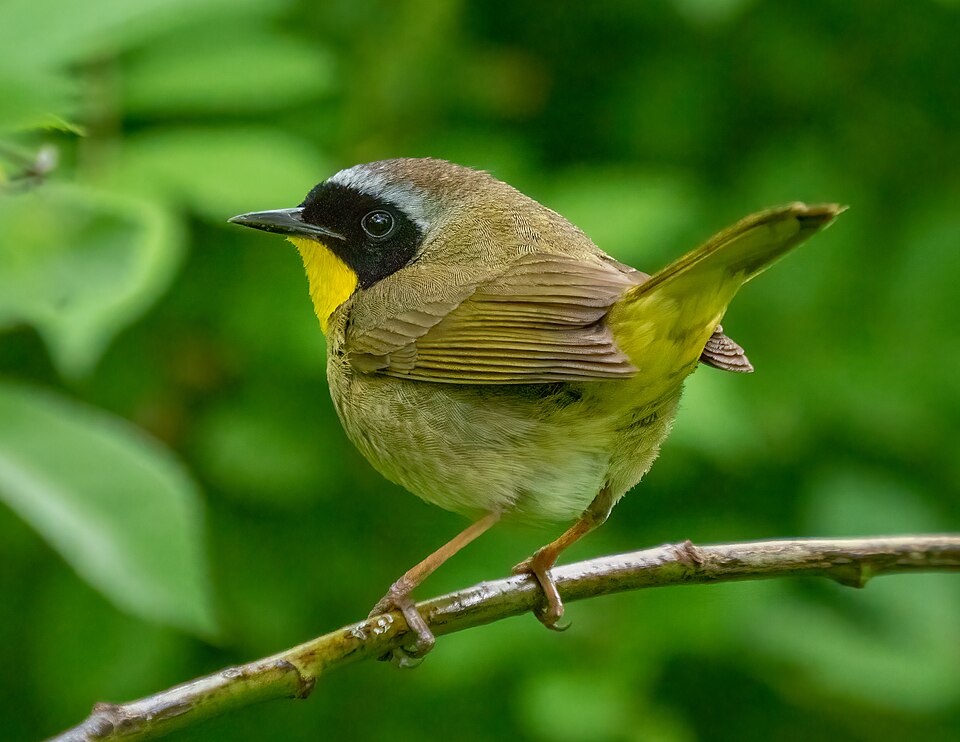
The Common Yellowthroat is one of North America's most widespread and recognizable warblers, yet it spends much of its life hidden low in dense, wet vegetation where birders hear it far more often than they see it. Small, round-bodied, and endlessly curious, it skulks through cattails, sedges, and brushy field edges, popping up onto a stem just long enough to deliver its rollicking song before dropping back into cover. The adult male's broad black mask, set off by a bright lemon-yellow throat, gives the species an unmistakable "bandit" look that makes it a favorite first warbler for many beginning birders.
Despite its name and abundance, the Common Yellowthroat is anything but ordinary in behavior. It is one of the few warblers comfortable in marshes and wetlands, filling an ecological niche more often associated with wrens and sparrows. From southern Canada to central Mexico it breeds in nearly every kind of damp, tangled, low cover imaginable, and its loud, repetitive song is a defining sound of summer wetlands across the continent.
This is a small, compact warbler with a fairly long tail it often cocks or flicks, a rounded head, and a habit of staying low. Its wren-like skulking posture and tendency to scold from inside a thicket are good clues even before you get a clean look. Olive-toned upperparts and yellow on the throat and undertail are consistent across ages and sexes.
| Male face | Broad black mask across the forehead, eyes, and cheeks, bordered above by a hazy whitish-gray band |
| Throat & breast | Bright yellow throat and upper breast, fading to buffy or whitish on the belly |
| Upperparts | Plain olive-brown to olive-green back, wings, and tail with no wingbars |
| Female | No black mask; warm olive-brown above, yellow throat and undertail, plain face with a faint pale eyering |
| Size & shape | Small and chunky with a rounded head and a longish tail often held cocked |
| Behavior | Skulks low in dense cover, flicks tail, scolds with a sharp chuck |
Male vs. female
Males and females look distinctly different, which makes this one of the easier warblers to sex. The adult male wears the diagnostic black face mask bordered above by a pale grayish-white band, with a vivid yellow throat below. Females lack the mask entirely; they are warm plain-faced birds, olive-brown above with a yellow throat and undertail and a slightly more muted overall look. A female can be told from similar drab warblers by her unmarked wings, lack of streaking, and the way the yellow is concentrated at the throat and under the tail rather than spread across the underparts.
Juveniles
Juveniles and first-fall birds resemble adult females but are even plainer and browner, often with a buffy wash across the breast and flanks and a duller, less saturated yellow throat. Young males in their first fall begin to show a faint, dusky shadow where the black mask will eventually develop, sometimes mottled with gray; this incomplete "ghost mask" can puzzle birders but is a reliable sign of an immature male. By their first spring, young males have molted into the full crisp black-and-yellow pattern of adults.
The song is a loud, bright, rolling phrase most often written as witchity-witchity-witchity-witch or wichety-wichety-wichety, repeated several times with a cheerful, bouncing rhythm. It carries well across open marsh and is one of the easiest warbler songs to learn and remember. Songs vary regionally and even between individual males, so the number of repeated syllables and the exact cadence can shift from bird to bird.
The most frequent call is a sharp, husky chuck or tchat, often given as the bird scolds an intruder from deep in cover. In flight or when agitated it may give a buzzy, dry rattle. During spring, males sometimes perform a brief, jumbled flight song, launching upward from a perch while singing a fast tangle of notes before dropping back into the vegetation.
The Common Yellowthroat breeds across an enormous range, from coast to coast in the United States and through much of southern and central Canada, extending south into Mexico. It is one of the most widely distributed warblers on the continent, occupying suitable wet and brushy habitat almost everywhere it occurs.
It is a medium-distance migrant. Birds from northern breeding areas winter from the southern United States south through Mexico, Central America, and the Caribbean. Populations along the Gulf Coast, in the Desert Southwest, and in coastal California may be present year-round. Spring migration brings males north early, where their persistent singing quickly reveals which marshes and weedy fields are occupied.
The Common Yellowthroat is almost entirely insectivorous, gleaning small invertebrates from low vegetation, leaf surfaces, and the ground. Its diet includes spiders, beetles, grasshoppers, dragonflies, damselflies, flies, moths, caterpillars, ants, aphids, and other small arthropods. In wetland habitats it takes advantage of the abundant insect life around water, snapping up emerging aquatic insects from cattail stems and reed stalks.
It forages low and methodically, hopping along stems and through tangled cover, often near or just above the waterline. Birds frequently flick the tail and wings while searching, flushing or spotting prey among the leaves. Outside the breeding season it may add small amounts of seeds, but insects remain the core of its diet year-round.
Females build a bulky, somewhat loose cup nest of grasses, sedges, dead leaves, and bark strips, lined with finer grasses and hair. The nest is typically placed low, on or just above the ground, woven into dense cattails, sedge tussocks, briars, or weedy tangles where it is well hidden. In wetter sites the nest may be supported by emergent marsh vegetation just above the water.
A typical clutch is three to five eggs, white to creamy with brown and black speckling. The female incubates for roughly 12 days, and both parents feed the nestlings, which leave the nest after about 8 to 10 days. Common Yellowthroats often raise two broods per season in the southern part of their range. They are frequent hosts of the Brown-headed Cowbird, which lays its eggs in yellowthroat nests for the smaller warbler to raise.
The Common Yellowthroat is not a feeder bird and will essentially never visit seed or suet stations, since it eats insects gleaned from dense low vegetation. You attract it by providing habitat rather than food, and a yard adjacent to wet, brushy, or weedy areas has the best odds.
- Leave low, dense cover. Let a corner of the yard grow into tall grasses, weeds, and shrubby tangles instead of mowing it short.
- Add or preserve water and damp ground. Yellowthroats favor marshy edges, so a wet ditch, pond margin, or rain garden with cattails and sedges is a strong draw.
- Skip pesticides. A healthy population of spiders, caterpillars, and flying insects is exactly what this warbler comes for.
- Plant native shrubs and grasses along property edges to create the brushy, transitional habitat it nests and forages in.
- Listen during spring migration. Even yards far from marshes can host a passing migrant in tall weedy cover, especially if you learn the witchity-witchity song.
- Provide a ground-level or low water source near vegetation rather than an open elevated birdbath, which it is far less likely to use.
- Kentucky Warbler: Also yellow below with black on the face, but the black forms a sideburn-and-spectacle pattern rather than a full bandit mask, and it stays in shady forest interiors, not open marsh.
- Mourning Warbler: Yellow underparts but a gray hood and (in males) a black bib; lacks the black facial mask and prefers dense forest-edge thickets.
- Nashville Warbler: Yellow throat and a gray head with a bold white eyering; smaller-tailed, more arboreal, and never shows a black mask.
- Yellow Warbler: Entirely bright yellow with no mask; males show reddish breast streaks. Forages higher in shrubs and small trees rather than skulking low.
What does a Common Yellowthroat look like?
The adult male is unmistakable: a small olive-brown warbler with a bright yellow throat and a broad black mask across the eyes and cheeks, bordered above by a pale grayish band. Females and young birds lack the mask and are plainer olive-brown with a yellow throat and undertail.
What bird sounds like 'witchity-witchity-witchity'?
That rollicking, repeated phrase is almost always a male Common Yellowthroat. It's one of the most distinctive and easy-to-learn warbler songs in North America, usually delivered from low in marsh or brushy cover in spring and summer.
Where do Common Yellowthroats live?
They favor dense, low, often wet vegetation: cattail marshes, sedge meadows, brushy field edges, overgrown ditches, and weedy thickets. They breed across most of the U.S. and southern Canada and winter in the southern U.S., Mexico, Central America, and the Caribbean.
Will Common Yellowthroats come to a bird feeder?
No. They are insect-eaters that glean prey from dense low vegetation and essentially never visit seed or suet feeders. The way to attract them is to provide brushy, weedy, or marshy habitat and avoid pesticides rather than offering feeder food.
How can I tell a female Common Yellowthroat from other plain warblers?
Look for an unmarked olive-brown bird with no wingbars and no streaking, with the yellow concentrated on the throat and under the tail. Combine that with its low, skulking, tail-flicking behavior in dense cover and its sharp chuck call, and the female yellowthroat usually gives itself away.