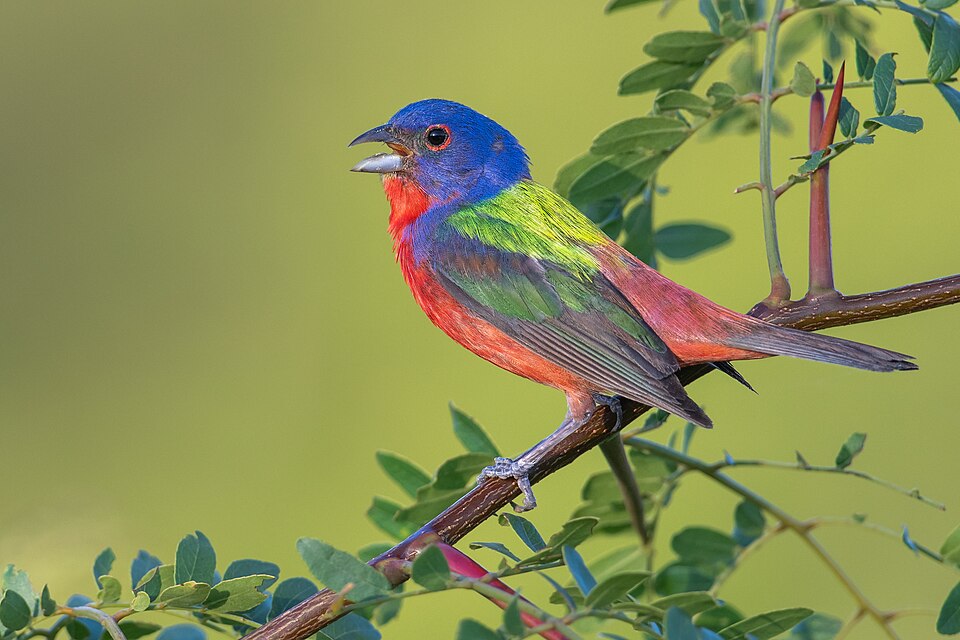
Few North American birds stop a birder in their tracks like an adult male Painted Bunting. With a deep blue head, a lime-green back, and a chest and rump the color of ripe tomatoes, he looks less like a wild bird than something a child colored without staying inside the lines. The French name for the species, nonpareil, "without equal", captures the reaction perfectly. For all that flamboyance, the male is surprisingly hard to see well: he favors dense brushy edges, sings from partly hidden perches, and seems to know exactly how to keep a tangle of leaves between himself and your binoculars.
Painted Buntings breed in two separate populations, one along the Atlantic coast of the Southeast and a larger one across the south-central states. They are birds of scrubby field edges, hedgerows, thickets, and overgrown old fields rather than deep forest or open prairie. Though still locally common in the right habitat, the species has declined over recent decades, losses tied to habitat loss on both the breeding and wintering grounds, and historically to illegal trapping for the cage-bird trade in parts of its winter range. Catching up with one remains one of the great small thrills of summer birding in the South.
This is a small, compact, large-headed finch-like bird with a short tail and a thick, conical, seed-cracking bill. It is roughly the size of a House Finch but stockier and more secretive. Adult males are unmistakable; females and immatures are far plainer and are best identified by their unusual overall green coloring.
| Adult male | Blue-violet head, bright yellow-green back, and brilliant red underparts and rump, no other U.S. bird looks like this |
| Female/immature | Uniform bright yellow-green above and paler lemon-green below, with no streaking or wing bars |
| Bill | Short, thick, and conical, a classic seed-eater's bill, pale gray to silvery |
| Eye-ring | Females and immatures show a faint pale eye-ring, often the only obvious facial mark |
| Size & shape | Small and chunky with a large head, short neck, and short tail |
| Wings & tail | Plain, unmarked wings; tail often flicked or pumped while foraging |
Male vs. female
The sexes look completely different, which makes this one of the easiest songbirds to sex once you can see the bird. The adult male wears the full red-green-blue palette. The female (and first-year birds of both sexes) is a soft, glowing yellow-green all over, brighter green above and more yellowish below, with no other strong markings. That green tone is itself the field mark: very few small North American birds are this evenly, vividly green, so a plain green "sparrow-shaped" bird in southern brush is almost always a female or young Painted Bunting.
Juveniles
Juveniles and first-fall birds look much like adult females, overall yellow-green with a pale eye-ring and a thick conical bill. Young males are especially confusing, because they spend their entire first year looking green and do not acquire the famous red-blue-green adult plumage until their second fall, after a complete molt. A green Painted Bunting singing on territory in spring is, surprisingly, often a one-year-old male in female-like plumage.
The song is a sweet, rambling, slightly metallic warble, a series of short, sharp, well-spaced phrases that rise and fall, often rendered as pew-eata-pew-eata-I-eaty-you-too. It is musical but somewhat thin and tinkling compared to the rich warble of an Indigo Bunting, and it carries a clipped, slightly insect-like quality. Males sing persistently from elevated but partly concealed perches, especially in early morning during the breeding season.
The most common call is a sharp, dry chip or plik, given frequently as the birds move through brush. You will often hear that crisp call note before you ever spot the bird itself.
Painted Buntings breed in two distinct populations. The larger interior population covers the south-central United States, roughly from southern and eastern Texas and Oklahoma east through Louisiana, Arkansas, and Mississippi, with extensions into Kansas, Missouri, and northern Mexico. A separate, smaller Atlantic coastal population breeds in a narrow band from coastal North Carolina south through South Carolina, Georgia, and into northern Florida.
They are long-distance migrants. The interior birds winter mainly in Mexico and Central America, while the Atlantic coastal birds winter largely in southern Florida and the Caribbean. Migration is mostly nocturnal. Interestingly, adult males of the interior population often molt during a stopover in northwestern Mexico before continuing south, an unusual "molt-migration" strategy.
Through most of the year Painted Buntings are seed-eaters, feeding on the seeds of grasses, sedges, and weedy plants such as bristlegrass, pigweed, dock, and panicgrass. They forage low, often on or near the ground at the edges of brush, hopping along and reaching up to pull seeds directly from grass heads.
During the breeding season, however, the diet shifts heavily toward insects and other small invertebrates, grasshoppers, caterpillars, beetles, spiders, and snails, which provide the protein that growing nestlings need. This seasonal switch from seeds to bugs is typical of buntings and many other finch-like songbirds.
Painted Buntings nest low in dense shrubs, vine tangles, or small trees, usually within a few feet of the ground and well hidden in foliage. The female does nearly all the work: she builds a neat, compact open cup of grasses, weed stems, and leaves, lined with finer material and rootlets, woven into a fork or supported by surrounding twigs.
She typically lays 3 to 4 pale, finely speckled eggs and incubates them alone for about 11 to 12 days. The young leave the nest a little over a week after hatching. Pairs frequently raise two broods in a season, and sometimes three in the long southern summer. Painted Buntings are also regular hosts of Brown-headed Cowbirds, which lay their eggs in the bunting's nest.
Yes, within their breeding and wintering range, Painted Buntings can absolutely be drawn to backyards, and a feeder visit from a male is a highlight many southern birders chase all summer. The key is the right food and, just as important, the right cover nearby.
- Offer white proso millet, their clear favorite feeder food, in a tube or hopper feeder; they will also take some small mixed seeds.
- Place feeders near dense shrubs, hedgerows, or brushy edges, these shy birds want escape cover within a quick flight.
- Provide fresh water; a low or ground-level birdbath with moving or dripping water is a strong draw in hot southern summers.
- Let part of your yard grow weedy and brushy, natural grass and weed seeds plus tangled cover mimic their preferred habitat.
- Be patient and watch early morning; they often visit quietly and briefly, and a green female may show up well before any male.
- Within their range, set feeders out by mid- to late spring when migrants and breeders arrive.
- Indigo Bunting: Breeding male is all deep blue, not multicolored; females are plain warm brown rather than green, with faint streaking below.
- Painted Bunting female vs. Orange-crowned Warbler: Warbler is slimmer with a thin pointed bill, not the bunting's thick conical seed-cracking bill.
- Varied Bunting: Overlaps in Texas; male is dark purple-red and looks almost black at a distance, never showing green and red together.
- Blue Grosbeak: Larger with a much heavier bill and rusty wing bars; blue male lacks any red or green.
Are Painted Buntings rare?
They are still locally common in the right brushy habitat within their range, but the species has declined and is listed as Near Threatened. They can also be genuinely hard to see well because they stay in dense cover, so they feel rarer than they are.
Why is the male Painted Bunting so colorful?
The vivid blue, green, and red plumage is driven by sexual selection, brighter males are more attractive to females and signal quality. The colors come from a mix of pigments (reds and yellows from the diet) and feather structure (the blues), and males don't reach full adult coloring until their second year.
What do Painted Buntings eat at feeders?
Their top choice is white proso millet. They'll also take some small mixed seeds. Offer it in a tube or hopper feeder placed close to shrubs, and add a water source to improve your chances.
Why is my Painted Bunting green instead of multicolored?
Green birds are either females or young birds. First-year males stay green and female-like through their entire first year, only molting into the famous red-blue-green plumage in their second fall, so a green bunting is completely normal.
Where can I see a Painted Bunting?
Look in brushy field edges, hedgerows, and overgrown thickets across the south-central U.S. (Texas to Mississippi) and along the southeastern Atlantic coast (the Carolinas through northern Florida) during the breeding season, generally from spring through summer.