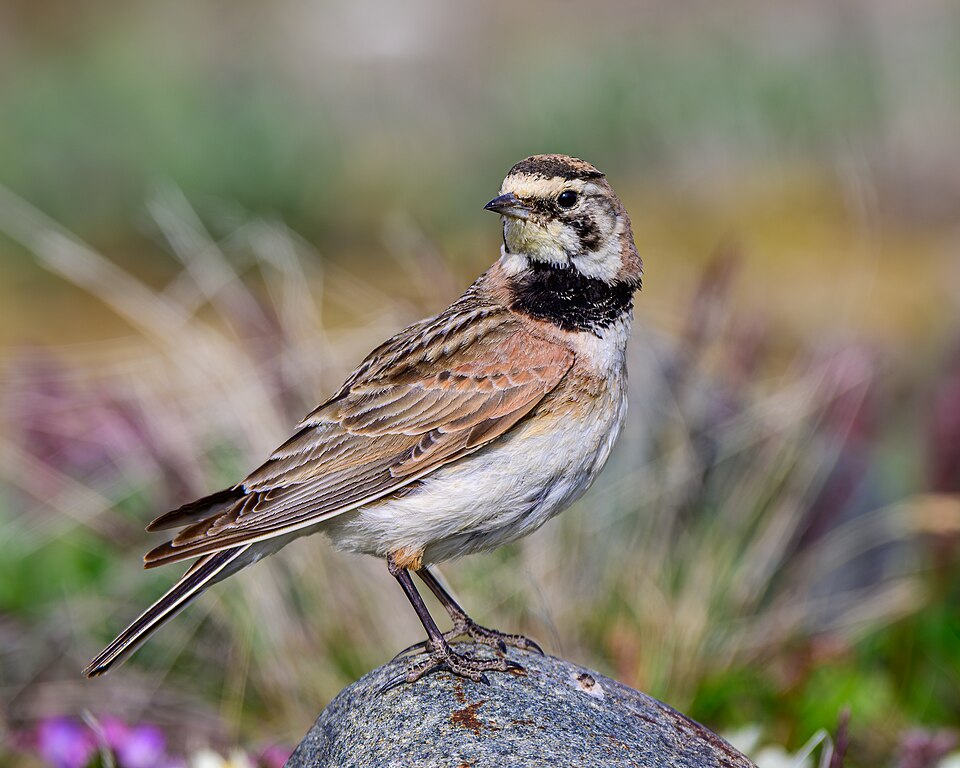
The Horned Lark is a bird of wide-open, sparsely vegetated ground, the kind of landscape most people drive past without a second glance: stubble fields, gravel shoulders, overgrazed pasture, plowed dirt, alpine tundra, and shortgrass prairie. It is North America's only true native lark, and despite a delicate, almost dressy appearance up close, it thrives in some of the harshest, barest terrain on the continent. Walk a country road in winter and watch the flocks flush ahead of you in low, undulating waves, flashing pale outer tail feathers as they drop back down and vanish against the bare earth.
What makes this bird worth a closer look is its surprising elegance. Through binoculars, a Horned Lark reveals a bold black face pattern, a sulphur-to-white throat, and the two tiny tufts of dark feathers that give the species its name. It is also remarkably widespread, breeding across an enormous range that stretches from arctic Canada to the deserts of Mexico, and across Europe and Asia as well, where it is known as the Shore Lark. For all its abundance, though, the Horned Lark has been declining steadily as open ground gets developed or grown over, making it a quietly important bird to know and watch.
Horned Larks are slim, long-bodied songbirds that spend nearly all their time on the ground, where they walk and run rather than hop. The silhouette is low-slung and horizontal, with a fairly long tail and a slender, pointed bill. Plumage tones vary a lot across the range, from sandy pinkish-brown desert birds to darker, grayer northern ones, but the bold face pattern is the constant giveaway.
| Face pattern | Bold black mask running from the bill down through the cheek, plus a black crescent across the upper breast; framed by a pale yellow to white face and throat. |
| "Horns" | Two small tufts of black feathers on the rear crown that can be raised or laid flat. Often hard to see and frequently absent-looking, especially on females. |
| Upperparts | Streaky brown to pinkish-brown back and nape; the nape often shows a warm cinnamon or rosy wash. |
| Underparts | Whitish belly contrasting with the dark breast band above; flanks lightly streaked. |
| Tail | Black tail with white outer feathers, obvious in flight as the bird flushes and flies low over the ground. |
| Bill & legs | Short, sharp, dark gray bill; dark legs. Walks and runs rather than hops. |
Male vs. female
Males and females look similar but males are noticeably bolder. A breeding male shows a crisp, jet-black mask and breast band, a clean yellow throat, and the longest, most obvious feather "horns," which he raises during display. Females are a muted, washed-out version of the same pattern: the black areas are duller and less complete, the yellow tones are paler, the streaking on the upperparts is heavier, and the horns are short and often invisible in the field. In fresh fall plumage, pale feather edges can soften the face pattern on both sexes, making males look a bit more female-like until the edges wear away by spring.
Juveniles
Juvenile Horned Larks look strikingly different from adults and can puzzle observers. They lack the black face mask and horns entirely, and instead are heavily spangled above with pale spots and scaly buff-and-dark feather edging, giving a speckled, almost dappled appearance over the back and head. The breast is dusky and softly spotted rather than marked with a clean black band. This streaked, spotty plumage is held only briefly; by late summer young birds molt into a plainer, adult-like body plumage and begin to show the diagnostic face pattern.
The song of the Horned Lark is a thin, high, tinkling series of jumbled notes that often speeds into a tumbling little jingle: a delicate tsip-tsip-tseedle-eedle-eee rising at the end. It is surprisingly weak and high-pitched for such an open habitat, and it carries best on still mornings. Males sing both from a low perch, such as a clod of dirt or a fence post, and famously in a high, fluttering song flight, climbing far up into the sky, hanging there, and then sometimes plunging back to earth.
The most familiar sound, though, is the flight call given by passing flocks: a soft, high, lisping tsee-titi or tsee-ee, easy to overlook but a reliable way to detect birds overhead in fall and winter. Once you learn that thin two- or three-note whisper, you will start picking Horned Larks out of the sky over fields you never knew they used.
The Horned Lark has one of the largest ranges of any songbird, breeding across most of North America from the high Arctic and alpine tundra south through the Great Plains, the Intermountain West, and into Mexico, wherever open, barren ground is available. It also breeds widely across Europe and northern Asia, where it carries the name Shore Lark. Numerous regional subspecies differ in overall color, roughly matching the soil tone of their home turf.
Northern and high-elevation populations are migratory, pulling south and downslope for winter, while many birds in the middle of the continent are year-round residents. In winter, larks from the north join local birds to form large, roving flocks on stubble fields, feedlots, airports, and snowy roadsides, often mixing with Snow Buntings and longspurs. These winter flocks are nomadic, following bare ground and seed availability rather than fixed wintering sites.
Horned Larks are primarily seed-eaters for much of the year, foraging on the ground for the seeds of grasses, weeds, and waste grain. They walk methodically over open dirt and stubble, picking food from the surface and from low plants, and in winter a flock can spend hours working a single field or roadside. Grit and small stones are swallowed to help grind hard seeds.
During the breeding season the diet shifts heavily toward insects and other invertebrates, especially small beetles, grasshoppers, caterpillars, and ants, which provide the protein nestlings need to grow fast. Adults snap up insects as they walk, and this seasonal switch from seeds to bugs is typical of many open-country songbirds.
Horned Larks nest directly on the ground, and they are among the earliest songbirds to breed, sometimes starting while snow still lingers. The female chooses a site in the open, often beside a clump of grass, a stone, or a dirt clod that offers a little shelter, and digs or uses a natural hollow. She lines the cup with grass and softer material, and many nests have a small "pavement" of pebbles, dung, or soil clods placed along one edge, an unusual habit whose purpose is still debated.
The female builds the nest and incubates the eggs alone, while the male defends the territory and helps feed the young once they hatch. Because the nest is fully exposed on bare ground, eggs and chicks are vulnerable to weather, trampling, and predators, and pairs frequently raise more than one brood in a season to compensate. Young leave the nest and scurry off on foot before they can fly well, relying on their cryptic, dirt-colored plumage to stay hidden.
Be honest with yourself here: the Horned Lark is not a backyard or feeder bird in any normal sense. It avoids trees, shrubs, lawns, and the cluttered edges that most yards offer, so you will almost never lure one to a feeder. Instead, attracting Horned Larks is really about finding and protecting the bare, open habitat they need, and learning to look for them where they actually live.
- Look in the right places: drive or walk gravel roads, stubble fields, sod farms, airports, feedlots, and short overgrazed pasture, especially in fall and winter when flocks gather.
- Scan the bare ground ahead of you, not the bushes. Larks blend into dirt and are usually seen when a flock flushes low and resettles a short distance away.
- Learn the thin tsee-titi flight call so you can detect flocks passing overhead even when you cannot pick them out on the ground.
- In winter, check fields right after a snowfall, when larks (often with Snow Buntings and longspurs) crowd onto exposed roadsides and plowed edges.
- If you own open land, the best help you can offer is keeping some ground sparse and unmowed-but-not-overgrown: avoid converting bare fields to dense cover or development, which is the main reason this species is declining.
- American Pipit: Also an open-ground walker that bobs its tail, but pipits are plainer brown with no black face mask or horns, and have white outer tail feathers with a thinner bill.
- Lapland Longspur: Often flocks with Horned Larks in winter fields. Longspurs are chunkier, finch-billed, and more boldly streaked, lacking the lark's clean black face pattern and horns.
- Snow Bunting: Shares winter flocks and open habitat but shows extensive white in the wings and body, with no black mask; flushing buntings flash large white wing patches, not just pale tail edges.
- Vesper Sparrow: A streaky open-country sparrow with white outer tail feathers, but it has a typical conical sparrow bill, a streaked breast, and lacks the bold black face mask and horns.
Do Horned Larks really have horns?
Not real horns. The name comes from two small tufts of black feathers on the back of the crown that males can raise into little points, especially during display. They are feathers, not bone, and are often laid flat and hard to see in the field.
Where do I find Horned Larks?
Look in wide, open, bare-ground habitat: stubble and plowed fields, gravel roadsides, short overgrazed pasture, sod farms, airports, and alpine or arctic tundra. They avoid trees, shrubs, and lawns, so scan the ground rather than bushes.
Will Horned Larks come to my bird feeder?
Almost never. They are ground-foraging open-country birds that shy away from yards, trees, and feeders. To see them you generally have to go to their habitat rather than expect them at the feeder.
What do Horned Larks eat?
Mostly seeds of grasses, weeds, and waste grain for much of the year, foraged on bare ground. In the breeding season they switch to eating large numbers of insects such as beetles, grasshoppers, and caterpillars to feed their nestlings.
Are Horned Larks endangered?
They are listed as Least Concern and remain common overall, but populations have been declining for decades as open, sparse habitat is lost to development and grown-over fields. They are an important species to watch for that reason.