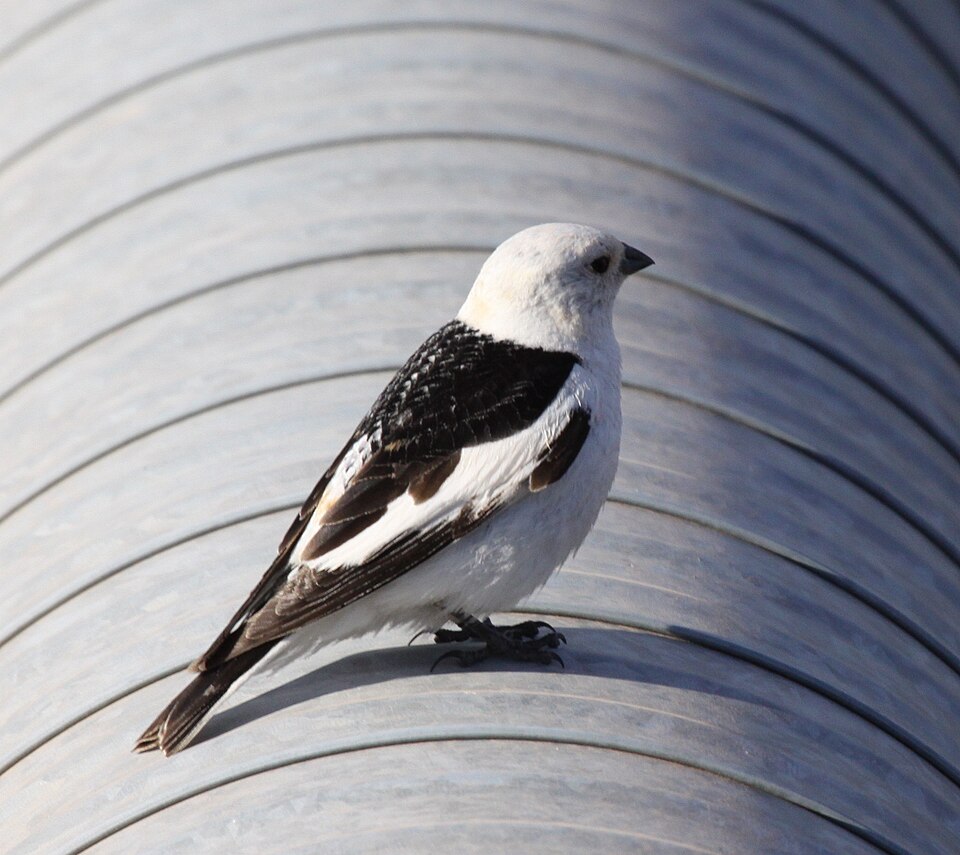
The Snow Bunting is one of the few songbirds that seems genuinely at home in a snowstorm. A stocky, sparrow-sized bird with a startling amount of white in its plumage, it breeds farther north than almost any other passerine on Earth, nesting on barren Arctic tundra and rocky coasts right up to the edge of the polar ice. In winter, flocks drift south into open country across the northern United States, Canada, and northern Eurasia, where birders prize them as a hardy, almost mythical reward for braving cold, windswept fields and beaches.
What makes the Snow Bunting unforgettable is the flock in flight. A feeding group flushes from a stubble field as a low, rolling cloud, and as the birds bank and catch the light, their bold white wing patches flash like a flurry of snowflakes settling and rising again. Old-time birders nicknamed them "snowflakes" and "snowbirds" for exactly this reason. Despite their fragile, wintry beauty, these are tough little birds, fueling up on weed seeds and grit to survive nights that would kill most songbirds.
Snow Buntings are compact, large-headed, short-legged songbirds, a touch chunkier than a House Sparrow, with a conical seed-eating bill. The single most reliable field mark in any plumage is the large white patch in the wing, obvious in flight and giving flocks their flickering, snowy look. They feed and walk low to the ground, often running rather than hopping.
| Wing pattern | Bold white wing patches in all plumages; flashing white-and-dark flight is the key flock mark |
| Breeding male | Pure snow-white head and underparts with a solid black back and black-and-white wings - unmistakable |
| Winter plumage | Warm rusty-buff wash on the crown, ear patch, and shoulders over a white base; very pale-looking overall |
| Bill | Short conical seed bill; orange-yellow with a dark tip in winter, all-black in breeding season |
| Tail | White outer tail feathers with a dark center, conspicuous as birds flush |
| Posture | Stocky, large-headed, short-legged; runs and creeps along the ground rather than hopping |
Male vs. female
In the breeding season the sexes are easy to tell apart. The male is spectacular: clean white head and underparts set against a jet-black back and largely white wings with black tips. The female is more subdued, with a grayer, streaked back and dusky smudging on the crown and cheeks, and she shows less white in the wing. In winter both sexes wear feather tips that wash everything with warm rusty-buff, so they look much more alike; even then, males tend to show more extensive white in the wing and a whiter, cleaner background, while females and young birds look browner and more washed-out. The black breeding plumage is revealed gradually as those buff tips wear away through late winter and spring.
Juveniles
Recently fledged juveniles are gray-headed and softly streaked, plainer and dingier than adults, with a grayish-buff wash across the breast and far less contrast than the bold adult male. By their first winter, young birds resemble winter-plumaged adult females - extensively buffy and brown above with white wing patches that are smaller and more broken than an adult male's. Sorting first-winter birds to age and sex in the field is genuinely tricky and often best left as "Snow Bunting" unless you get a clear look at the wing.
On the breeding grounds the male sings a clear, sweet, rippling warble, often delivered from a boulder or in a fluttering song flight - a musical, slightly tumbling phrase that carries across the open tundra and is one of the cheeriest sounds of the high Arctic spring. Most birders, though, encounter Snow Buntings in winter, when song is rare.
The everyday contact calls are far more useful for finding them. Listen for a soft, rippling, slightly buzzy tew or a rolling pirrr-rit given by flocks in flight, along with a sharp, whistled tyew or peeu. The dry, twittering rattle of a passing flock is often the first clue that "snowflakes" are working a nearby field before you ever spot them on the ground.
Snow Buntings have a circumpolar breeding range, nesting across the Arctic tundra and rocky coasts of northern Canada, Alaska, Greenland, Iceland, Scandinavia, and northern Russia - some of the highest-latitude breeding of any songbird, reaching the fringes of the polar sea. Males arrive on territory remarkably early, sometimes in late winter while snow still blankets the ground.
In winter they move south into open country: across southern Canada and the northern United States (from the Plains and Upper Midwest to the Northeast), and broadly across northern and central Eurasia. Look for them in the cold months on stubble fields, weedy farmland, grasslands, lakeshores, beaches, and dunes - flat, exposed places with abundant seeds and few trees. Numbers reaching any given area vary year to year, and southern fringes of the range may see them only in harder winters.
Snow Buntings are primarily seed-eaters in winter, foraging on the ground in flocks for the seeds of grasses, weeds, sedges, and waste grain. They walk and run through stubble, along beach wrack lines, and across snow-dusted fields, picking seeds and gleaning along roadside edges where wind has exposed bare ground. Like many seed-eaters they also swallow grit to help grind their food.
During the brief Arctic breeding season the diet shifts heavily toward insects and other invertebrates - flies, beetles, caterpillars, and spiders - which provide the protein nestlings need to grow fast in the short summer. Adults take both insects and seeds at that time of year, switching back to a seed-dominated diet once they head south.
Snow Buntings nest in cavities and crevices among rocks - tucked into the gaps of boulder fields, scree slopes, rock piles, and sometimes man-made structures in the far north. This sheltered nest site protects eggs and chicks from the brutal Arctic weather, though the cold, deep cup means the female must incubate almost continuously. The nest itself is a bulky cup of grasses, moss, and rootlets, generously lined with feathers and fur for insulation.
The female builds the nest and incubates the eggs while the male feeds her at the nest, helping her stay on the clutch in the cold. After hatching, both parents work hard to provision the young with insects during the compressed Arctic summer, racing to fledge a brood before conditions deteriorate.
The Snow Bunting is generally not a backyard feeder bird - it is a creature of wide-open, treeless country and the high Arctic, and most yards simply do not offer the habitat it wants. That said, there are a few ways to improve your odds if you live within its winter range near the right open ground.
- Go to the habitat rather than expecting it to come to you - scan stubble fields, weedy farmland, beaches, dunes, and lakeshores in winter, especially after fresh snow pushes flocks to bare, windblown edges.
- Check roadsides and field margins where plowing or wind has exposed seeds and grit; flocks often feed right along the open shoulders.
- If you live adjacent to large open fields, scattering cracked corn or small grains on the ground in an exposed, snow-free patch can occasionally draw foraging buntings - they feed on the ground, not at hanging feeders.
- Watch and listen for the flickering white-and-dark flock in flight and the soft rippling flight calls, which often reveal birds before you can pick them out on the ground.
- Look for them with Lapland Longspurs and Horned Larks, which favor the same winter fields and often travel in mixed flocks.
- Lapland Longspur: Shares the same open winter fields and often flocks with Snow Buntings, but is browner and more streaked overall with far less white in the wing; lacks the buntings flashing snow-white wing patches.
- McKay's Bunting: A close relative restricted to islands off western Alaska and even whiter than the Snow Bunting; breeding males are almost entirely white with minimal black. Range overlap is very limited and identification of pale birds outside Alaska is difficult.
- Horned Lark: Another ground-loving bird of bare winter fields; sandy-brown with a black chest mark and facial pattern, walking low like a bunting but lacking the bold white wing flash and showing dark, not white, in flight.
- Snow Bunting vs House Sparrow: Similar in size and chunkiness, but House Sparrows are gray-brown, stick to towns and feeders, and never show the bold white wing patches or the flashing flocked flight over open fields.
Why is it called a Snow Bunting?
The name comes from its snow-white plumage and its love of cold, snowy country - it breeds in the high Arctic and winters in open snowy fields. Watching a flock flush and flash their white wings, you can see why old birders called them snowflakes and snowbirds.
Where can I see Snow Buntings in winter?
Look in flat, treeless, open country - stubble fields, weedy farmland, grasslands, beaches, dunes, and lakeshores across southern Canada and the northern United States. They feed on the ground in flocks, often along snow-free roadsides and field edges, and frequently mix with Lapland Longspurs and Horned Larks.
Are Snow Buntings rare?
They are common across their huge northern range and not globally threatened, listed as Least Concern. However, populations are believed to be declining, and the number reaching any given wintering area can vary a lot from year to year, so a good Snow Bunting flock still feels like a special find.
How do you tell a male from a female Snow Bunting?
In breeding plumage the male is striking - clean white with a solid black back - while the female is grayer and streaked above. In winter both wear warm buff feather tips and look much more alike, though males generally show more white in the wing and a cleaner white background than the browner females and young birds.
Will Snow Buntings come to a backyard feeder?
Usually not. They are birds of wide-open spaces and the high Arctic, so typical yards do not appeal to them. If you live right next to large open fields within their winter range, scattering cracked corn or small grains on the bare ground in an exposed spot can occasionally draw them, since they feed on the ground rather than at hanging feeders.