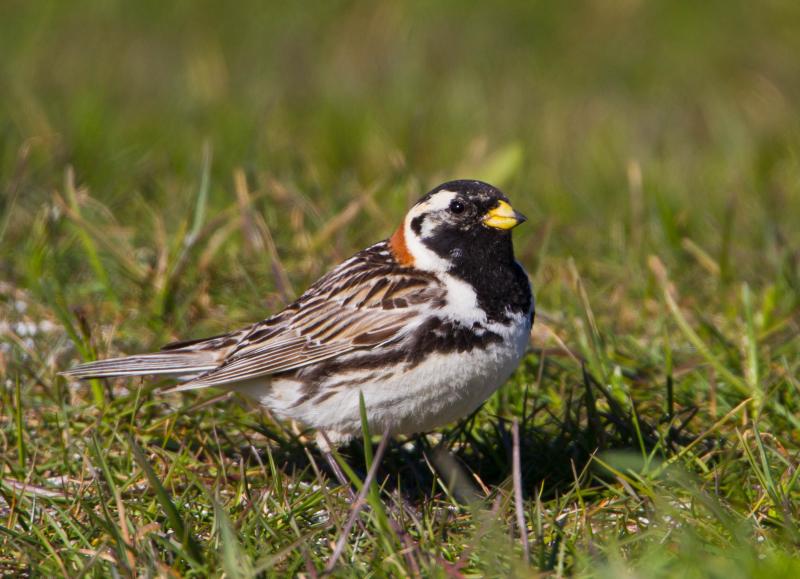
The Lapland Longspur is one of the most numerous songbirds of the high Arctic, breeding in vast numbers across the tundra of northern North America, Greenland, Scandinavia, and Siberia. Despite its abundance, most people in the lower 48 states and southern Canada only ever meet it in winter, when flocks of plain brown, sparrow-like birds drop into stubble fields, prairies, and barren shorelines to feed on weed seeds and waste grain. It belongs to the longspur family (Calcariidae), named for the unusually long, straight hind claw that helps these ground-walking birds keep their footing on open terrain.
In its breeding finery, the male is a genuine showstopper, black face and throat, a bold chestnut nape, and crisp white markings, but those colors are largely hidden during the months when southern birders see it. Learning to pick a Lapland Longspur out of a swirling flock of Horned Larks or Snow Buntings is one of the satisfying challenges of winter birding in open landscapes. It is a hardy, restless bird, perfectly adapted to wind, cold, and wide horizons.
This is a compact, fairly stout, ground-loving songbird about the size of a House Sparrow, with a short, conical seed-eating bill and a notably long hind claw. On the ground it walks and creeps rather than hops, often crouching low so it nearly disappears among clods and stubble. In flight it shows a short, slightly notched tail with white outer tail feathers.
| Breeding male | Jet-black face, throat, and upper breast outlined by a buff-white line curving down the side of the neck; rich chestnut nape; streaked brown back. |
| Winter plumage | Mostly streaky brown and buff; black markings veiled by pale feather tips, leaving a smudgy dark 'bib' shadow and warm reddish edges in the wing. |
| Bill | Short, conical, yellowish with a dark tip in winter; a true seed-cracker's bill. |
| Wing mark | Reddish-chestnut greater coverts forming a warm wing patch, bordered by a thin white wingbar, a key winter clue. |
| Hind claw | Very long, nearly straight rear claw (the 'longspur'), best seen on close, foraging birds. |
| Tail | Short and slightly notched with white outer feathers flashing in flight. |
Male vs. female
In breeding season the sexes are easy to separate. The male wears the famous black face and throat, broad chestnut nape, and clean head pattern; the female is muted by comparison, with a streaky brown crown, a paler buff-and-brown face, and only a hint of chestnut on the nape. In fresh winter plumage both sexes look much plainer and more alike, since pale feather fringes obscure the bold colors. Even so, winter males usually show a stronger dark smudge across the breast and a warmer chestnut nape than the more uniformly streaked females, and the difference becomes clearer as the fringes wear away toward spring.
Juveniles
Juveniles are streaky and buffy overall, looking much like a nondescript young sparrow, with heavily streaked underparts and a less distinct face pattern than adults. By their first winter they resemble adult females in fresh plumage, streaky brown above, buff below, and lack any bold black on the face. The warm chestnut wing panel and long hind claw are useful for placing these young birds in the longspur family even when the head pattern is unhelpful.
On the breeding grounds the male delivers a sweet, jingling, warbled song, often during a short fluttering song flight in which he rises and then parachutes back down to the tundra. The song is musical and tumbling, sometimes likened to a softer, more liquid version of a Snow Bunting's, carrying well across the open landscape where there are few song perches.
Away from the nesting grounds the bird is best known by its flight calls, given constantly by traveling flocks. Listen for a dry, rattling prrrt or tikitik trill, frequently followed by a clear, descending whistled teew or teu. That combination of a hard little rattle plus a sweet downslurred whistle is one of the most reliable ways to detect Lapland Longspurs overhead in winter, often before you ever see them.
The Lapland Longspur has a circumpolar breeding range, nesting on Arctic tundra across northern Alaska and Canada, Greenland, northern Scandinavia (including Lapland, the source of its name), and Siberia. It is one of the signature songbirds of the open tundra, often the most abundant breeding passerine in suitable habitat.
It is a long-distance migrant. North American breeders move south in fall to winter across the open country of the central and northern United States and southern Canada, favoring prairies, agricultural fields, airports, and shorelines. Numbers can be enormous on the Great Plains, where wintering flocks may reach into the thousands. The species is famously hardy, lingering in cold, windswept country that few other songbirds tolerate, and shifting around in response to snow cover and food.
For most of the year the Lapland Longspur is a seed specialist, feeding on the seeds of grasses, sedges, and weeds, along with waste grain such as corn and small grains gleaned from harvested fields. Its conical bill is well suited to cracking these small seeds, and wintering flocks forage by walking steadily across open ground, picking at the surface and at low vegetation.
During the brief Arctic summer the diet shifts heavily toward insects and other invertebrates, flies, beetles, and the abundant midges and craneflies of the tundra, which provide the protein needed to raise fast-growing chicks during the short breeding window. Nestlings are fed almost entirely on insects.
Lapland Longspurs nest on the ground, tucking the nest into a slight depression sheltered by a tussock, low shrub, or hummock on the open tundra. The female builds a cup of grasses and sedges, lined with finer plant material, feathers, and often a generous amount of soft animal hair or ptarmigan feathers for insulation against the Arctic cold.
The female lays a clutch of typically four to six eggs, pale and heavily marked with brown blotches, and does most of the incubation, which lasts roughly two weeks. The young develop quickly to take advantage of the short season, leaving the nest before they can fly well and hiding in the vegetation while the parents continue to feed them. Most pairs raise a single brood per year, a reflection of how little time the Arctic summer allows.
The Lapland Longspur is not a typical backyard or feeder bird, it favors wide-open ground far from houses and rarely visits suburban yards or hanging feeders. You're far more likely to find it by going to it than by attracting it home, but there are still ways to improve your odds.
- Go to open country in winter. Scan stubble fields, picked corn and grain fields, prairie, sod farms, and airport edges, especially on the Great Plains and northern states.
- Look low and listen up. They walk on bare ground and are easy to overlook; learn the dry rattle plus descending teew flight call to detect flocks passing overhead.
- Check mixed flocks. Lapland Longspurs often travel with Horned Larks and Snow Buntings, sort through those flocks carefully for the warm chestnut wing panel and longspur shape.
- Try after snow or storms. Fresh snow concentrates flocks along plowed roadsides and field edges where seeds are exposed, making them easier to find.
- If you have rural acreage, leave weedy field edges. Unmowed weedy stubble that holds seed heads through winter is the closest thing to habitat you can offer this open-country bird.
- Snow Bunting: Larger and much whiter, especially in flight where it flashes big white wing patches; lacks the longspur's warm chestnut wing panel and streaky brown tones.
- Horned Lark: Shares open winter fields and often flocks with longspurs, but has a yellow-and-black face pattern, walks on a thin slender body, and gives high tinkling calls rather than a rattle-and-whistle.
- Chestnut-collared Longspur: Another longspur of open country; in winter it is plainer and grayer with a different tail pattern (more white in a triangular shape) and lacks the strong chestnut wing panel.
- Smith's Longspur: Warmer buffy-orange below year-round with white shoulder patches in males; tends toward grassy fields and gives a dry, ticking flight call distinct from the Lapland's.
Why is it called a longspur?
The name refers to the unusually long, nearly straight claw on the hind toe. Longspurs are ground-dwelling birds that walk across open terrain, and that elongated rear claw helps stabilize the foot, a feature shared by several open-country species in the family Calcariidae.
Where does the 'Lapland' in its name come from?
Lapland is a region spanning northern Scandinavia and adjacent Russia, part of the bird's vast circumpolar Arctic breeding range. The species was described from that area, and the name stuck even though the bird breeds all the way across the Arctic and winters far to the south.
When and where can I see a Lapland Longspur in the United States?
Most U.S. birders see them in winter, roughly late fall through early spring, in open country such as stubble fields, prairies, and shorelines. The central and northern Great Plains are especially good, where large flocks gather. They breed only on far-northern Arctic tundra, so summer sightings in the lower 48 are not expected.
How do I tell a Lapland Longspur from a Snow Bunting in a winter flock?
Snow Buntings look much whiter, particularly in flight when they flash large white wing patches, and they have a frostier overall appearance. Lapland Longspurs are browner and more streaked, with a warm chestnut panel in the wing and a dark smudge across the breast. Their dry rattling flight call followed by a descending whistle also differs from the buntings' softer notes.
Will a Lapland Longspur come to my backyard feeder?
Almost never. This is an open-country, ground-feeding bird that avoids yards and hanging feeders, preferring wide fields and bare ground far from buildings. To see one you generally need to visit suitable winter habitat rather than wait for it at home.